Stories about delirium
Short illustrated stories for people with delirium, families and carers.
These stories cover adults of different ages, in hospital, intensive care, care homes, at home and in hospices.
Read them at your own pace and choose the topics that are useful to you. The original stories (A01–B50) are anonymised composite cases drawn from clinical practice. The newer stories (C01–C43 and D01–D14) are educational examples, with illustrative names and dialogue, and are labelled “Example case”. People’s experiences and recovery vary.
Showing 114 of 114 stories
Recognising delirium
Story A01
The sudden change
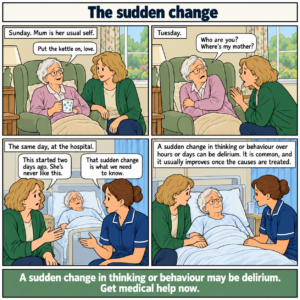
Read story A01: The sudden change (image and text)
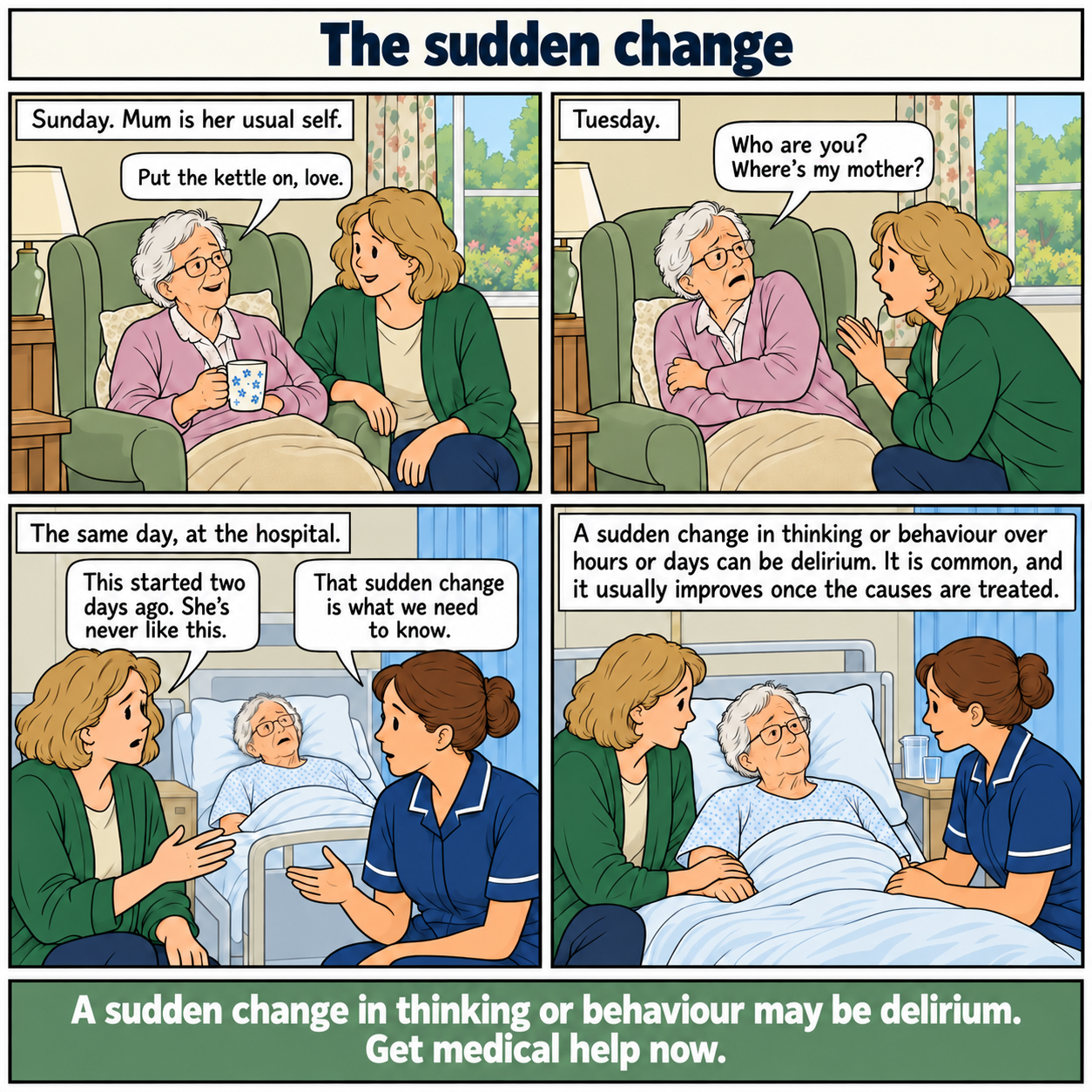
A sudden change in thinking or behaviour over hours or days can be delirium and needs a prompt check by a doctor or nurse. Say what changed, when it began and what the person was like before.
Delirium is common during illness and after operations. It often improves when causes are found and treated, but recovery varies.
Story text
-
Panel 1. Sunday. Mum is her usual self.
- Mum: Put the kettle on, love.
-
Panel 2. Tuesday.
- Mum: Who are you? Where’s my mother?
-
Panel 3. The same day, at the hospital.
- Karen: This started two days ago. She’s never like this.
- Nurse: That sudden change is what we need to know.
-
Panel 4. A sudden change in thinking or behaviour over hours or days can be delirium. It is common, and it usually improves once the causes are treated.
Bottom band. A sudden change in thinking or behaviour may be delirium. Get medical help now.
Story A02
Delirium is not dementia
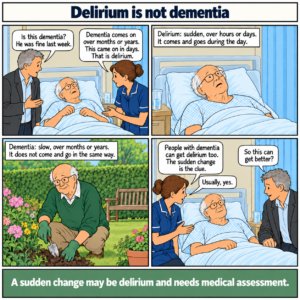
Read story A02: Delirium is not dementia (image and text)
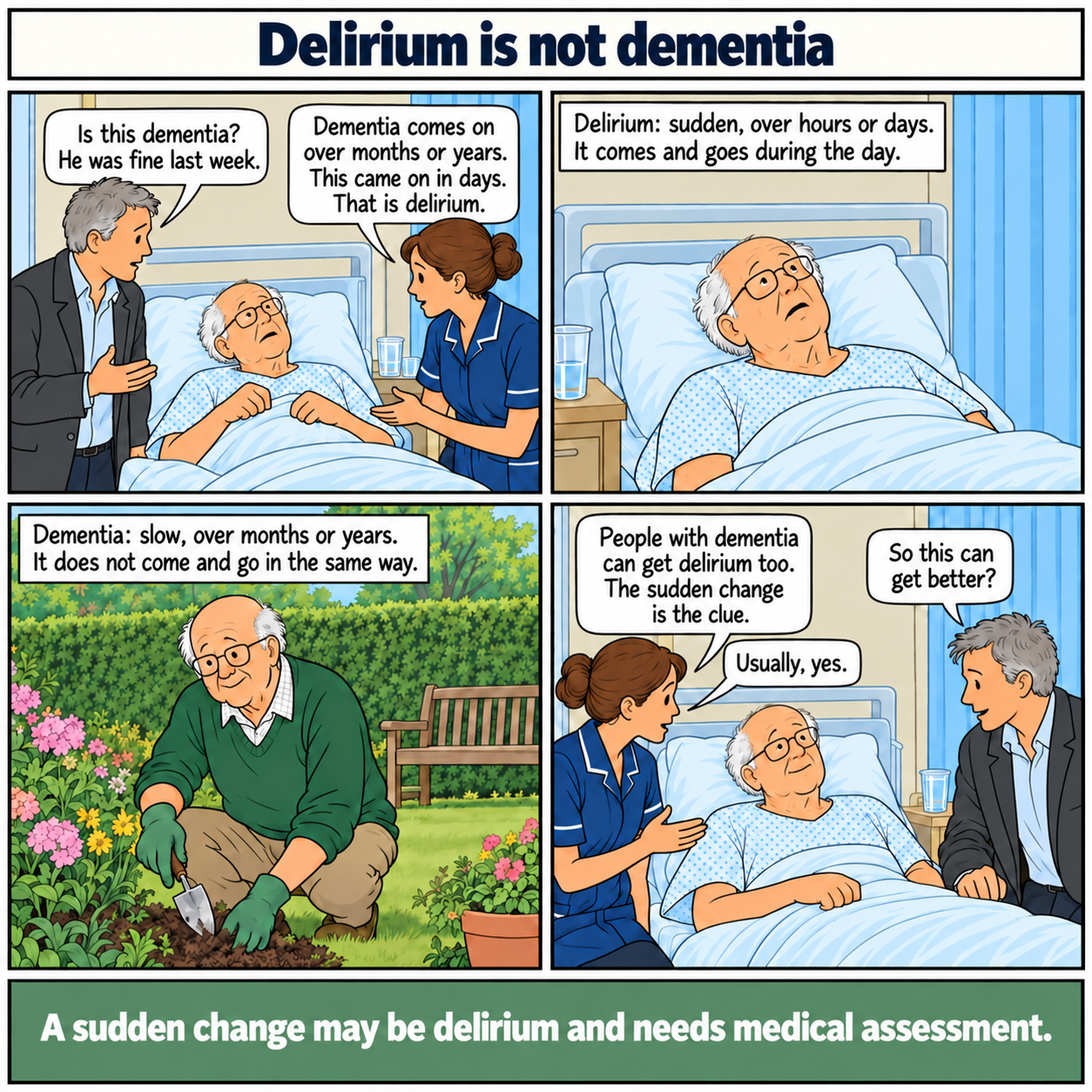
Delirium and dementia are different. Dementia usually develops slowly. Delirium begins suddenly, over hours or days, and often changes during the day. A person living with dementia can also develop delirium.
If someone’s thinking or behaviour changes suddenly, tell staff what they were like before and when the change began. Delirium often improves, although recovery varies and depends on the person and the causes.
Story text
-
Panel 1.
- David: Is this dementia? He was fine last week.
- Nurse: Dementia comes on over months or years. This came on in days. That is delirium.
-
Panel 2. Delirium: sudden, over hours or days. It comes and goes during the day.
-
Panel 3. Dementia: slow, over months or years. It does not come and go in the same way.
-
Panel 4.
- Nurse: People with dementia can get delirium too. The sudden change is the clue.
- David: So this can get better?
- Nurse: Usually, yes.
Bottom band. A sudden change may be delirium and needs medical assessment.
Story A03
The quiet kind
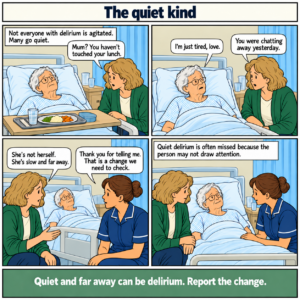
Read story A03: The quiet kind (image and text)
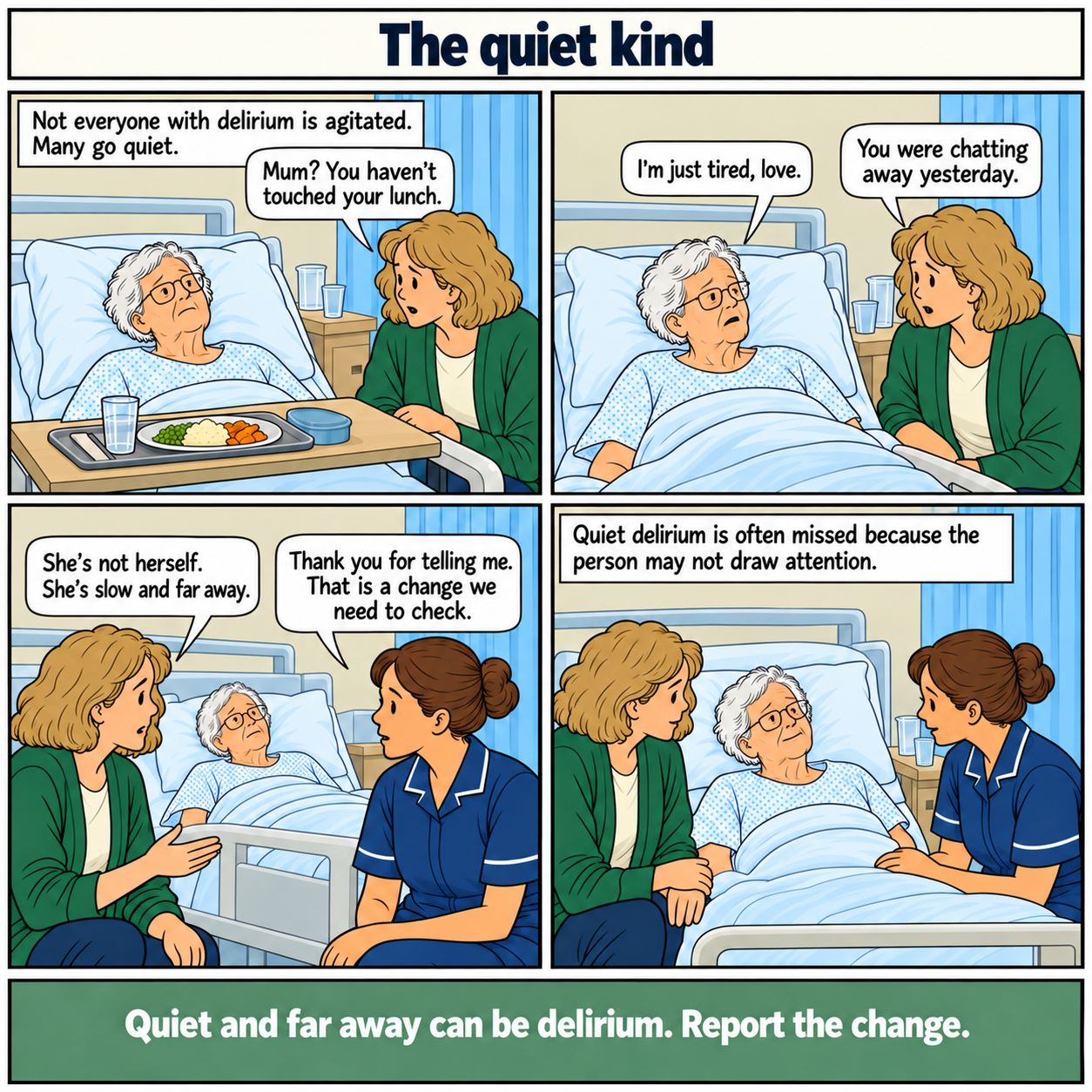
Delirium does not always make a person visibly restless or upset. A person may become unusually quiet, slow to respond, less interested in other people or less interested in food and drink. This quieter form is easily missed because it may not draw attention.
If someone is quieter than usual or seems less able to respond, tell a nurse or doctor. Describe what has changed and what the person is normally like.
Story text
-
Panel 1. Not everyone with delirium is agitated. Many go quiet.
- Karen: Mum? You haven’t touched your lunch.
-
Panel 2.
- Mum: I’m just tired, love.
- Karen: You were chatting away yesterday.
-
Panel 3.
- Karen: She’s not herself. She’s slow and far away.
- Nurse: Thank you for telling me. That is a change we need to check.
-
Panel 4. Quiet delirium is often missed because the person may not draw attention.
Bottom band. Quiet and far away can be delirium. Report the change.
Story A04
The change you can describe
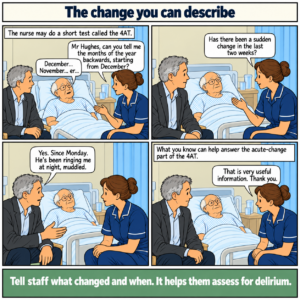
Read story A04: The change you can describe (image and text)
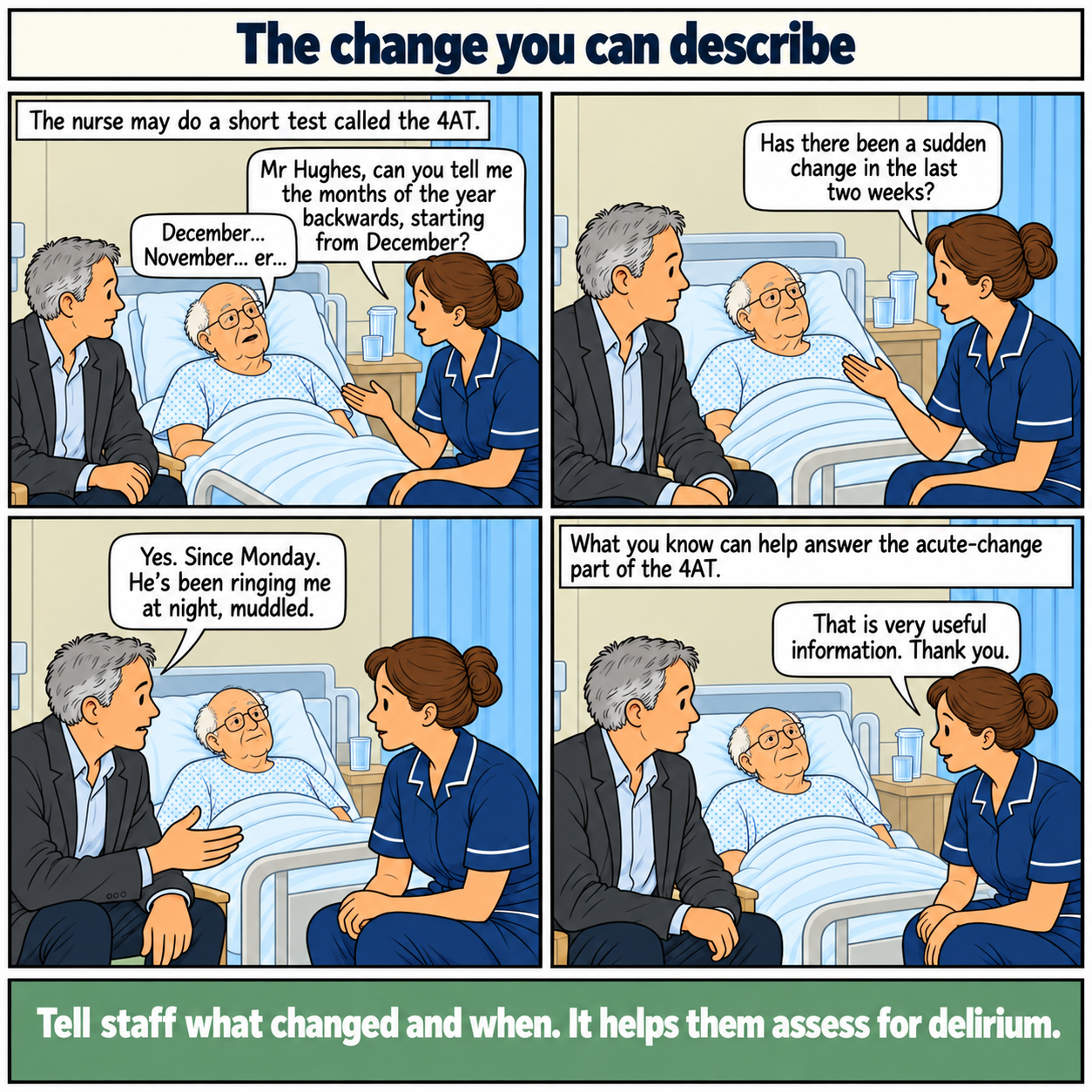
The 4AT is a short check used when delirium is suspected. It includes brief questions and a check of how well the person can pay attention. It also asks whether there has been a sudden change or changes during the day.
Information from someone who knows the person can be very useful. Say what changed, when it began and what the person was like beforehand. Staff may also use the person’s account, records and observations from other people.
Story text
-
Panel 1. The nurse may do a short test called the 4AT.
- Nurse: Mr Hughes, can you tell me the months of the year backwards, starting from December?
- Dad: December… November… er…
-
Panel 2.
- Nurse: Has there been a sudden change in the last two weeks?
-
Panel 3.
- David: Yes. Since Monday. He’s been ringing me at night, muddled.
-
Panel 4. What you know can help answer the acute-change part of the 4AT.
- Nurse: That is very useful information. Thank you.
Bottom band. Tell staff what changed and when. It helps them assess for delirium.
Story A06
Who you are, where she is, what day it is
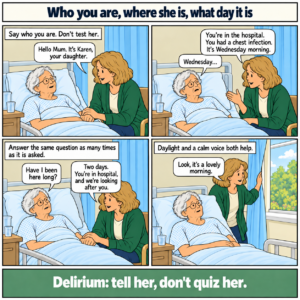
Read story A06: Who you are, where she is, what day it is (image and text)
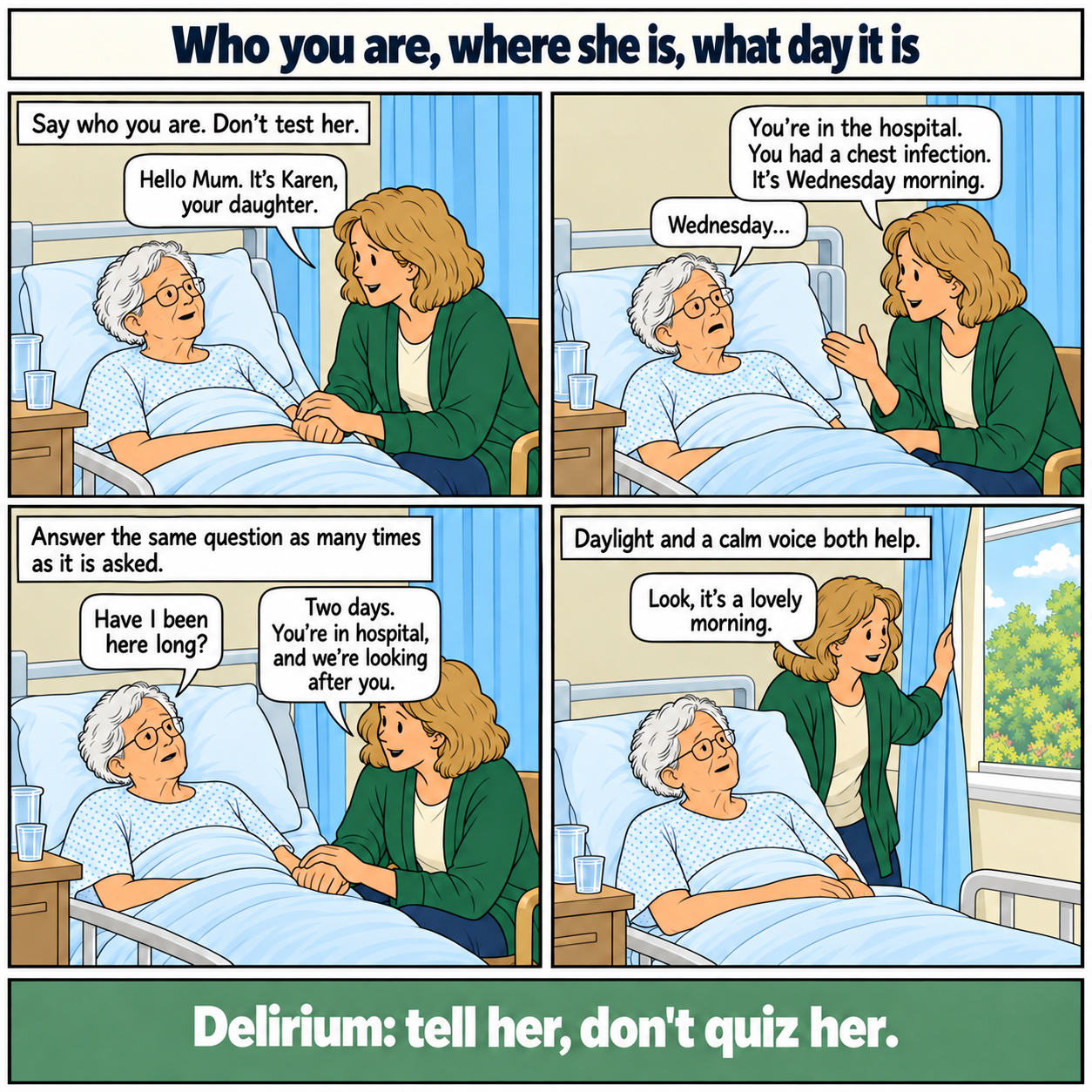
A calm, short explanation can help someone with delirium: say who you are, where they are and why, and what day it is. Repeat it when needed without turning the conversation into a family quiz.
Staff are responsible for checking the person for delirium. Families can offer familiar reassurance, daylight and reminders of who is with them and where they are while responding to the person’s questions.
Story text
-
Panel 1. Say who you are. Don’t test her.
- Karen: Hello Mum. It’s Karen, your daughter.
-
Panel 2.
- Karen: You’re in the hospital. You had a chest infection. It’s Wednesday morning.
- Mum: Wednesday…
-
Panel 3. Answer the same question as many times as it is asked.
- Mum: Have I been here long?
- Karen: Two days. You’re in hospital, and we’re looking after you.
-
Panel 4. Daylight and a calm voice both help.
- Karen: Look, it’s a lovely morning.
Bottom band. Delirium: tell her, don’t quiz her.
Story B02
Awake but far away
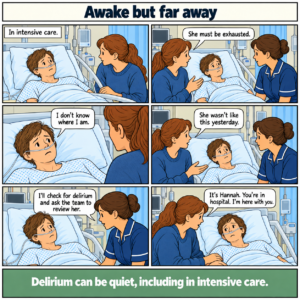
Read story B02: Awake but far away (image and text)
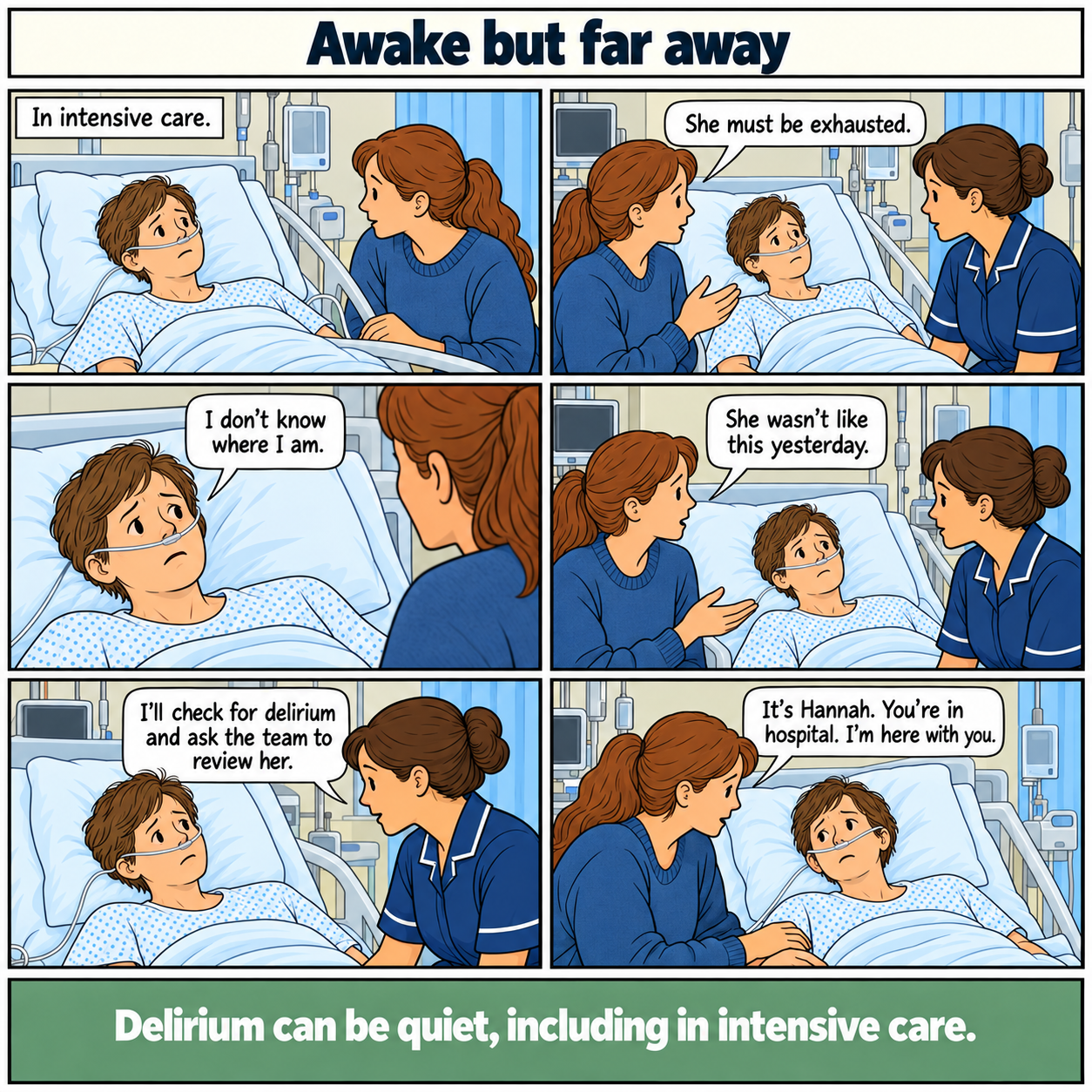
Delirium does not always look restless or visibly upset. Someone may be quiet, less interested in other people or slow to respond, and still feel frightened. This can happen in intensive care, including in younger adults.
Tell the team about changes from the person’s usual self. Ask whether staff have checked for delirium. A familiar voice and a short explanation can be part of care while staff look for and treat the causes.
Story text
-
Panel 1. In intensive care.
-
Panel 2.
- Hannah: She must be exhausted.
-
Panel 3.
- Louise: I don’t know where I am.
-
Panel 4.
- Hannah: She wasn’t like this yesterday.
-
Panel 5.
- Nurse: I’ll check for delirium and ask the team to review her.
-
Panel 6.
- Hannah: It’s Hannah. You’re in hospital. I’m here with you.
Bottom band. Delirium can be quiet, including in intensive care.
Story B05
The phone call
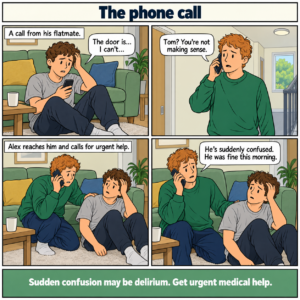
Read story B05: The phone call (image and text)
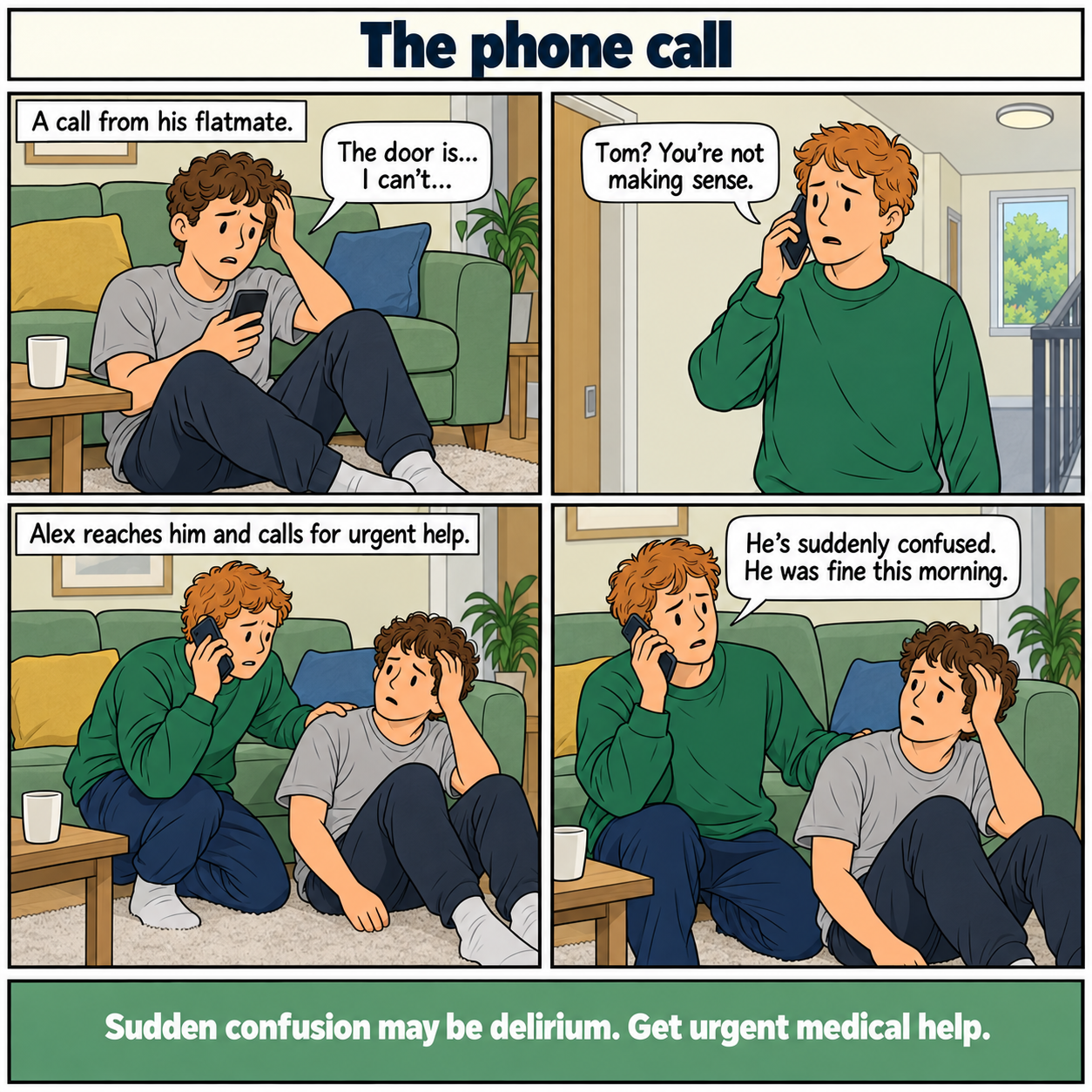
A sudden change in someone’s thinking or speech needs urgent medical help, including when you first notice it over the phone. Delirium is one possible cause; other urgent problems can also cause sudden confusion.
Say what has changed and when it began. Give the person’s location and explain whether someone is with them. Call local emergency services for sudden confusion or a sudden change in speech. Do not leave someone struggling to arrange help alone.
Story text
-
Panel 1. A call from his flatmate.
- Tom: The door is… I can’t…
-
Panel 2.
- Alex: Tom? You’re not making sense.
-
Panel 3. Alex reaches him and calls for urgent help.
-
Panel 4.
- Alex: He’s suddenly confused. He was fine this morning.
Bottom band. Sudden confusion may be delirium. Get urgent medical help.
Story B06
She was better this morning
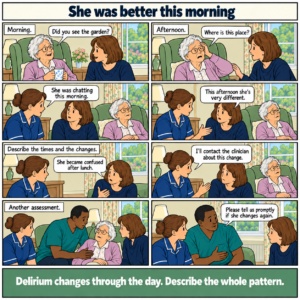
Read story B06: She was better this morning (image and text)
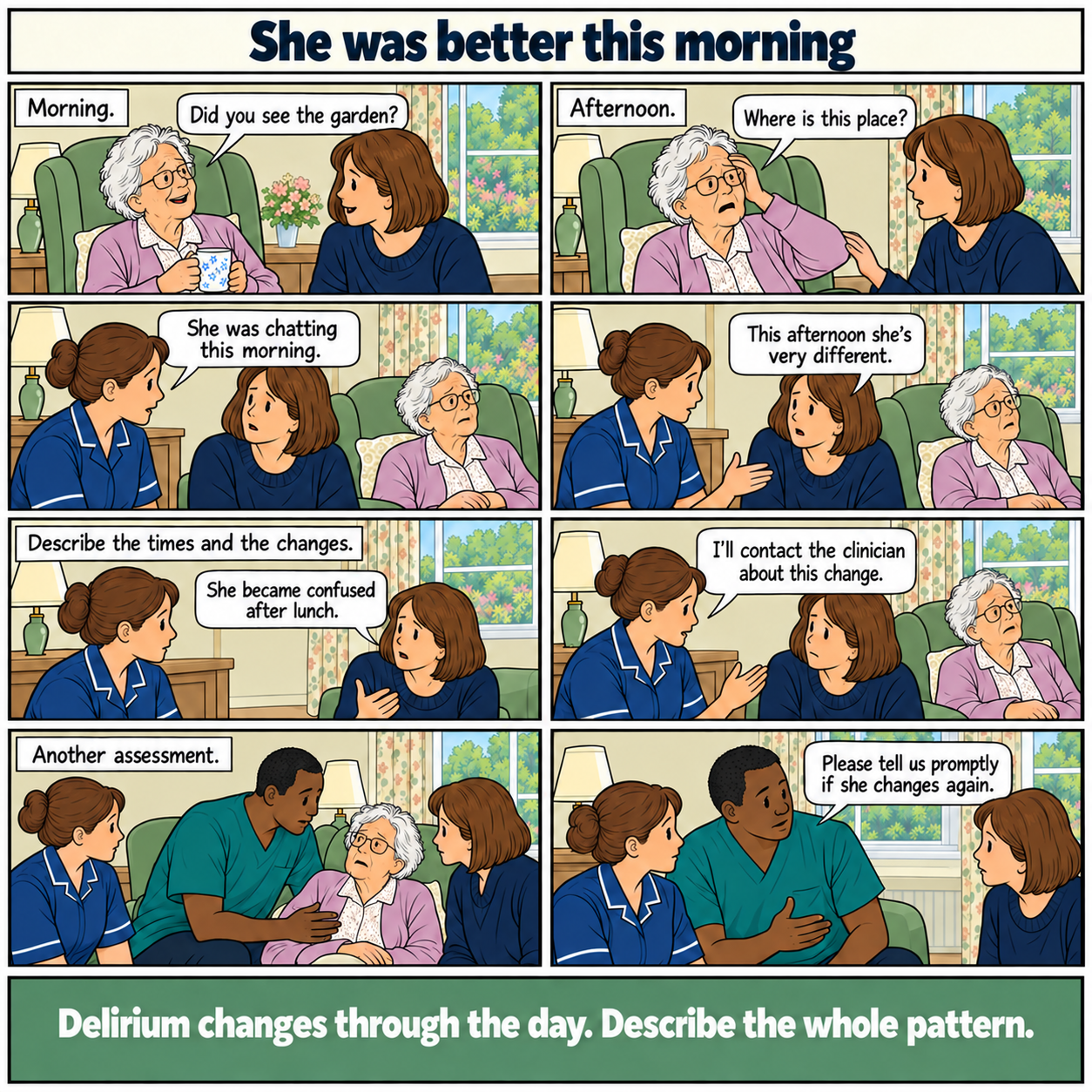
Delirium can change over the course of a day. A person may have a clear conversation in the morning and be confused or less interested in other people later. A period when someone seems better does not remove the need to report the change you see afterwards.
Tell staff about the whole pattern, including roughly when things changed. If the person becomes more confused, less responsive or otherwise worse, report it promptly. Ask who will review them and how you will be kept informed.
Story text
-
Panel 1. Morning.
- Jean: Did you see the garden?
-
Panel 2. Afternoon.
- Jean: Where is this place?
-
Panel 3.
- Nurse: She was chatting this morning.
-
Panel 4.
- Moira: This afternoon she’s very different.
-
Panel 5. Describe the times and the changes.
- Moira: She became confused after lunch.
-
Panel 6.
- Nurse: I’ll contact the clinician about this change.
-
Panel 7. Another assessment.
-
Panel 8.
- Doctor: Please tell us promptly if she changes again.
Bottom band. Delirium changes through the day. Describe the whole pattern.
Story B29
A clear answer at last
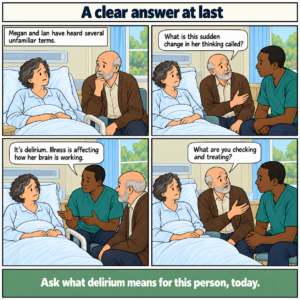
Read story B29: A clear answer at last (image and text)
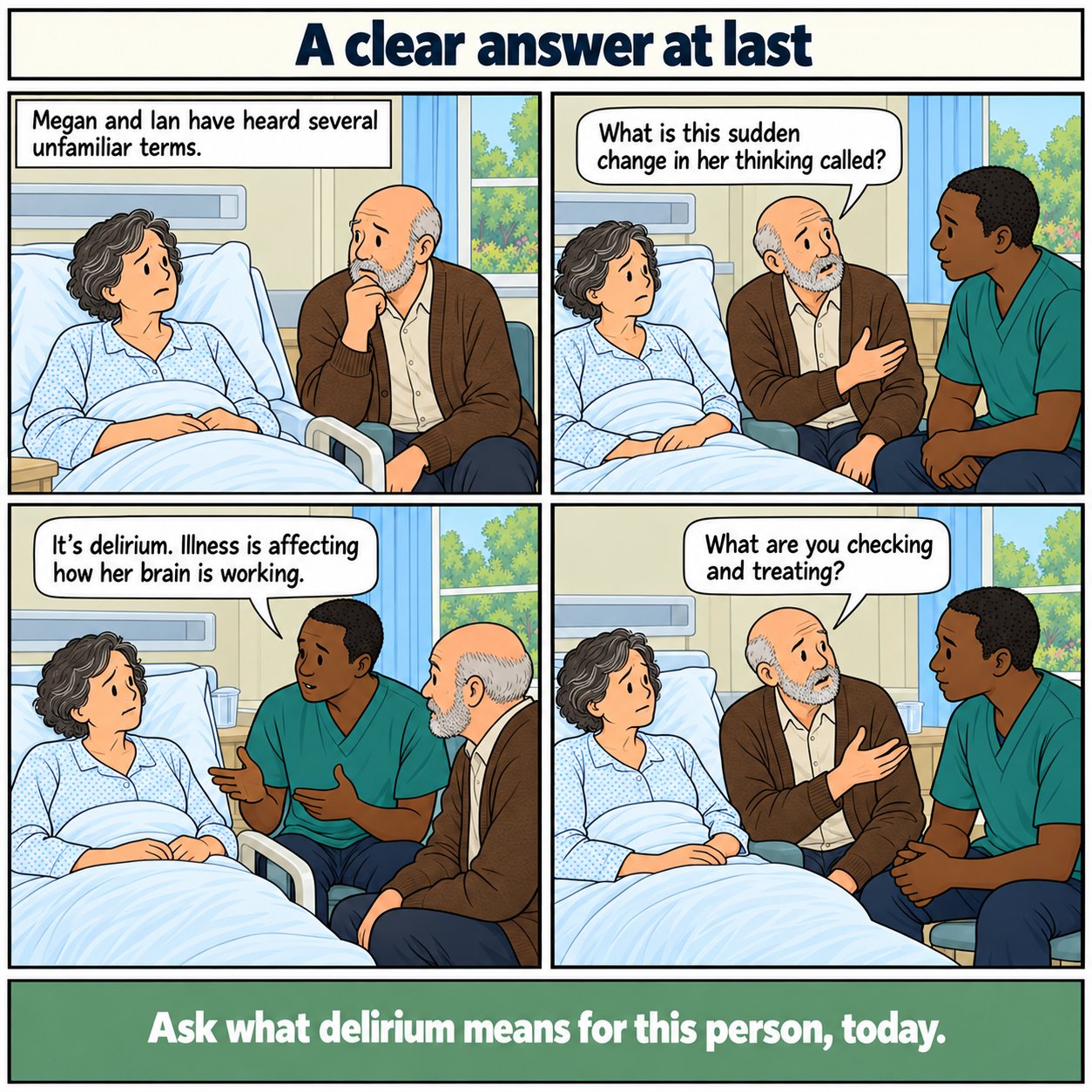
Families sometimes hear several terms for a sudden change in thinking without a clear explanation of what they mean. You can ask staff to name the condition and explain the plan in everyday language.
Delirium affects thinking, attention and awareness, usually developing over hours or days. It needs checks for the problems causing it as well as ongoing care. Ask what is known, what remains uncertain and how you will be updated.
Story text
-
Panel 1. Megan and Ian have heard several unfamiliar terms.
-
Panel 2.
- Ian: What is this sudden change in her thinking called?
-
Panel 3.
- Doctor: It’s delirium. Illness is affecting how her brain is working.
-
Panel 4.
- Ian: What are you checking and treating?
Bottom band. Ask what delirium means for this person, today.
Story B39
The nurse noticed first
Read story B39: The nurse noticed first (image and text)
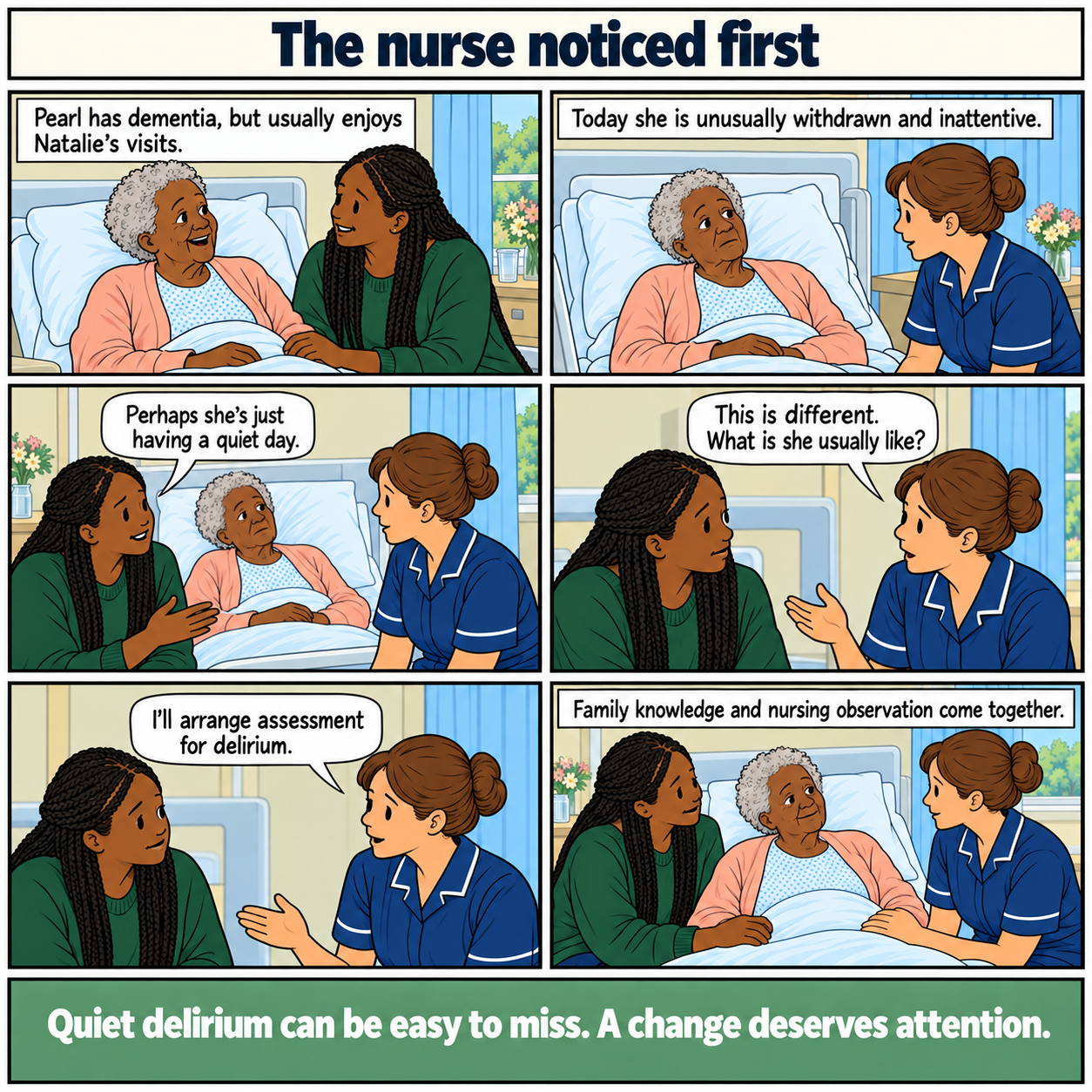
Good delirium care includes noticing small changes. A nurse may recognise that someone is quieter, slower or less able to pay attention before the family realises there is a problem.
Staff and relatives can share what they have noticed to help explain the change. This is especially important when a person already has dementia. A person can be quiet and still have delirium or feel distressed. A new change needs a check by a doctor or nurse, even when there is no shouting, restlessness or obvious upset.
Story text
-
Panel 1. Pearl has dementia, but usually enjoys Natalie’s visits.
-
Panel 2. Today she is unusually withdrawn and inattentive.
-
Panel 3.
- Natalie: Perhaps she’s just having a quiet day.
-
Panel 4.
- Nurse: This is different. What is she usually like?
-
Panel 5.
- Nurse: I’ll arrange assessment for delirium.
-
Panel 6. Family knowledge and nursing observation come together.
Bottom band. Quiet delirium can be easy to miss. A change deserves attention.
Story B40
Too young?
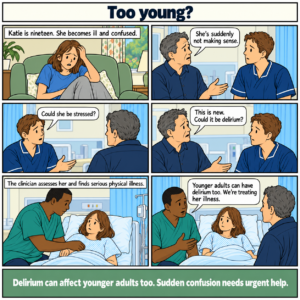
Read story B40: Too young? (image and text)
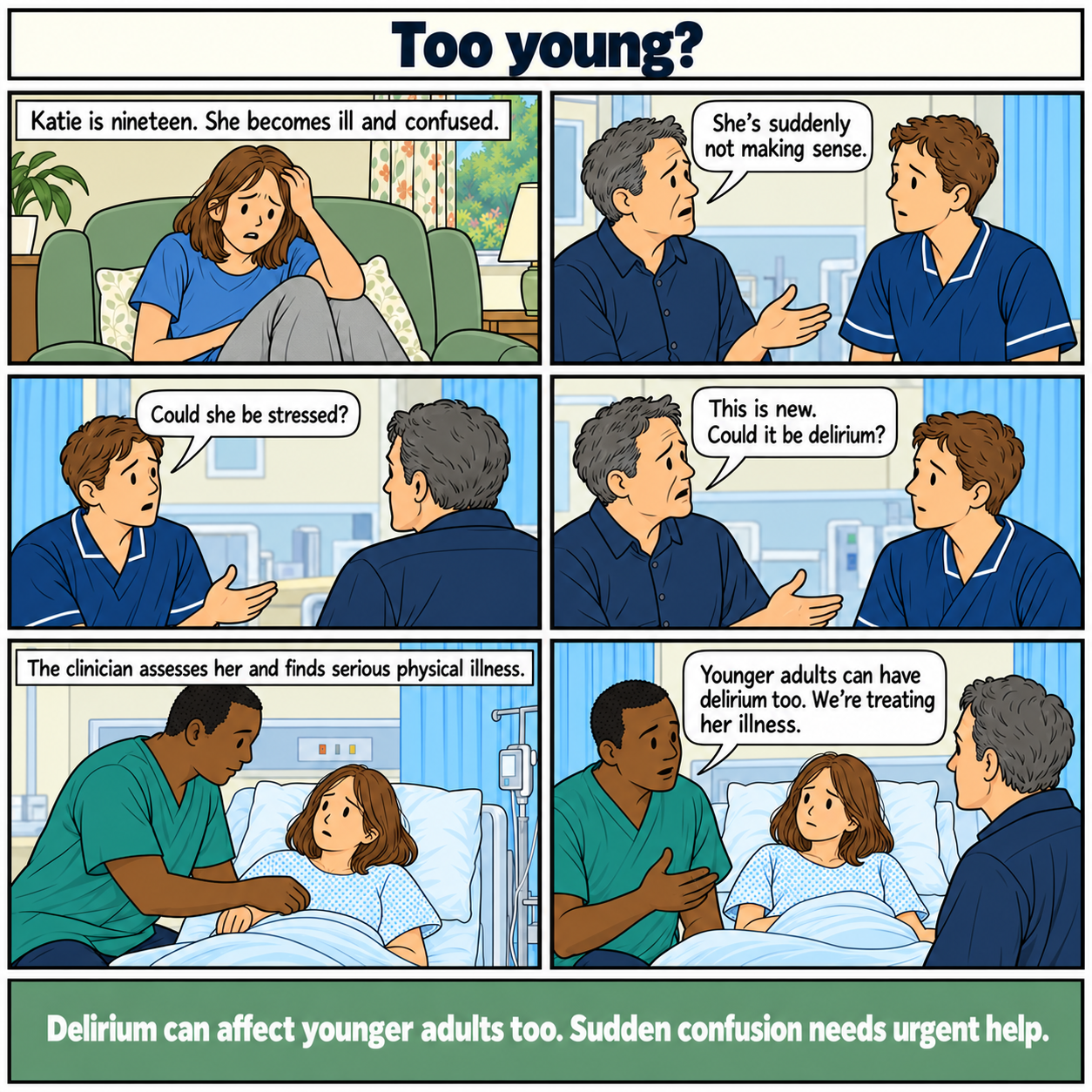
Delirium is more common in older people, but it can affect younger adults too. A sudden change in thinking, attention or awareness should not be dismissed simply because someone is young.
Explain what has changed and how quickly it happened. Ask for a doctor or nurse to check what is wrong. Delirium is one possible explanation, and other urgent problems can also cause sudden confusion. Recognise the change and get medical help promptly.
Story text
-
Panel 1. Katie is nineteen. She becomes ill and confused.
-
Panel 2.
- Martin: She’s suddenly not making sense.
-
Panel 3.
- Nurse: Could she be stressed?
-
Panel 4.
- Martin: This is new. Could it be delirium?
-
Panel 5. The clinician assesses her and finds serious physical illness.
-
Panel 6.
- Doctor: Younger adults can have delirium too. We’re treating her illness.
Bottom band. Delirium can affect younger adults too. Sudden confusion needs urgent help.
Story B46
Not just sleeping
Read story B46: Not just sleeping (image and text)
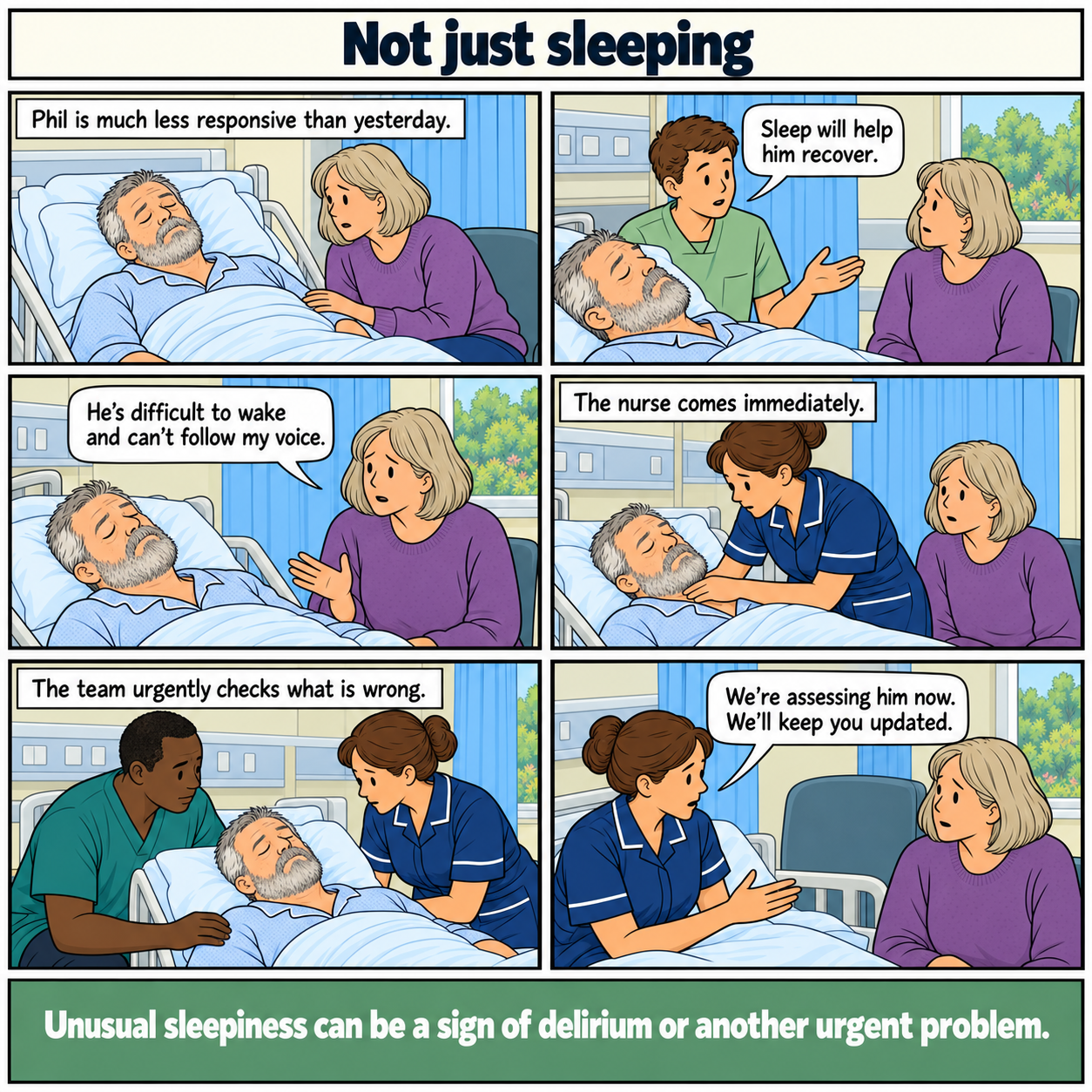
An unusually sleepy or less responsive person needs attention, especially when this is a new change. Delirium is one possibility, but other serious medical problems can also make the person slower to respond.
Tell staff clearly if someone is difficult to wake or can’t respond as usual. Ask for urgent checks by the team. This is different from an ordinary rest. At home, call local emergency services if someone becomes suddenly confused or is difficult to wake. Do not wait to see how they are tomorrow.
Story text
-
Panel 1. Phil is much less responsive than yesterday.
-
Panel 2.
- Care assistant: Sleep will help him recover.
-
Panel 3.
- Janet: He’s difficult to wake and can’t follow my voice.
-
Panel 4. The nurse comes immediately.
-
Panel 5. The team urgently checks what is wrong.
-
Panel 6.
- Nurse: We’re assessing him now. We’ll keep you updated.
Bottom band. Unusual sleepiness can be a sign of delirium or another urgent problem.
Story C04 · Example case
The label in the notes
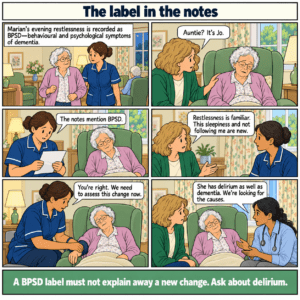
Read story C04: The label in the notes (image and text)
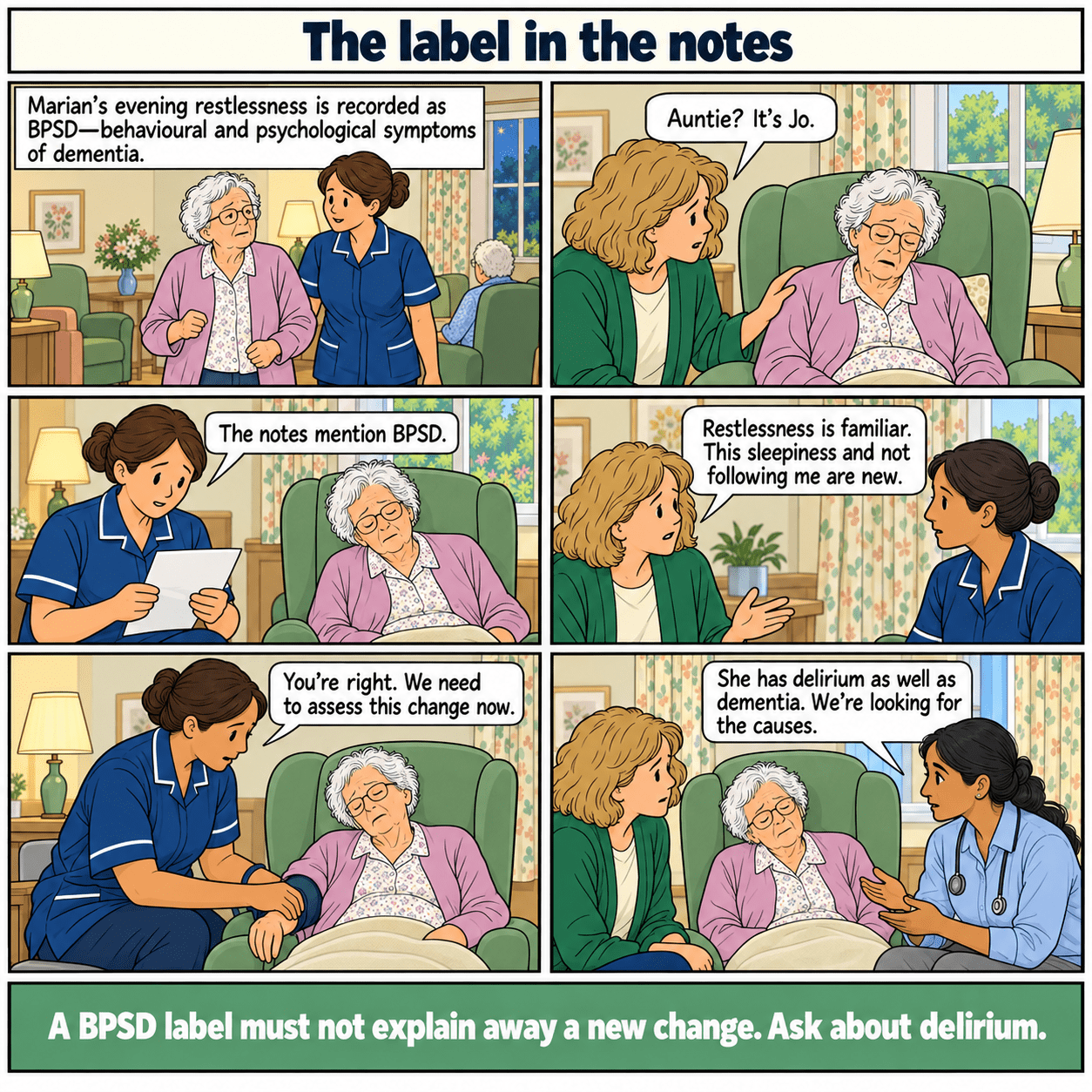
BPSD or delirium? A new change still needs assessment
Marian’s records mention BPSD because she has longstanding periods of restlessness. Today she is unusually sleepy and can’t follow a familiar conversation. Her niece describes the difference. An old label does not explain a new change: the team assesses her promptly and identifies delirium alongside her dementia. BPSD means behavioural and psychological symptoms of dementia.
Story text
Panel 1. Marian’s evening restlessness is recorded as BPSD—behavioural and psychological symptoms of dementia.
Panel 2.
- Jo: Auntie? It’s Jo.
Panel 3.
- Care worker: The notes mention BPSD.
Panel 4.
- Jo: Restlessness is familiar. This sleepiness and not following me are new.
Panel 5.
- Nurse: You’re right. We need to assess this change now.
Panel 6.
- Doctor: She has delirium as well as dementia. We’re looking for the causes.
Bottom band. A BPSD label must not explain away a new change. Ask about delirium.
Story C05 · Example case
Two changes, two timescales
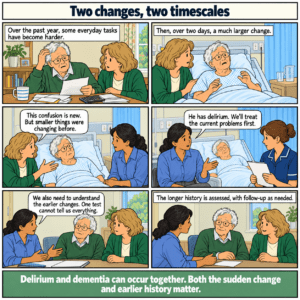
Read story C05: Two changes, two timescales (image and text)
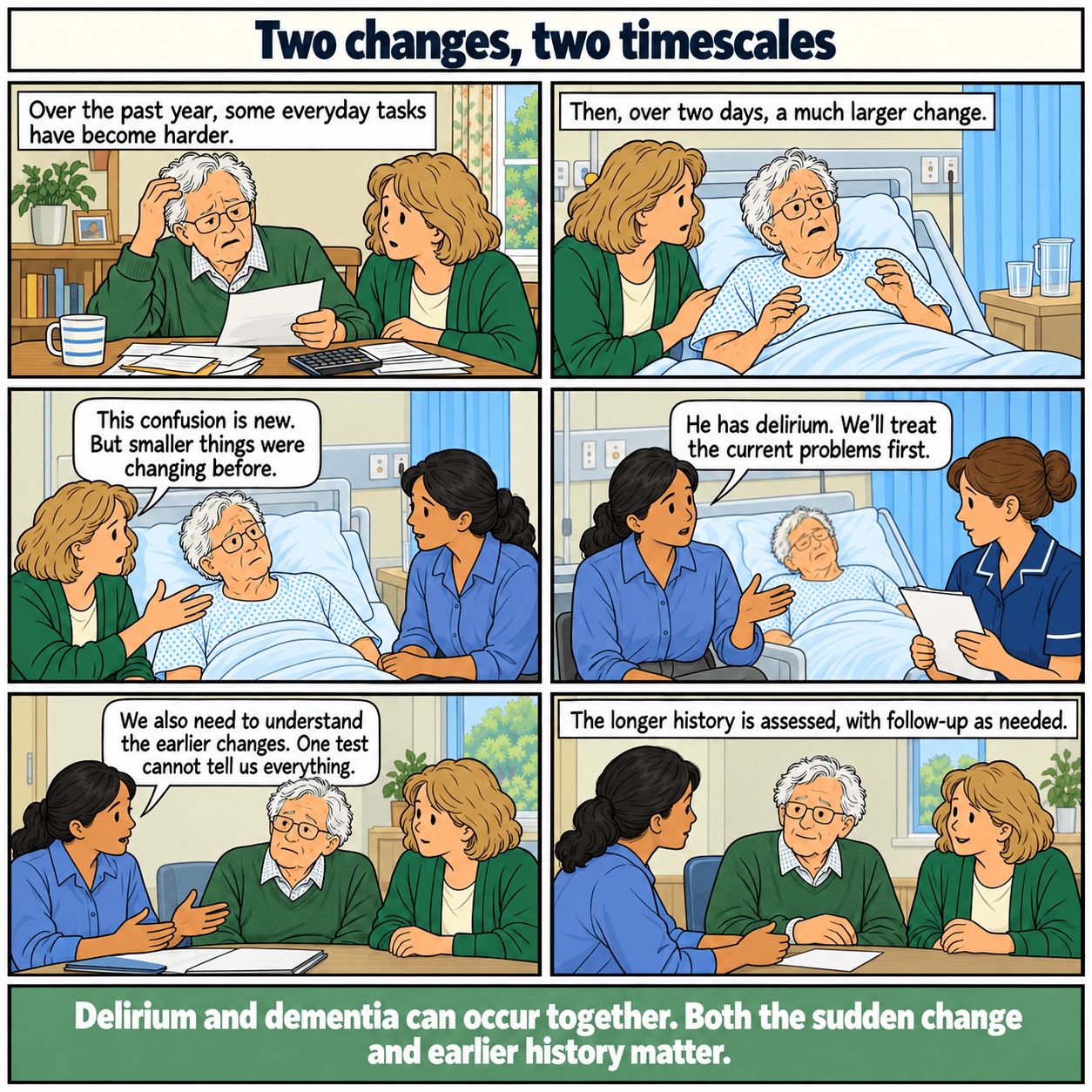
Delirium and dementia together: understanding the earlier history
David’s sudden confusion needs urgent care. His wife also describes slower changes over the previous year. The team treats delirium and arranges a fuller assessment of the longer history. Two things may be happening together. A diagnosis of dementia should not be made from one poor test during an acute illness.
Story text
Panel 1. Over the past year, some everyday tasks have become harder.
Panel 2. Then, over two days, a much larger change.
Panel 3.
- Helen: This confusion is new. But smaller things were changing before.
Panel 4.
- Doctor: He has delirium. We’ll treat the current problems first.
Panel 5.
- Doctor: We also need to understand the earlier changes. One test cannot tell us everything.
Panel 6. The longer history is assessed, with follow-up as needed.
Bottom band. Delirium and dementia can occur together. Both the sudden change and earlier history matter.
Story C06 · Example case
Her usual visions, a new change
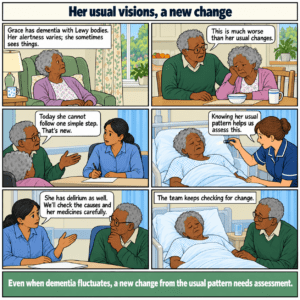
Read story C06: Her usual visions, a new change (image and text)
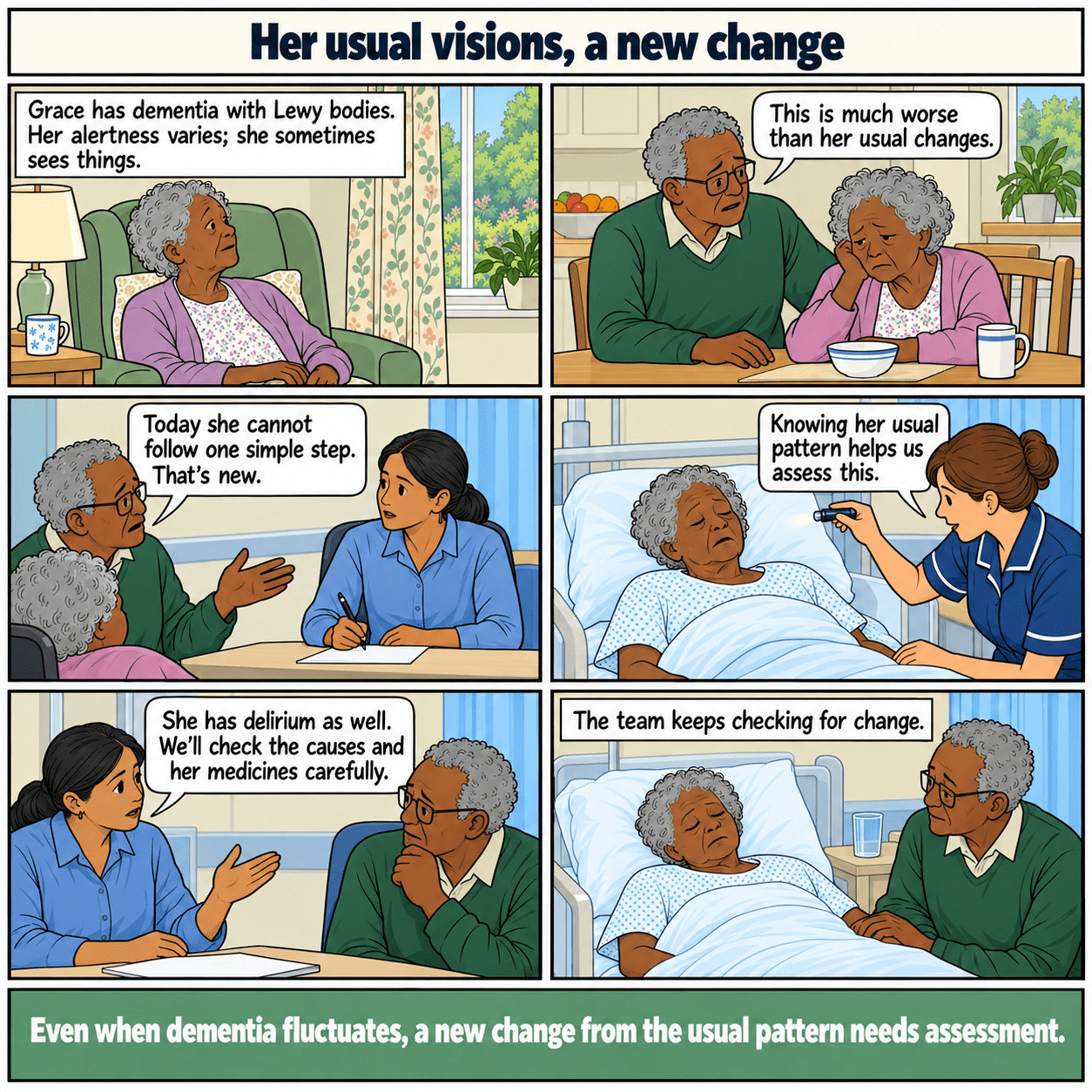
Lewy body dementia and delirium: recognising a change from the usual pattern
Grace already has periods of variable alertness and sometimes sees things others do not. Her husband knows that today is different: she is much harder to engage and can’t manage a familiar task. The team considers delirium and other causes rather than dismissing the change as part of her usual dementia.
Story text
Panel 1. Grace has dementia with Lewy bodies. Her alertness varies; she sometimes sees things.
Panel 2.
- Daniel: This is much worse than her usual changes.
Panel 3.
- Daniel: Today she cannot follow one simple step. That’s new.
Panel 4.
- Nurse: Knowing her usual pattern helps us assess this.
Panel 5.
- Doctor: She has delirium as well. We’ll check the causes and her medicines carefully.
Panel 6. The team keeps checking for change.
Bottom band. Even when dementia fluctuates, a new change from the usual pattern needs assessment.
Story C07 · Example case
Which word do we need?
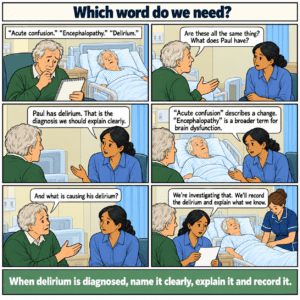
Read story C07: Which word do we need? (image and text)
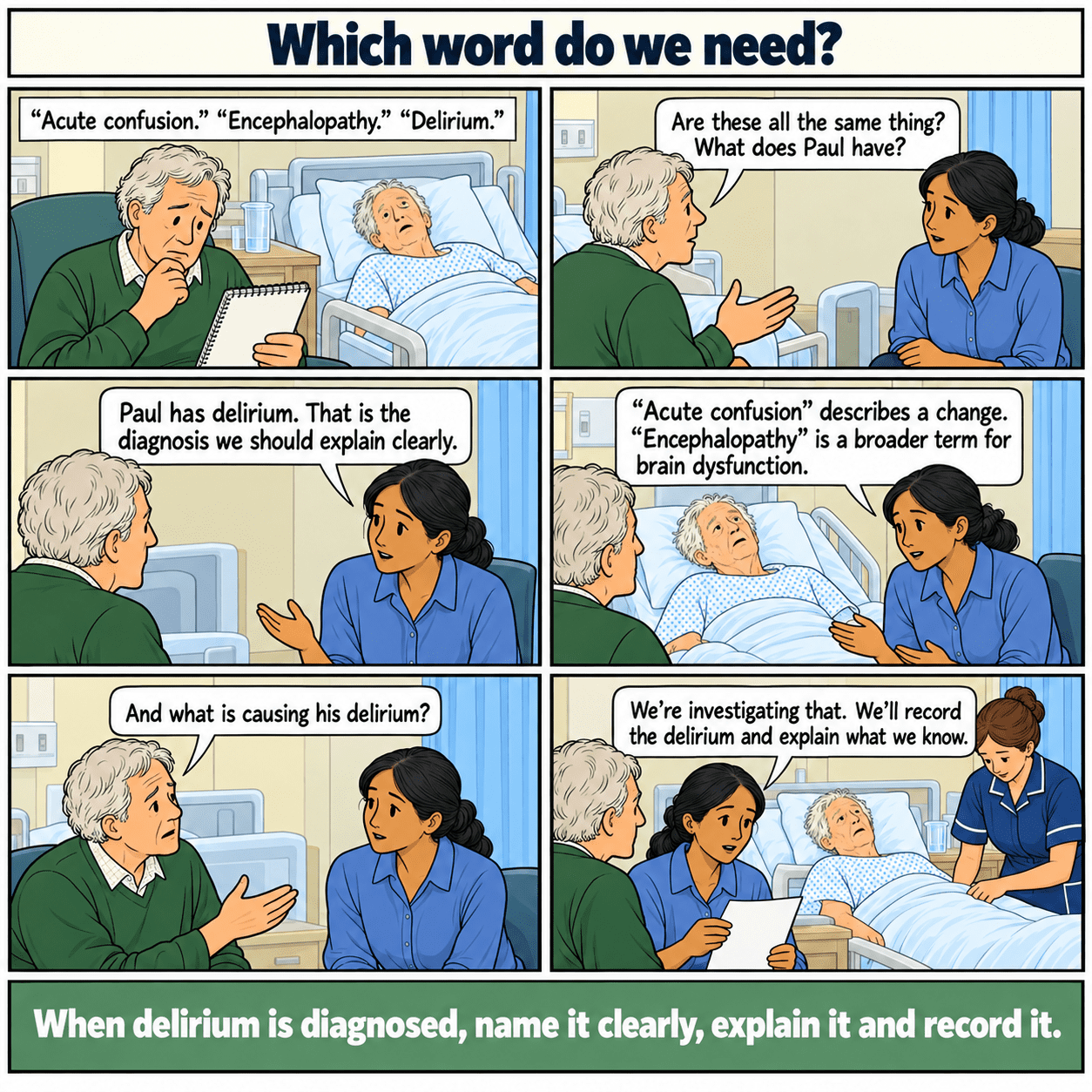
Acute confusion, encephalopathy or delirium: what do the words mean?
Martin has heard several terms for Paul’s sudden change. He asks what the diagnosis is. The team explains that Paul has delirium and that the other words do not all mean exactly the same thing. Naming delirium clearly helps the family understand the care plan, while the team continues to investigate the cause.
Story text
Panel 1. “Acute confusion.” “Encephalopathy.” “Delirium.”
Panel 2.
- Martin: Are these all the same thing? What does Paul have?
Panel 3.
- Doctor: Paul has delirium. That is the diagnosis we should explain clearly.
Panel 4.
- Doctor: “Acute confusion” describes a change. “Encephalopathy” is a broader term for brain dysfunction.
Panel 5.
- Martin: And what is causing his delirium?
Panel 6.
- Doctor: We’re investigating that. We’ll record the delirium and explain what we know.
Bottom band. When delirium is diagnosed, name it clearly, explain it and record it.
Story C09 · Example case
He knew my name
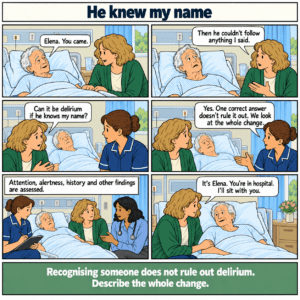
Read story C09: He knew my name (image and text)
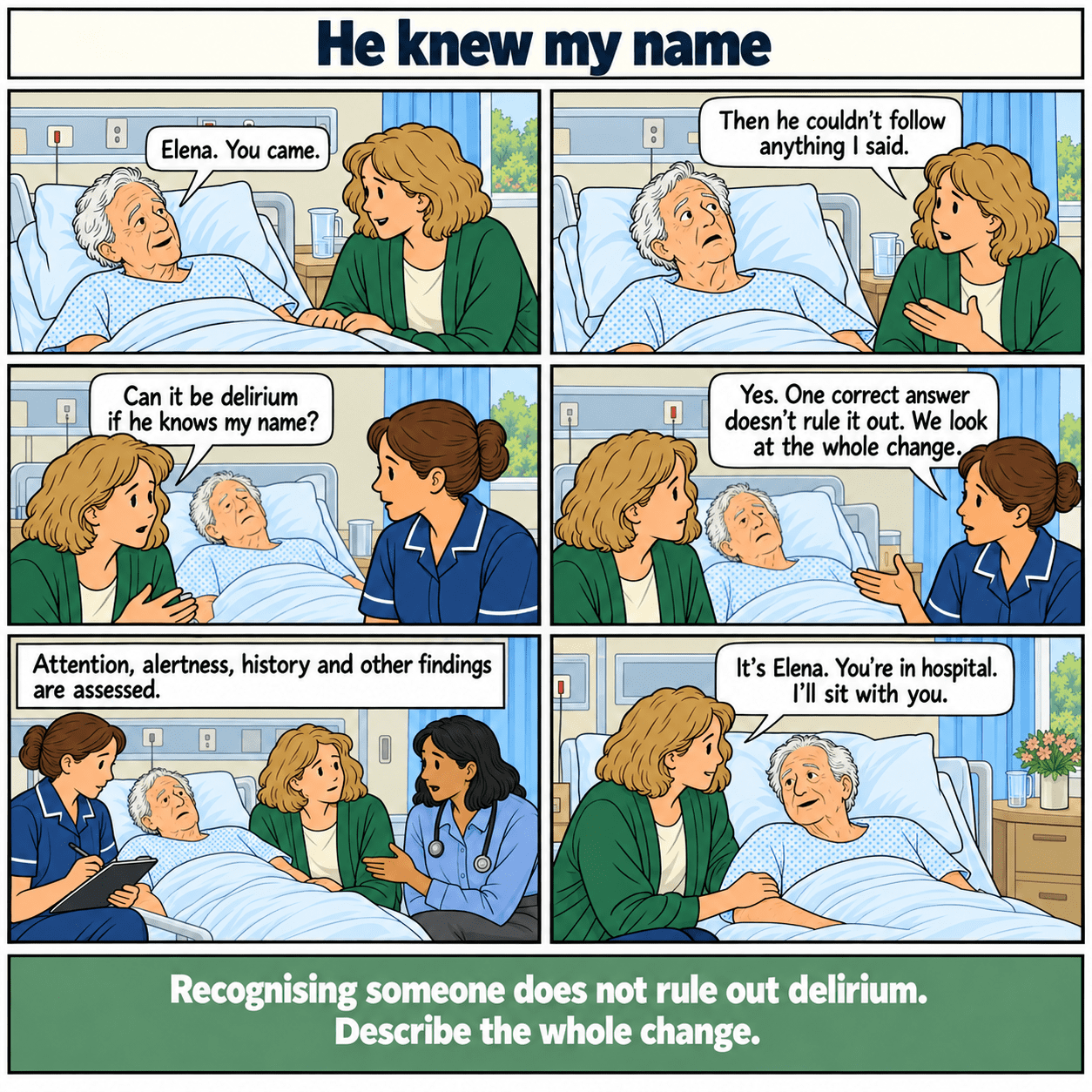
Can someone with delirium still recognise their family?
Luca greets his daughter by name, but can’t follow what she says next. One familiar answer does not settle whether delirium is present. The nurse takes the wider change seriously and arranges an assessment. Families can describe a pattern without repeatedly testing the person or trying to prove a diagnosis themselves.
Story text
Panel 1.
- Luca: Elena. You came.
Panel 2.
- Elena: Then he couldn’t follow anything I said.
Panel 3.
- Elena: Can it be delirium if he knows my name?
Panel 4.
- Nurse: Yes. One correct answer doesn’t rule it out. We look at the whole change.
Panel 5. Attention, alertness, history and other findings are assessed.
Panel 6.
- Elena: It’s Elena. You’re in hospital. I’ll sit with you.
Bottom band. Recognising someone does not rule out delirium. Describe the whole change.
Story C11 · Example case
Quiet is not the same as better
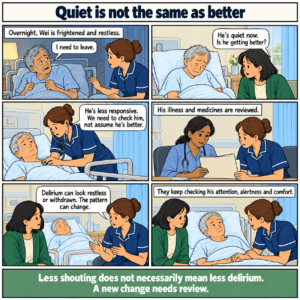
Read story C11: Quiet is not the same as better (image and text)
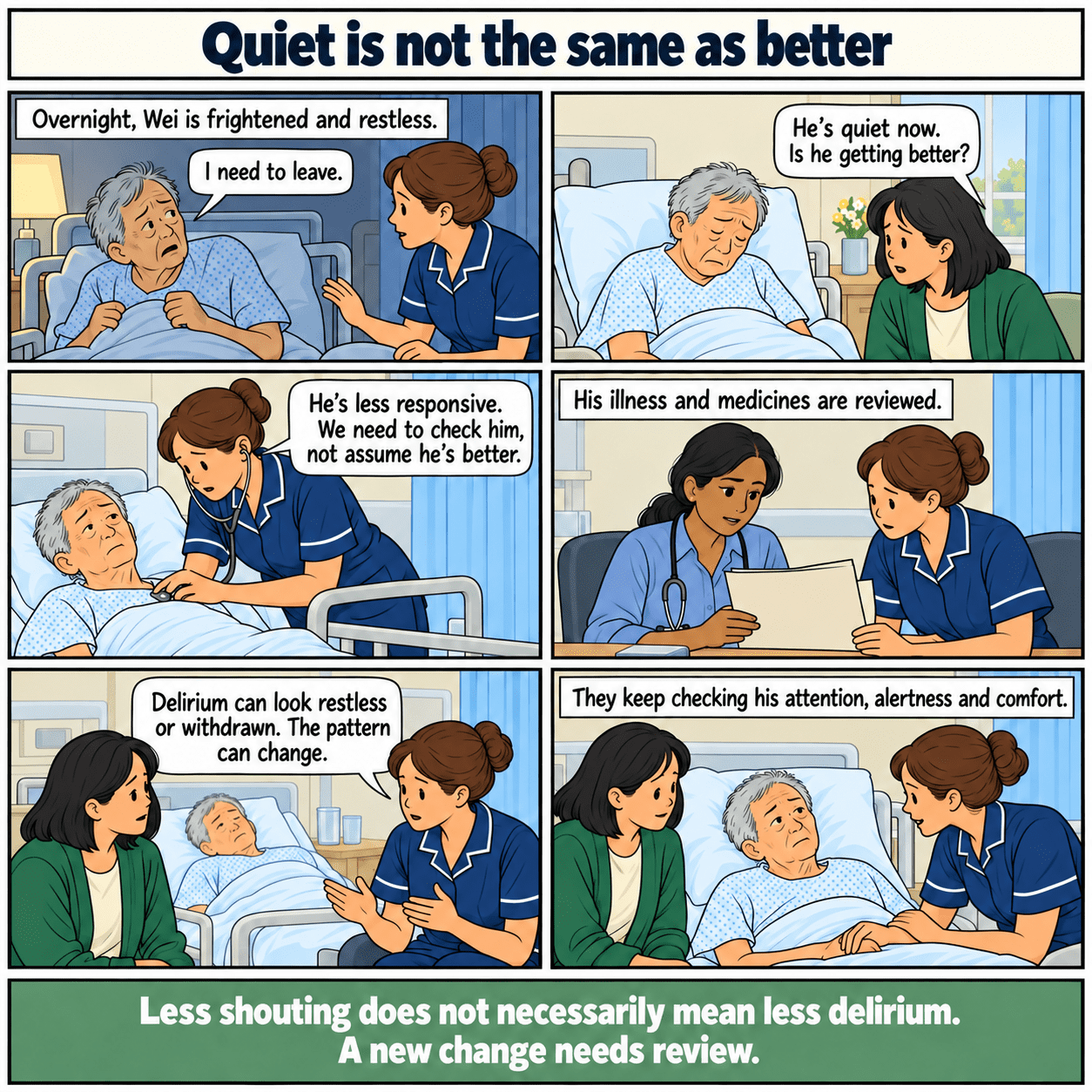
Hyperactive and hypoactive delirium: why becoming quiet may not mean recovery
Wei was restless and frightened overnight. By morning he is much quieter, but he is also less responsive. His nurse recognises that quietness is not enough to show recovery and asks for a prompt review. Illness, medicines and changes in delirium can all need consideration. The goal is better health and comfort, not silence.
Story text
Panel 1. Overnight, Wei is frightened and restless.
- Wei: I need to leave.
Panel 2.
- Lin: He’s quiet now. Is he getting better?
Panel 3.
- Nurse: He’s less responsive. We need to check him, not assume he’s better.
Panel 4. His illness and medicines are reviewed.
Panel 5.
- Nurse: Delirium can look restless or withdrawn. The pattern can change.
Panel 6. They keep checking his attention, alertness and comfort.
Bottom band. Less shouting does not necessarily mean less delirium. A new change needs review.
Story C13 · Example case
Not simply the anaesthetic
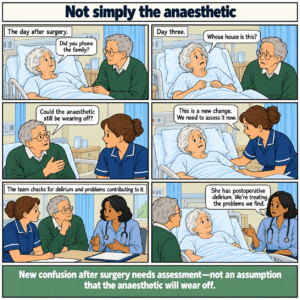
Read story C13: Not simply the anaesthetic (image and text)
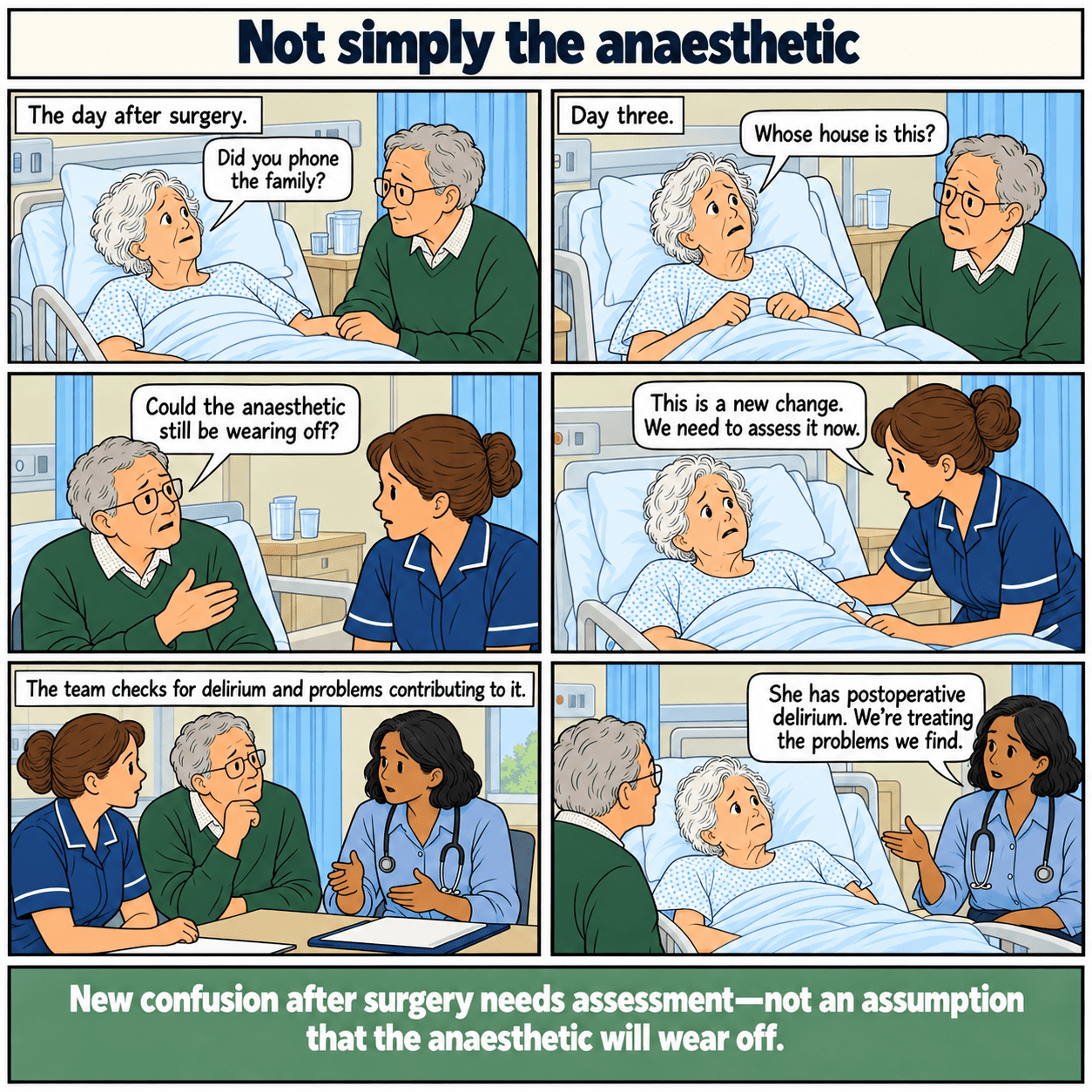
Delirium days after surgery: why new confusion needs assessment
Ruth was talking clearly after her operation, then became confused two days later. Her husband wonders whether the anaesthetic is still wearing off. The nurse treats this as a new change needing assessment. Postoperative delirium is not explained simply by the word anaesthetic; clinicians consider the whole illness, recovery, medicines and possible complications.
Story text
Panel 1. The day after surgery.
- Ruth: Did you phone the family?
Panel 2. Day three.
- Ruth: Whose house is this?
Panel 3.
- Michael: Could the anaesthetic still be wearing off?
Panel 4.
- Nurse: This is a new change. We need to assess it now.
Panel 5. The team checks for delirium and problems contributing to it.
Panel 6.
- Surgeon: She has postoperative delirium. We’re treating the problems we find.
Bottom band. New confusion after surgery needs assessment—not an assumption that the anaesthetic will wear off.
Story C14 · Example case
But he was awake
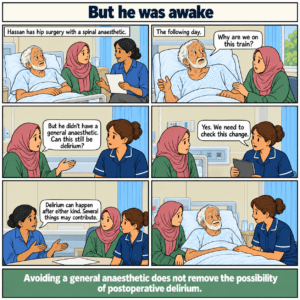
Read story C14: But he was awake (image and text)
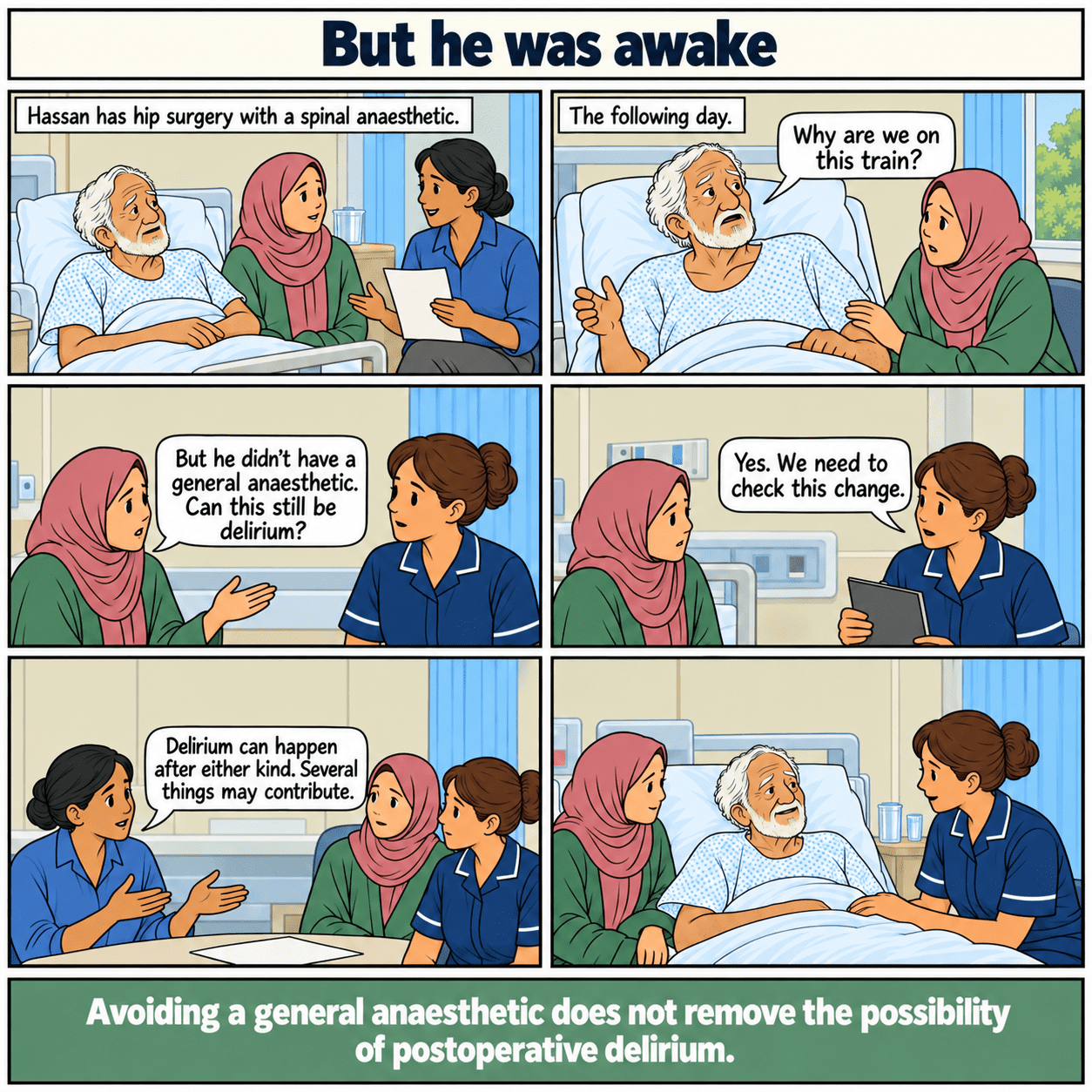
Delirium after spinal or regional anaesthesia: it can still happen
Hassan had surgery with a spinal anaesthetic rather than a general anaesthetic. When he becomes confused, his granddaughter is surprised. Delirium can occur after either approach. The team evaluates the new change and considers pain, illness, medicines and other contributors. This story does not recommend one anaesthetic technique over another.
Story text
Panel 1. Hassan has hip surgery with a spinal anaesthetic.
Panel 2. The following day.
- Hassan: Why are we on this train?
Panel 3.
- Salma: But he didn’t have a general anaesthetic. Can this still be delirium?
Panel 4.
- Nurse: Yes. We need to check this change.
Panel 5.
- Anaesthetist: Delirium can happen after either kind. Several things may contribute.
Panel 6. Treatment, comfort and repeated review continue.
Bottom band. Avoiding a general anaesthetic does not remove the possibility of postoperative delirium.
Story C15 · Example case
She has no fever
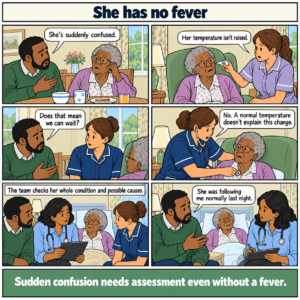
Read story C15: She has no fever (image and text)
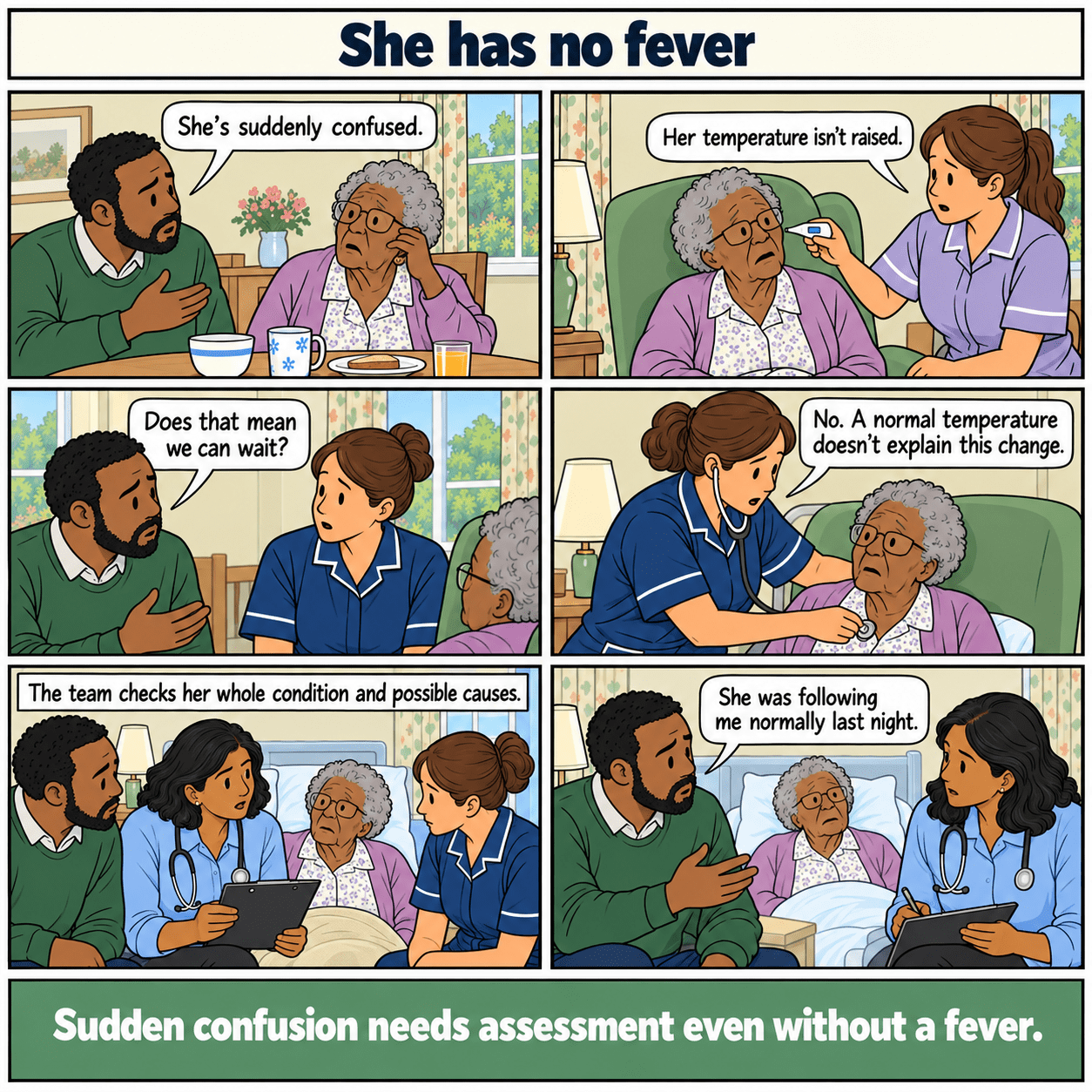
Sudden confusion without fever: it still needs urgent assessment
Esther is suddenly confused, but her temperature is not raised. Her nephew is unsure whether that means it is safe to wait. The nurse explains that temperature is only one part of assessment. The team checks promptly for the cause of the change. Delirium has many possible contributors, and a normal temperature does not settle the question.
Story text
Panel 1.
- Leon: She’s suddenly confused.
Panel 2.
- Care worker: Her temperature isn’t raised.
Panel 3.
- Leon: Does that mean we can wait?
Panel 4.
- Nurse: No. A normal temperature doesn’t explain this change.
Panel 5. The team checks her whole condition and possible causes.
Panel 6.
- Leon: She was following me normally last night.
Bottom band. Sudden confusion needs assessment even without a fever.
Story C17 · Example case
The first check was normal
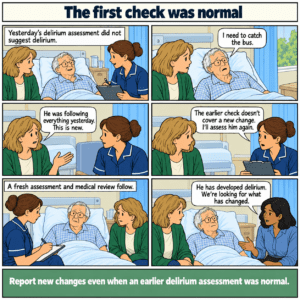
Read story C17: The first check was normal (image and text)
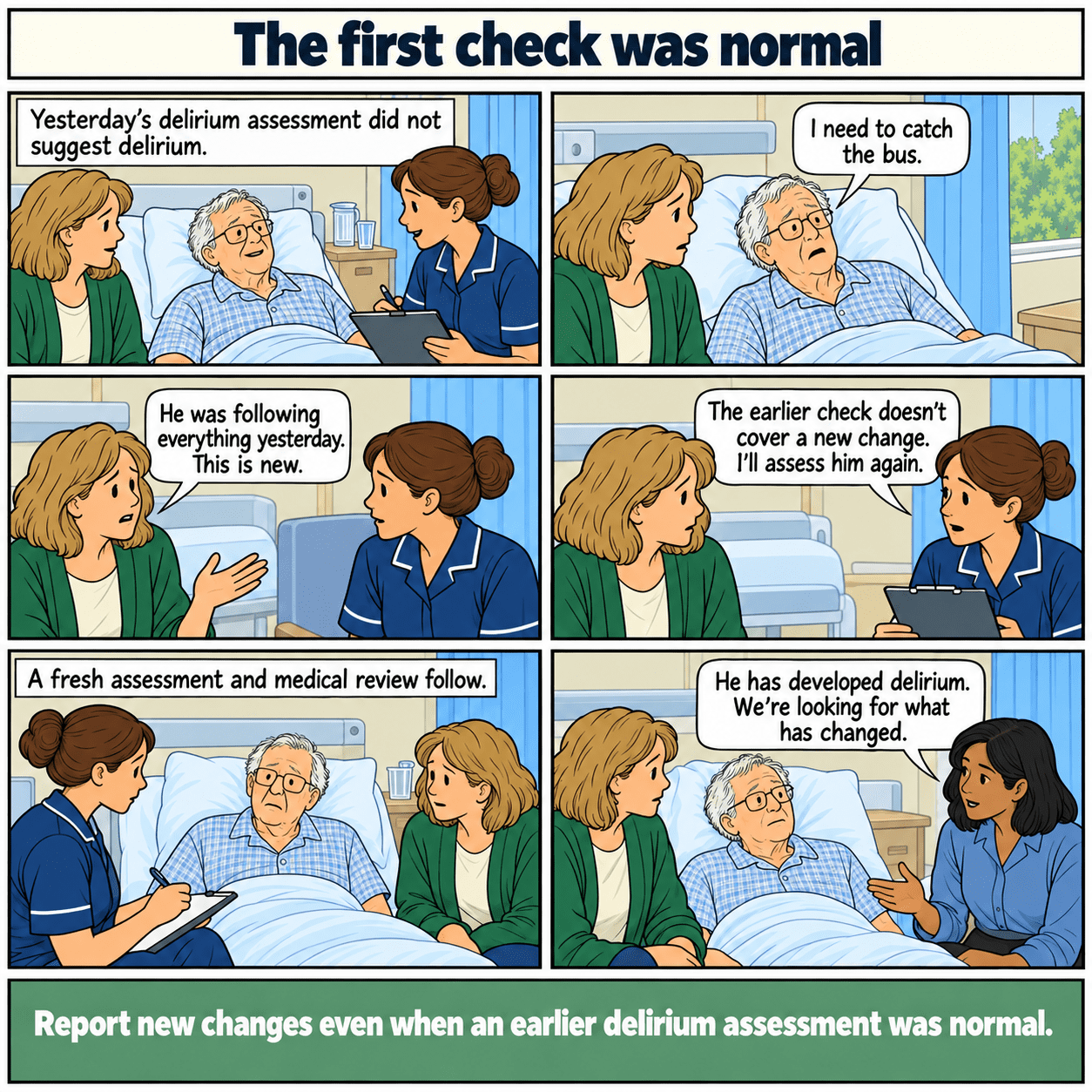
A normal delirium check earlier does not rule out a new episode later
Graham’s first assessment did not suggest delirium. The next day, his daughter notices a clear new change. The nurse repeats the assessment and seeks a medical review. A previous result describes an earlier moment; it is not a guarantee that delirium can’t develop later. Families should report the change rather than try to repeat the test themselves.
Story text
Panel 1. Yesterday’s delirium assessment did not suggest delirium.
Panel 2.
- Graham: I need to catch the bus.
Panel 3.
- Beth: He was following everything yesterday. This is new.
Panel 4.
- Nurse: The earlier check doesn’t cover a new change. I’ll assess him again.
Panel 5. A fresh assessment and medical review follow.
Panel 6.
- Doctor: He has developed delirium. We’re looking for what has changed.
Bottom band. Report new changes even when an earlier delirium assessment was normal.
Story C30 · Example case
The scan was reassuring
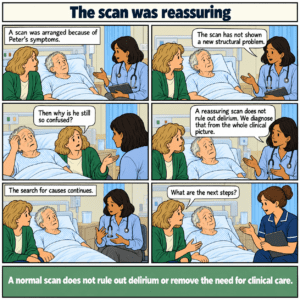
Read story C30: The scan was reassuring (image and text)
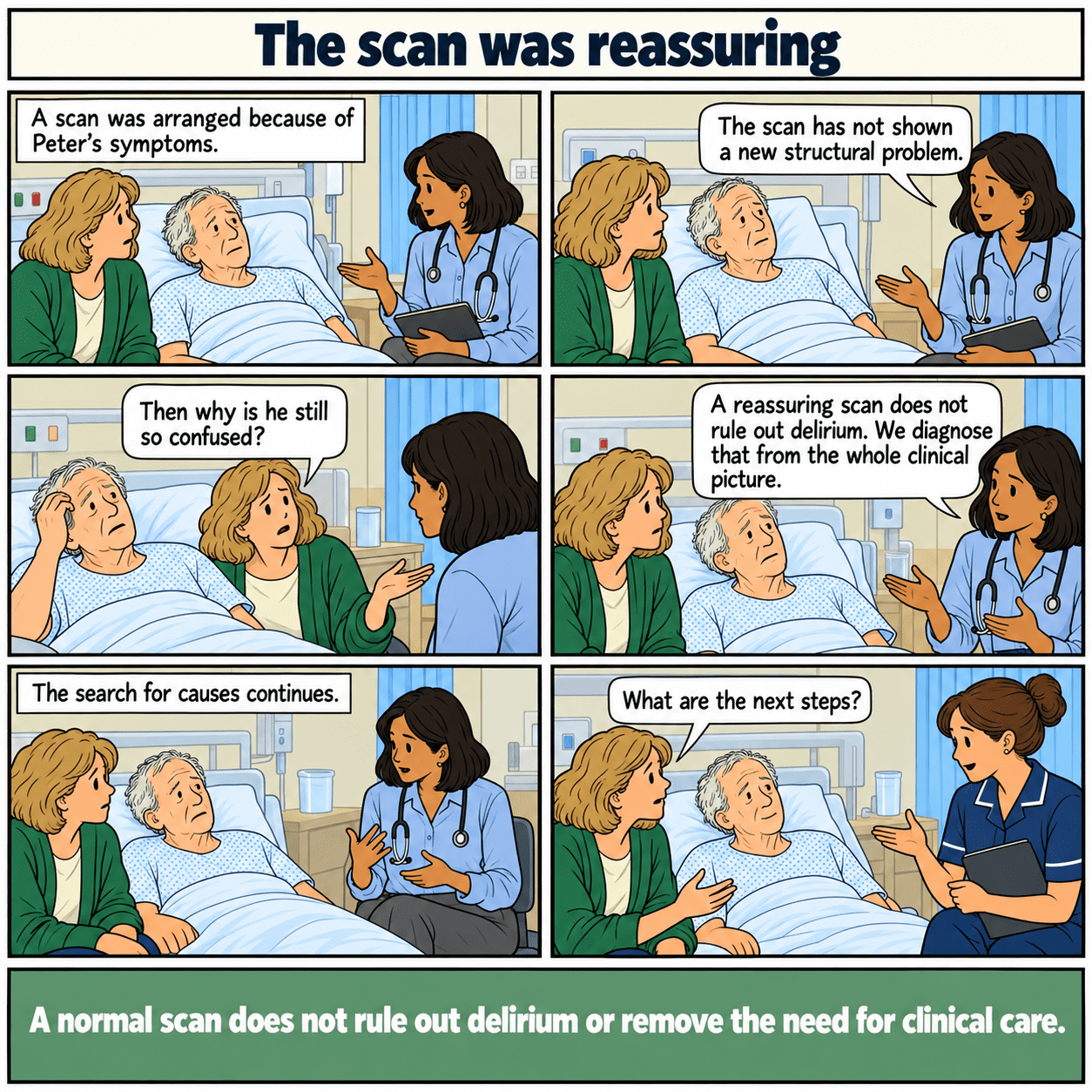
Can someone have delirium with a normal brain scan?
Peter’s brain scan does not show a new structural problem, but he is still clearly unwell and confused. Anna asks how both things can be true. The doctor explains that delirium is identified from the clinical picture, not by a visible mark on every scan. Other investigations and care continue according to his needs.
Story text
Panel 1. A scan was arranged because of Peter’s symptoms.
Panel 2.
- Doctor: The scan has not shown a new structural problem.
Panel 3.
- Anna: Then why is he still so confused?
Panel 4.
- Doctor: A reassuring scan does not rule out delirium. We diagnose that from the whole clinical picture.
Panel 5. The search for causes continues.
Panel 6.
- Anna: What are the next steps?
Bottom band. A normal scan does not rule out delirium or remove the need for clinical care.
Story D04 · Example case
Is she depressed?
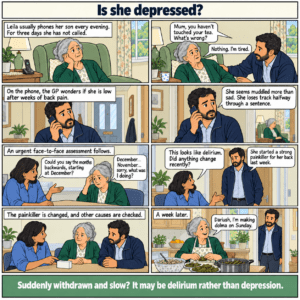
Read story D04: Is she depressed? (image and text)
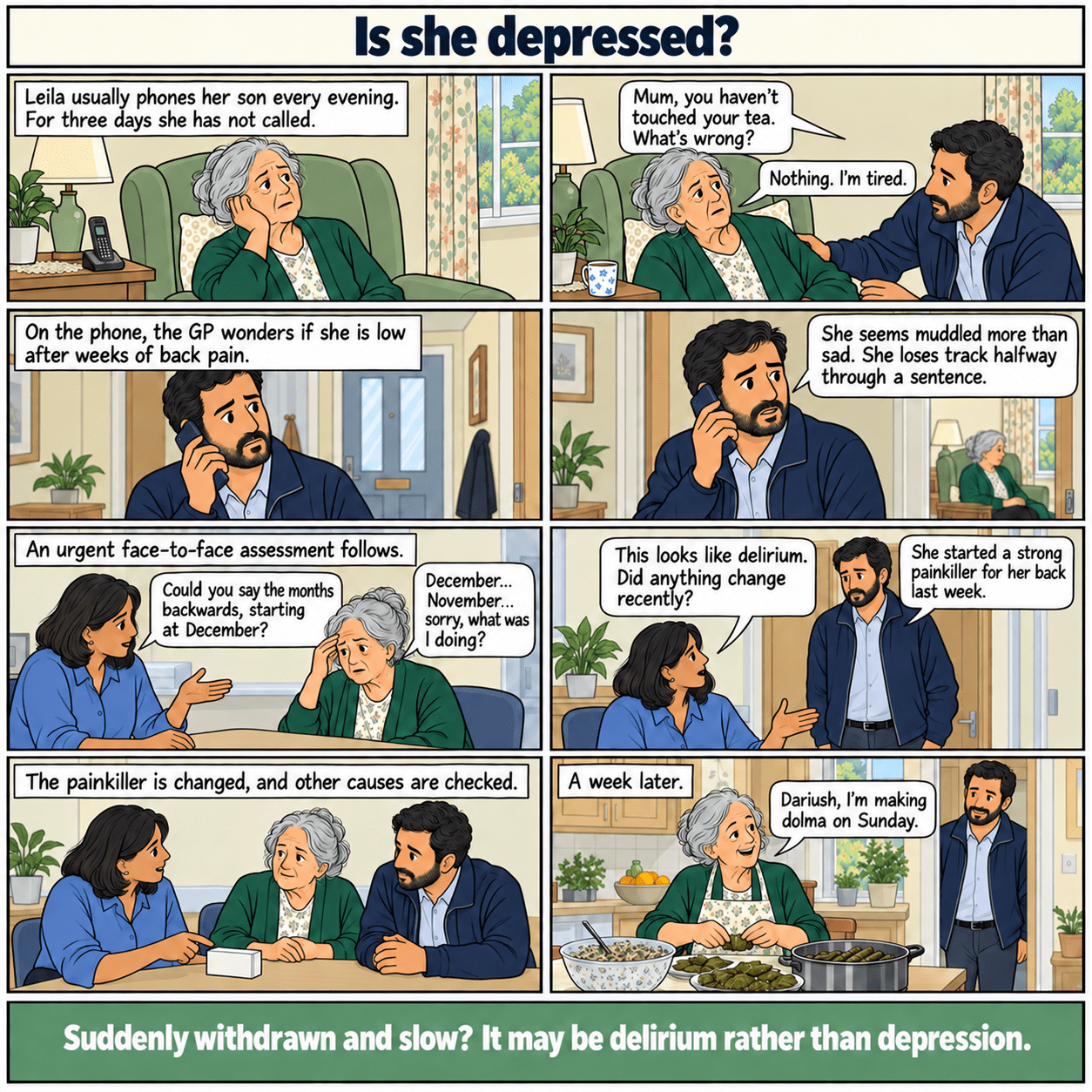
Is she depressed?
Leila becomes withdrawn and loses track of conversations over a few days. These changes need urgent medical assessment, even when tiredness or depression seems possible.
Delirium may make someone slow to respond, less interested in food or company, and unable to sustain attention. Staff need to assess the whole change. Tell them about recent medicines as well as the person’s usual abilities. In this example, the team reviews a new painkiller and checks for other causes.
Story text
Panel 1. Leila usually phones her son every evening. For three days she has not called.
Panel 2.
- Dariush: Mum, you haven't touched your tea. What's wrong?
- Leila: Nothing. I'm tired.
Panel 3. On the phone, the GP wonders if she is low after weeks of back pain.
Panel 4.
- Dariush: She seems muddled more than sad. She loses track halfway through a sentence.
Panel 5. An urgent face-to-face assessment follows.
- GP: Could you say the months backwards, starting at December?
- Leila: December… November… sorry, what was I doing?
Panel 6.
- GP: This looks like delirium. Did anything change recently?
- Dariush: She started a strong painkiller for her back last week.
Panel 7. The painkiller is changed, and other causes are checked.
Panel 8. A week later.
- Leila: Dariush, I'm making dolma on Sunday.
Bottom band. Suddenly withdrawn and slow? It may be delirium rather than depression.
Story D05 · Example case
Not every vision is delirium
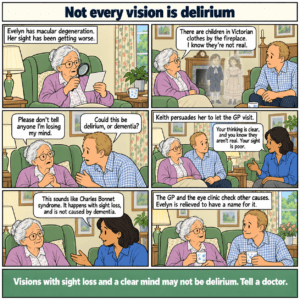
Read story D05: Not every vision is delirium (image and text)
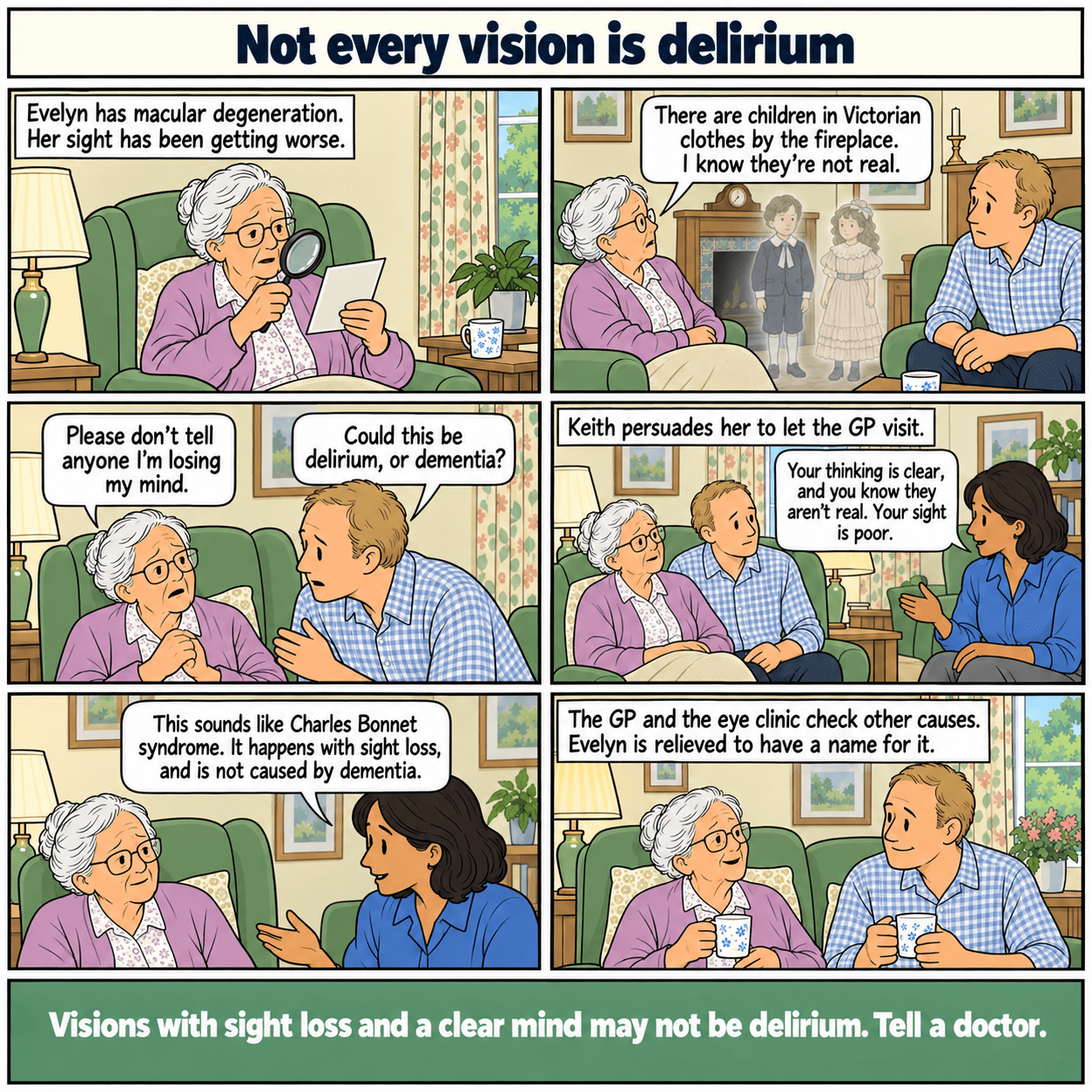
Not every vision is delirium
Seeing images that other people do not see can happen with significant sight loss. This is called Charles Bonnet syndrome. Affected people often know the images are not real, but an assessment is still needed.
Evelyn’s doctor and eye clinic check her symptoms and sight. This example does not show delirium. New hallucinations should be discussed promptly with a clinician. Sudden confusion, unusual drowsiness or a marked change in attention needs urgent medical help, whether or not the person has sight loss.
Story text
Panel 1. Evelyn has macular degeneration. Her sight has been getting worse.
Panel 2.
- Evelyn: There are children in Victorian clothes by the fireplace. I know they're not real.
Panel 3.
- Evelyn: Please don't tell anyone I'm losing my mind.
- Keith: Could this be delirium, or dementia?
Panel 4. Keith persuades her to let the GP visit.
- GP: Your thinking is clear, and you know they aren't real. Your sight is poor.
Panel 5.
- GP: This sounds like Charles Bonnet syndrome. It happens with sight loss, and is not caused by dementia.
Panel 6. The GP and the eye clinic check other causes. Evelyn is relieved to have a name for it.
Bottom band. Visions with sight loss and a clear mind may not be delirium. Tell a doctor.
Getting help and being heard
Story B01
Please look again
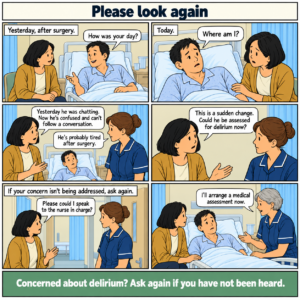
Read story B01: Please look again (image and text)
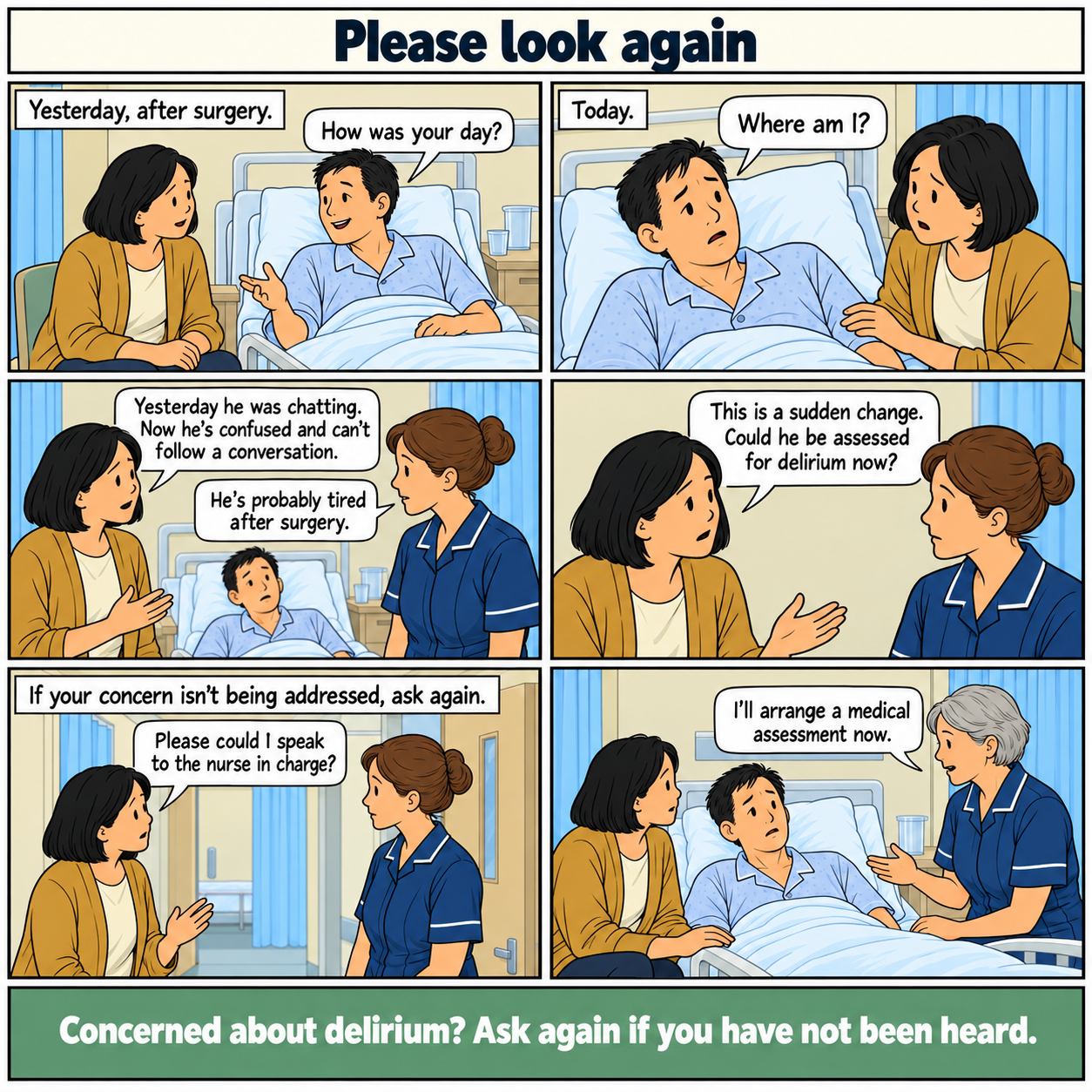
If a sudden change in your relative's thinking or behaviour has not been assessed, you can ask again. Say what has changed, when it began, and what they were like before. Use the word delirium.
If you still have no clear response, ask to speak to the nurse in charge and ask who will check the person, and when. You do not need to diagnose the problem yourself. If they are getting worse, ask for urgent help immediately.
Story text
-
Panel 1. Yesterday, after surgery.
- Ken: How was your day?
-
Panel 2. Today.
- Ken: Where am I?
-
Panel 3.
- Mei: Yesterday he was chatting. Now he's confused and can't follow a conversation.
- Nurse: He's probably tired after surgery.
-
Panel 4.
- Mei: This is a sudden change. Could he be assessed for delirium now?
-
Panel 5. If your concern isn't being addressed, ask again.
- Mei: Please could I speak to the nurse in charge?
-
Panel 6.
- Nurse in charge: I'll arrange a medical assessment now.
Bottom band. Concerned about delirium? Ask again if you have not been heard.
Story B17
When words are difficult
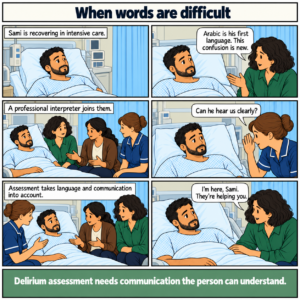
Read story B17: When words are difficult (image and text)
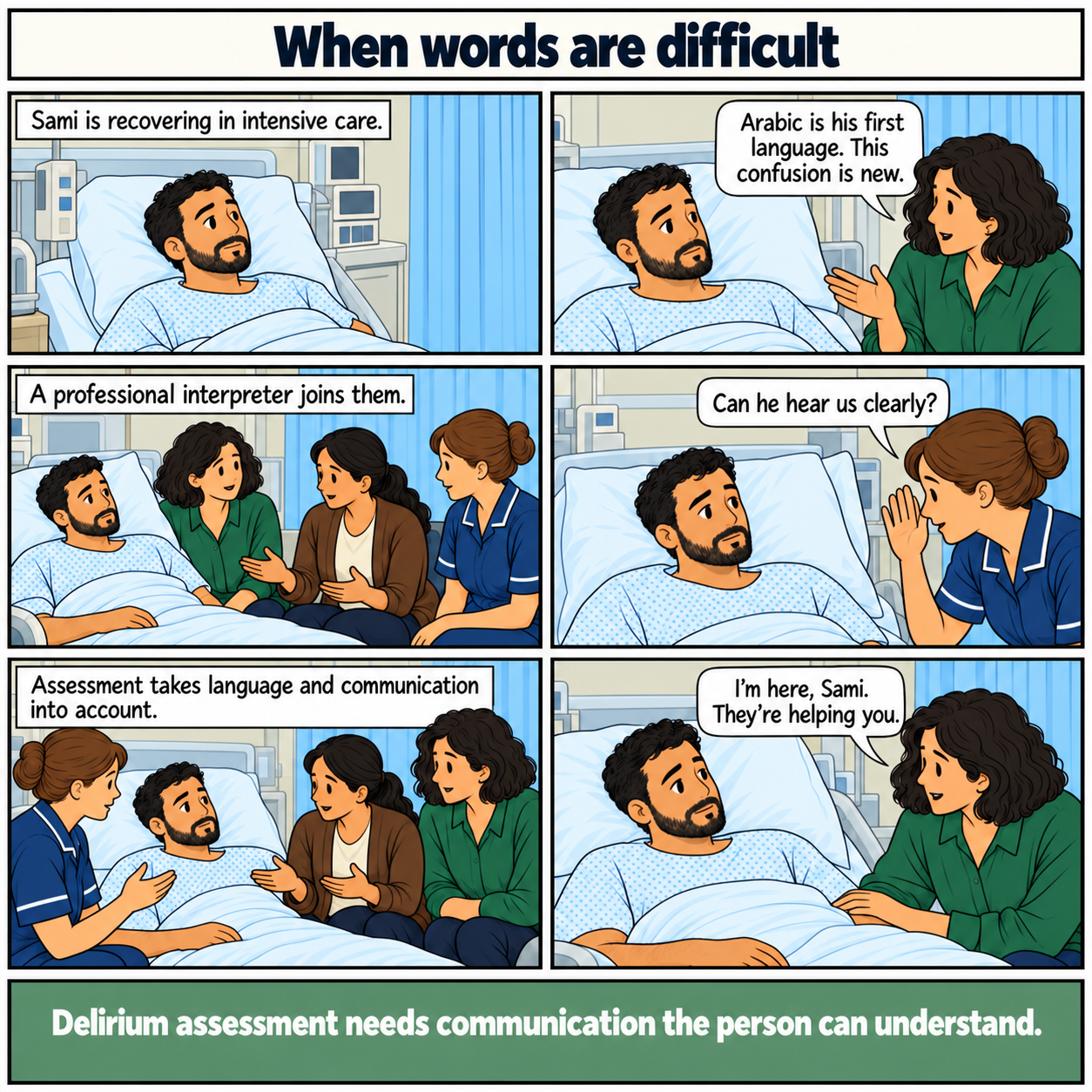
A language barrier can make a frightening hospital stay harder. It should not be mistaken for delirium, or prevent a new change being checked by a doctor or nurse.
Tell staff which language the person understands best and how they usually communicate. Ask for a professional interpreter when one is needed. Hearing, vision and illness can also affect communication. Families can share familiar words and reassurance without being expected to replace an interpreter for important conversations about care.
Story text
-
Panel 1. Sami is recovering in intensive care.
-
Panel 2.
- Lina: Arabic is his first language. This confusion is new.
-
Panel 3. A professional interpreter joins them.
-
Panel 4.
- Nurse: Can he hear us clearly?
-
Panel 5. Assessment takes language and communication into account.
-
Panel 6.
- Lina: I’m here, Sami. They’re helping you.
Bottom band. Delirium assessment needs communication the person can understand.
Story B30
One more question
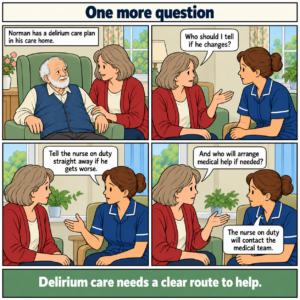
Read story B30: One more question (image and text)
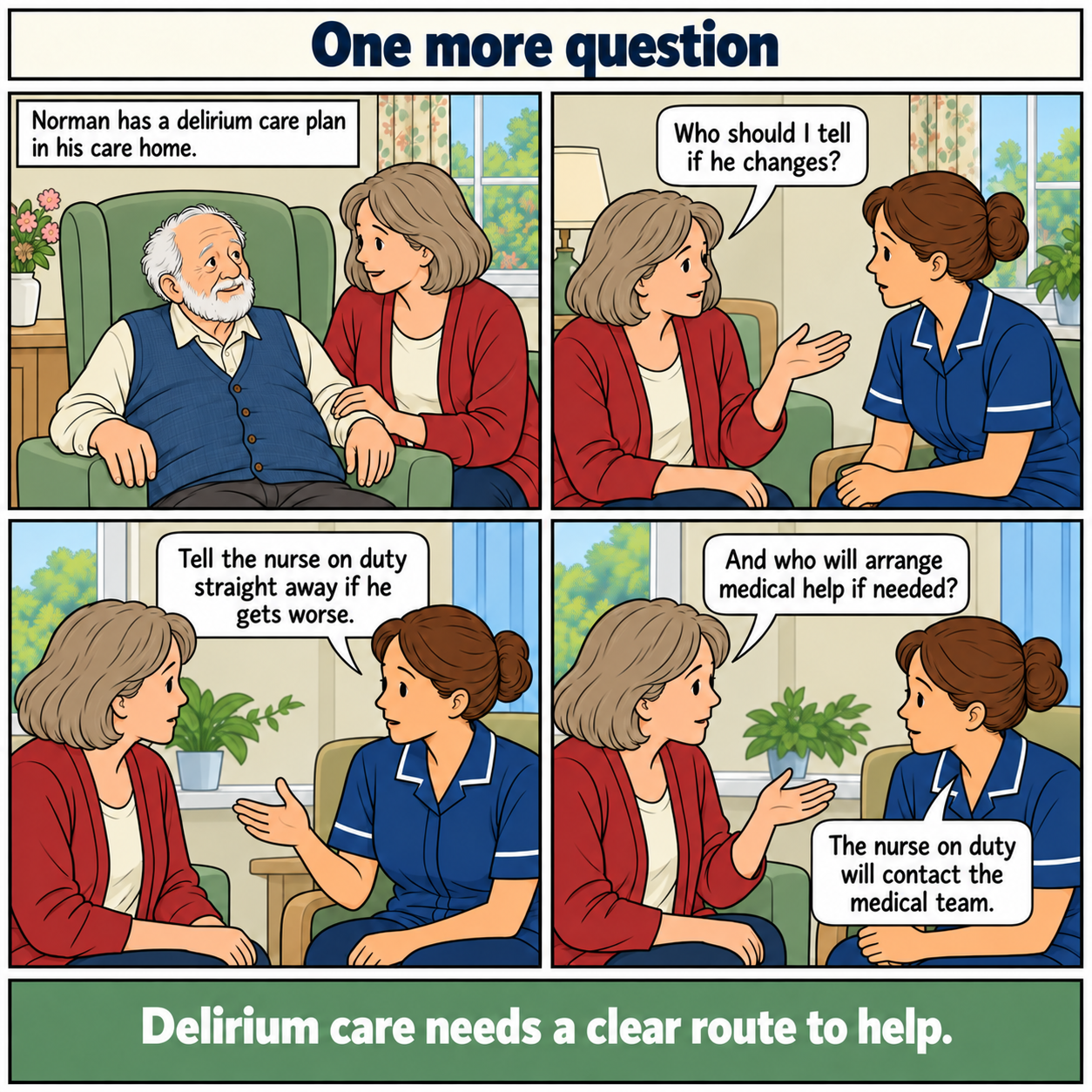
A care plan should include clear instructions about whom to contact for help. Before a discussion ends, ask whom to contact about a change, who can arrange a check by a doctor or nurse and how you will hear about the response.
This applies in care homes as well as hospitals. Do not wait for the next routine meeting if someone becomes suddenly more confused, less responsive or otherwise unwell. Tell staff promptly and ask for urgent medical help when needed.
Story text
-
Panel 1. Norman has a delirium care plan in his care home.
-
Panel 2.
- Ruth: Who should I tell if he changes?
-
Panel 3.
- Nurse: Tell the nurse on duty straight away if he gets worse.
-
Panel 4.
- Ruth: And who will arrange medical help if needed?
- Nurse: The nurse on duty will contact the medical team.
Bottom band. Delirium care needs a clear route to help.
Story B37
She has dementia. This is new.
Read story B37: She has dementia. This is new. (image and text)
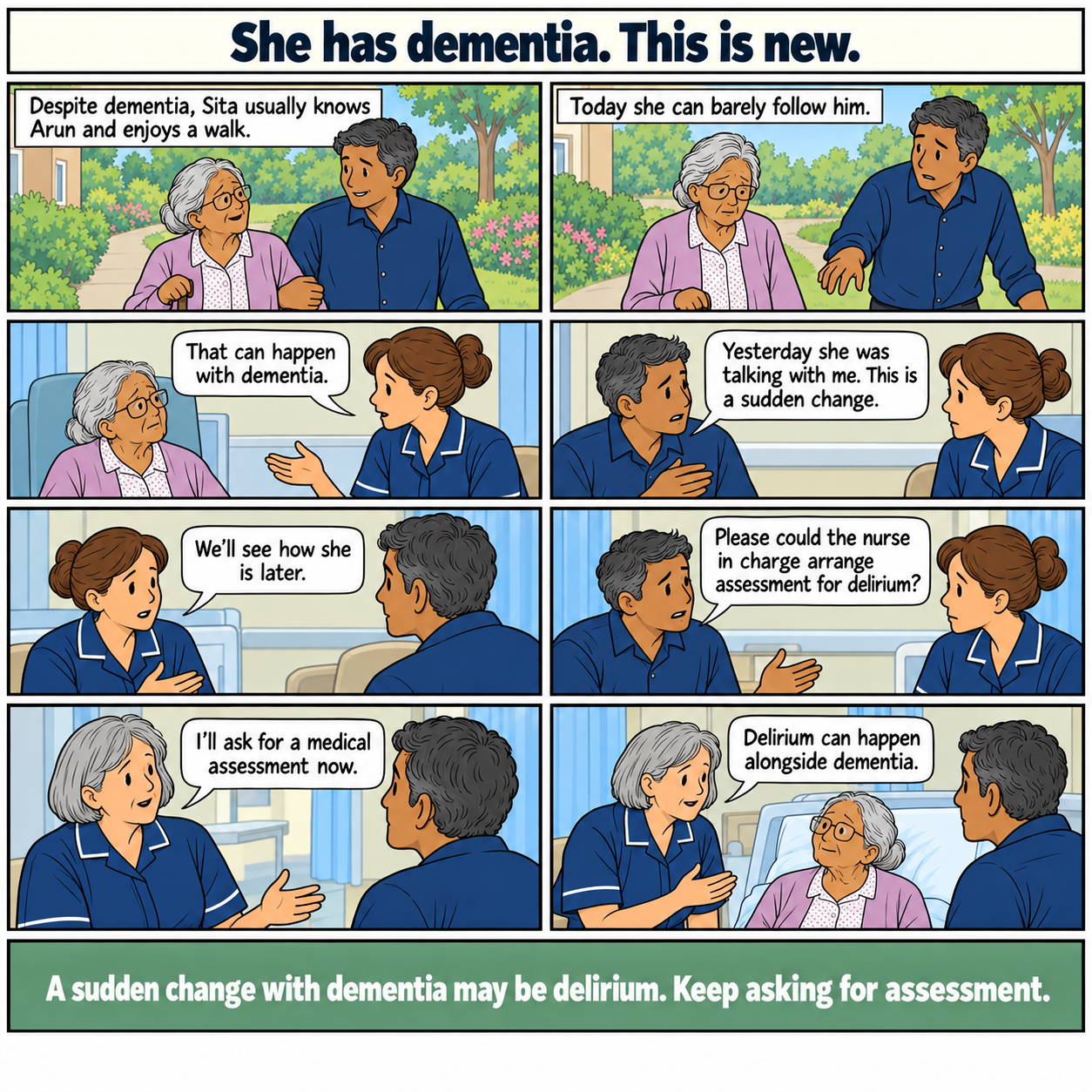
“She has dementia” does not explain every new change. Delirium can happen alongside dementia, and a sudden change from the person’s usual pattern needs a doctor or nurse to check what is wrong.
Give a specific before-and-after example. If the concern is not being addressed, ask again and ask to speak to the nurse in charge. You can use the word delirium without having to prove the diagnosis yourself. The team is responsible for checking and responding to the change.
Story text
-
Panel 1. Despite dementia, Sita usually knows Arun and enjoys a walk.
-
Panel 2. Today she can barely follow him.
-
Panel 3.
- Nurse: That can happen with dementia.
-
Panel 4.
- Arun: Yesterday she was talking with me. This is a sudden change.
-
Panel 5.
- Nurse: We’ll see how she is later.
-
Panel 6.
- Arun: Please could the nurse in charge arrange assessment for delirium?
-
Panel 7.
- Senior nurse: I’ll ask for a medical assessment now.
-
Panel 8.
- Senior nurse: Delirium can happen alongside dementia.
Bottom band. A sudden change with dementia may be delirium. Keep asking for assessment.
Story B38
Still not heard
Read story B38: Still not heard (image and text)
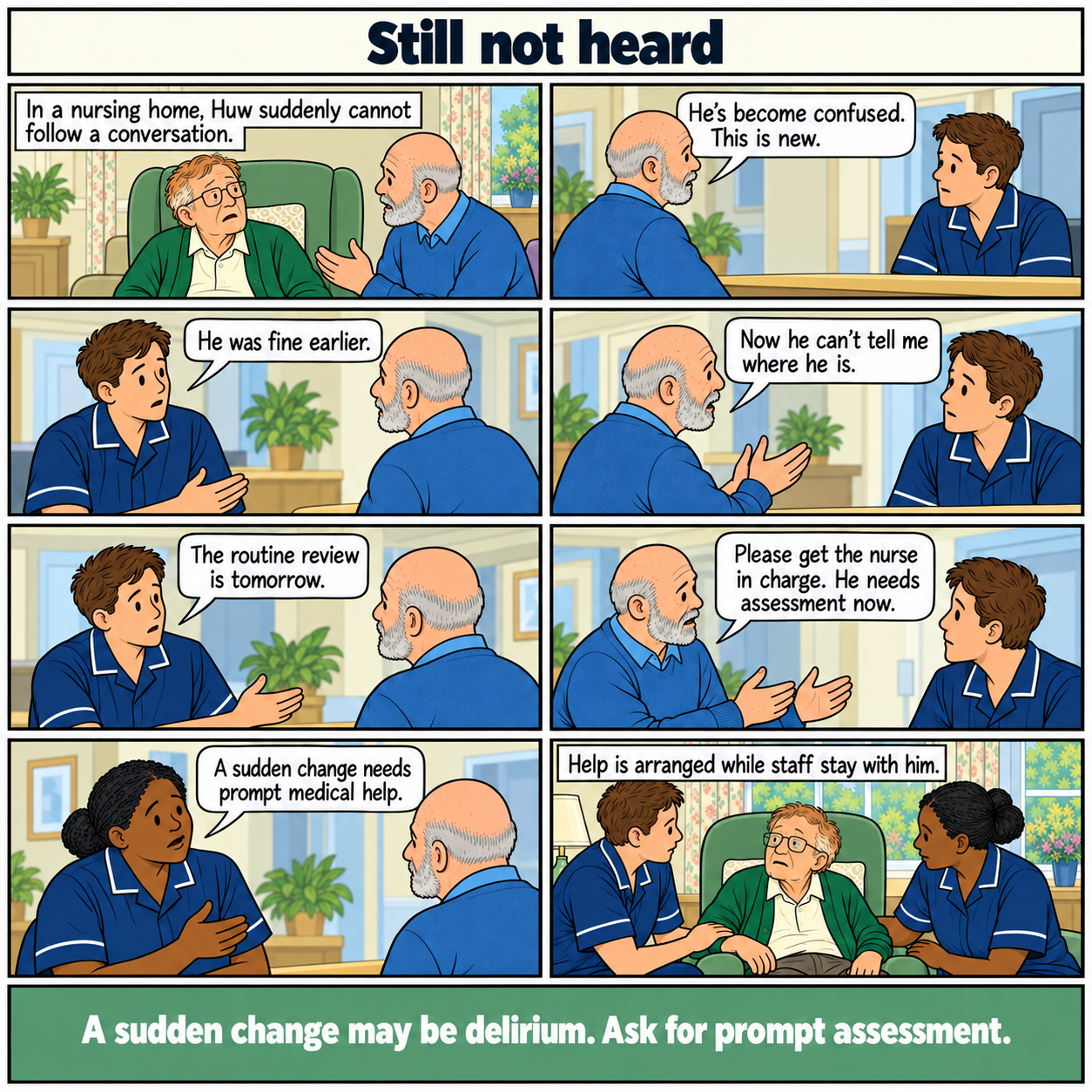
If you are repeatedly told to wait after reporting a sudden change, keep the concern specific. Explain what is different now and ask who will arrange a check by a doctor or nurse, and when.
You can ask for the nurse in charge or the appropriate senior person in that setting. This is about getting a doctor or nurse to check a new medical problem. If the person gets worse suddenly, ask for help now. Do not wait for a routine meeting or for a formal complaint to be dealt with.
Story text
-
Panel 1. In a nursing home, Huw suddenly cannot follow a conversation.
-
Panel 2.
- Glyn: He’s become confused. This is new.
-
Panel 3.
- Nurse: He was fine earlier.
-
Panel 4.
- Glyn: Now he can’t tell me where he is.
-
Panel 5.
- Nurse: The routine review is tomorrow.
-
Panel 6.
- Glyn: Please get the nurse in charge. He needs assessment now.
-
Panel 7.
- Senior nurse: A sudden change needs prompt medical help.
-
Panel 8. Help is arranged while staff stay with him.
Bottom band. A sudden change may be delirium. Ask for prompt assessment.
Story B48
We need another explanation
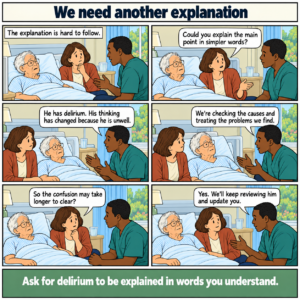
Read story B48: We need another explanation (image and text)
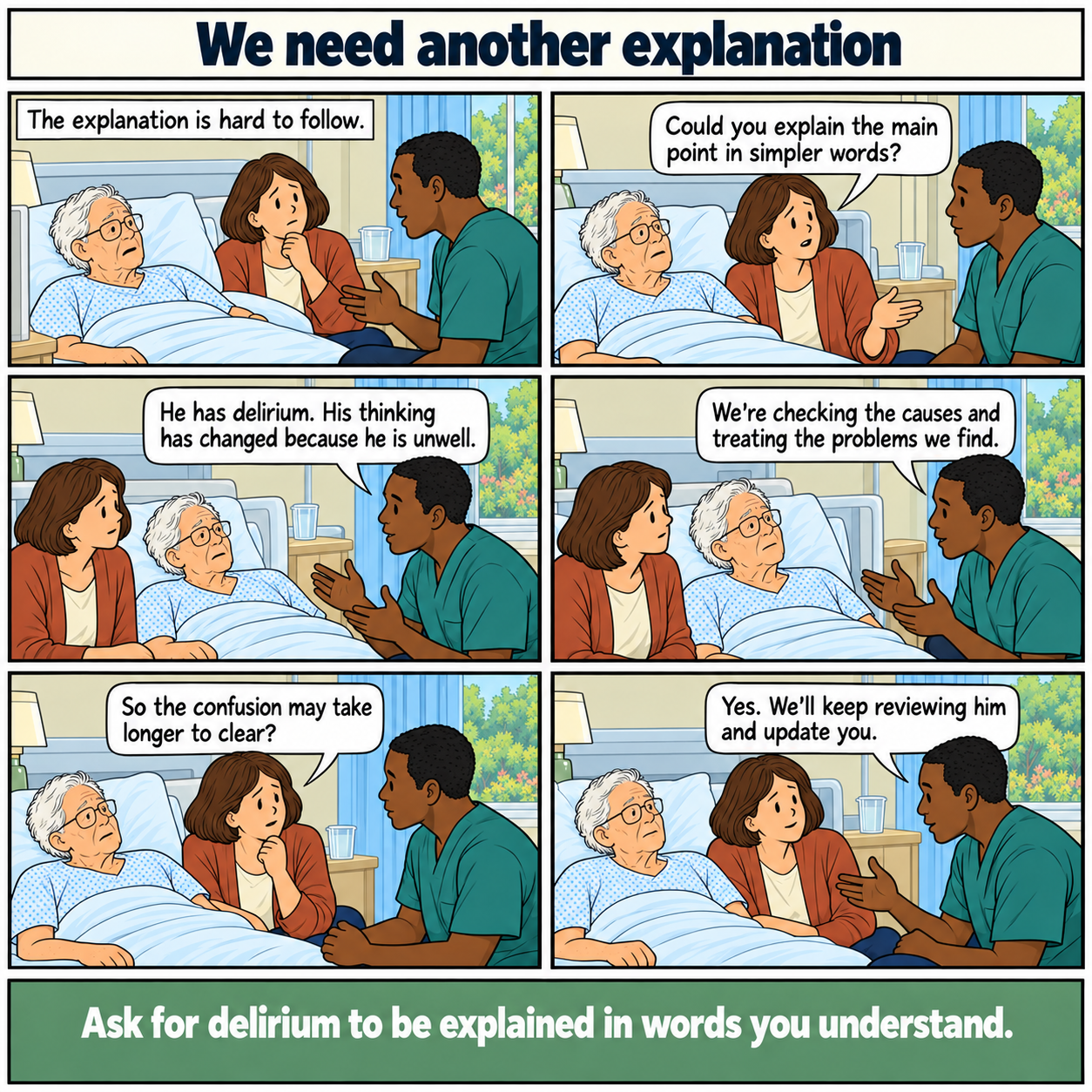
It is reasonable to ask for an explanation again, or in different words. Stress, tiredness and unfamiliar medical language can make a difficult conversation harder to follow.
Ask what delirium means for this person, what the team is checking and treating, and when you will hear more. Saying the plan back in your own words can show whether you have misunderstood anything. Good communication includes taking time to explain, rather than assuming that silence means understanding.
Story text
-
Panel 1. The explanation is hard to follow.
-
Panel 2.
- Rose: Could you explain the main point in simpler words?
-
Panel 3.
- Doctor: He has delirium. His thinking has changed because he is unwell.
-
Panel 4.
- Doctor: We’re checking the causes and treating the problems we find.
-
Panel 5.
- Rose: So the confusion may take longer to clear?
-
Panel 6.
- Doctor: Yes. We’ll keep reviewing him and update you.
Bottom band. Ask for delirium to be explained in words you understand.
Story C10 · Example case
Before the bed is ready
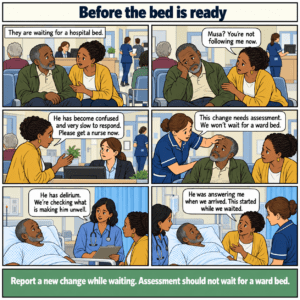
Read story C10: Before the bed is ready (image and text)
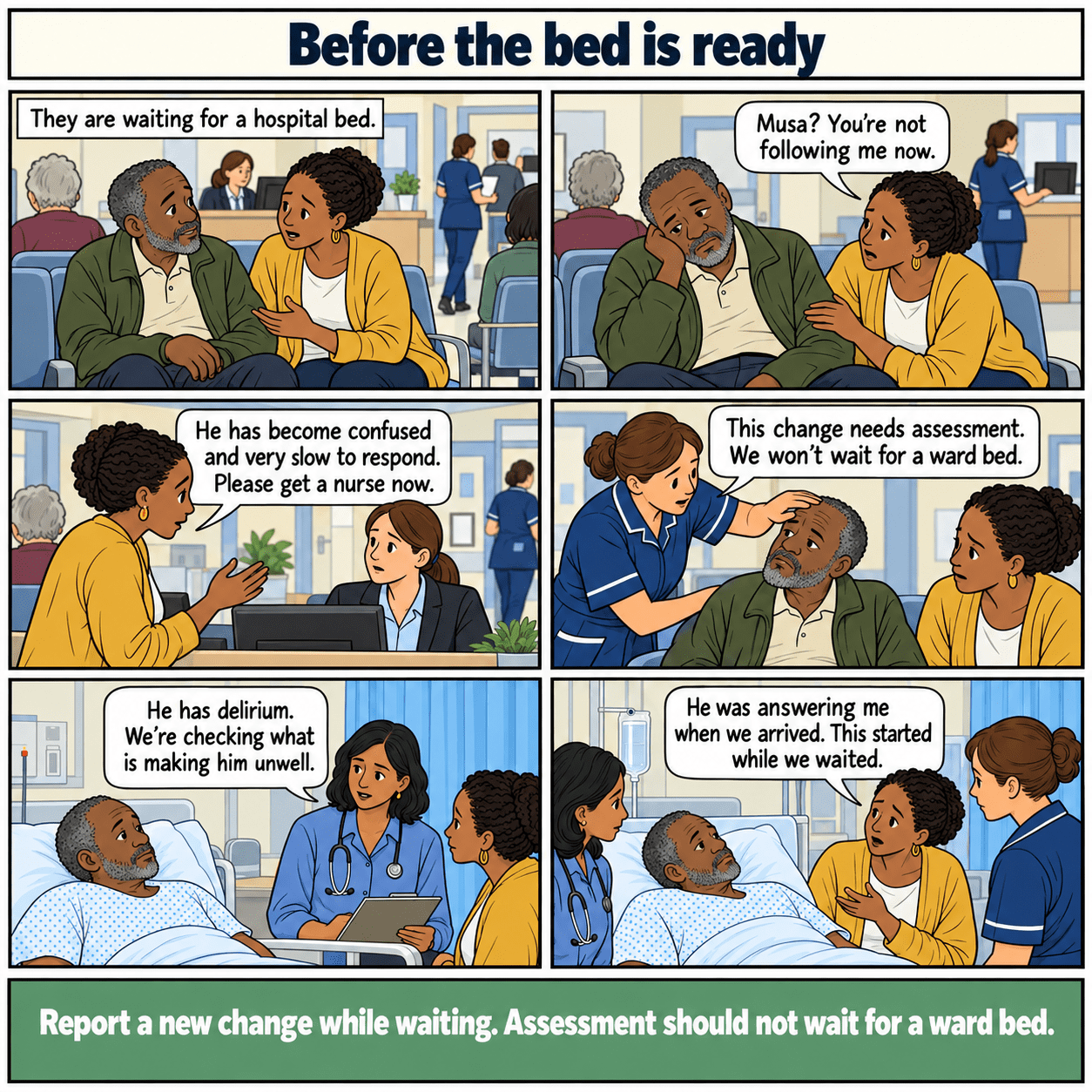
Quiet delirium in the emergency department: raising a concern while waiting
Musa becomes unusually quiet while waiting in the emergency department. Aisha describes the change rather than simply asking when a bed will be ready. The nurse reassesses him promptly. A new deterioration needs a clinical response wherever the person is waiting; an available ward bed is not a prerequisite for recognising delirium.
Story text
Panel 1. They are waiting for a hospital bed.
Panel 2.
- Aisha: Musa? You’re not following me now.
Panel 3.
- Aisha: He has become confused and very slow to respond. Please get a nurse now.
Panel 4.
- Nurse: This change needs assessment. We won’t wait for a ward bed.
Panel 5.
- Doctor: He has delirium. We’re checking what is making him unwell.
Panel 6.
- Aisha: He was answering me when we arrived. This started while we waited.
Bottom band. Report a new change while waiting. Assessment should not wait for a ward bed.
Story C16 · Example case
Home yesterday, confused today
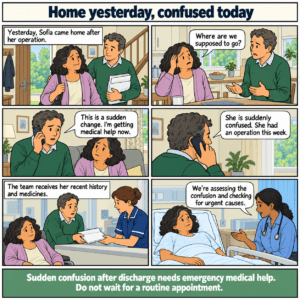
Read story C16: Home yesterday, confused today (image and text)
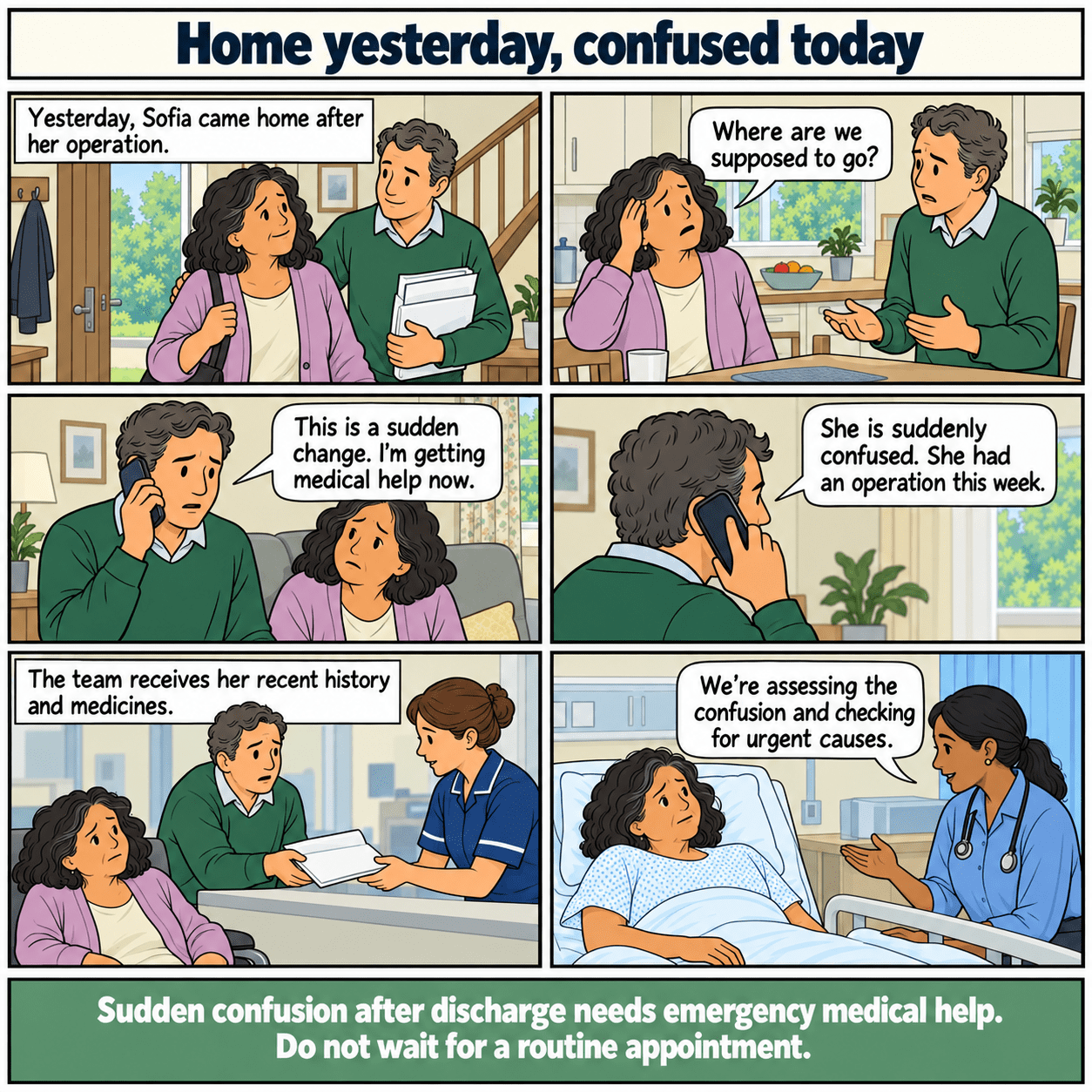
New confusion after going home from surgery: do not wait for a routine appointment
Sofia was managing at home after surgery, then suddenly can’t make sense of a familiar task. Alex seeks emergency help and explains the recent operation and medicines. New confusion after discharge should not be left until a planned appointment. Delirium is one possible explanation, and other urgent problems also need assessment.
Story text
Panel 1. Yesterday, Sofia came home after her operation.
Panel 2.
- Sofia: Where are we supposed to go?
Panel 3.
- Alex: This is a sudden change. I’m getting medical help now.
Panel 4.
- Alex: She is suddenly confused. She had an operation this week.
Panel 5. The team receives her recent history and medicines.
Panel 6.
- Clinician: We’re assessing the confusion and checking for urgent causes.
Bottom band. Sudden confusion after discharge needs emergency medical help. Do not wait for a routine appointment.
Story C25 · Example case
He does not use many words
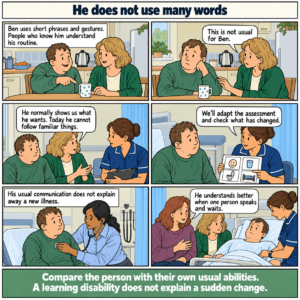
Read story C25: He does not use many words (image and text)
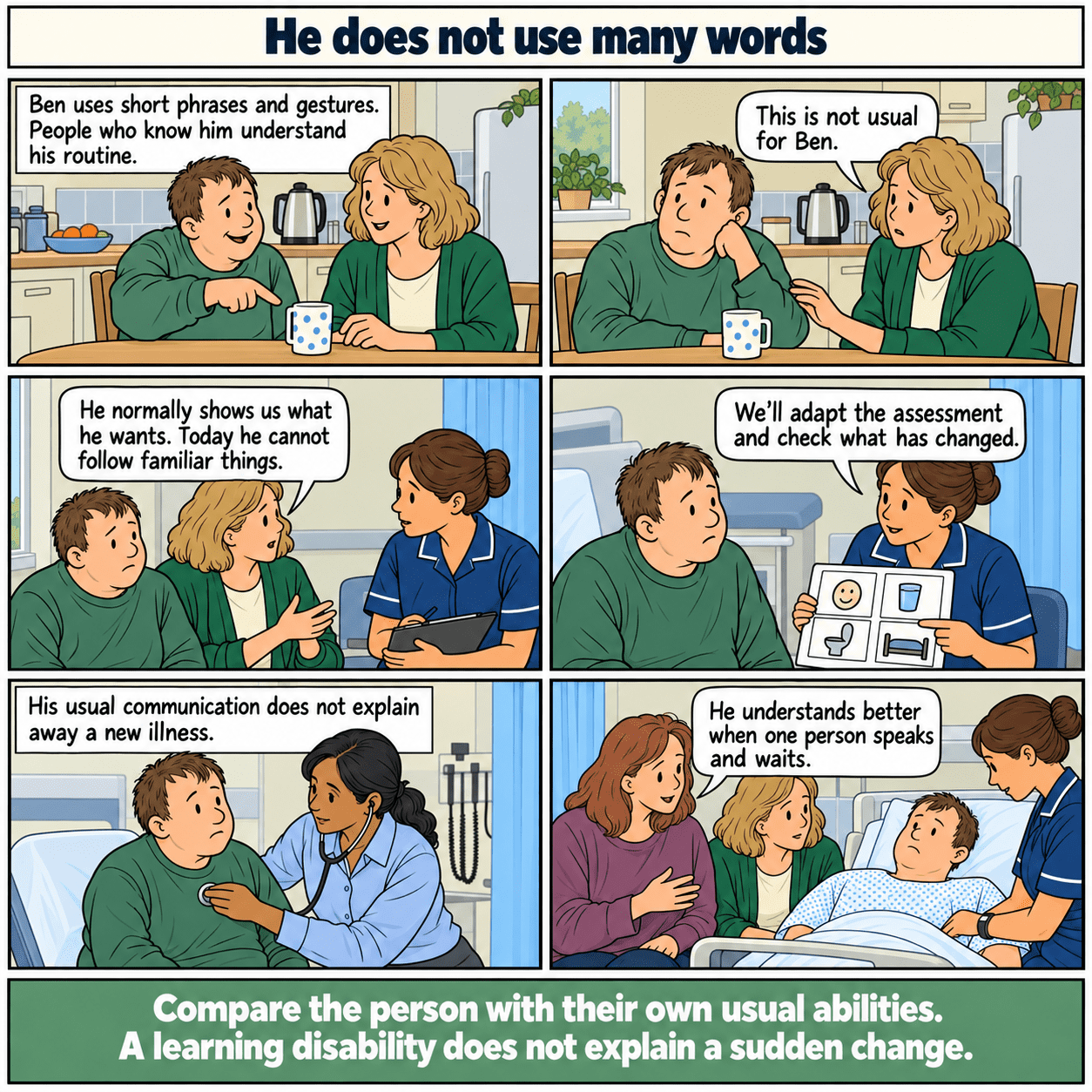
Delirium in a person with a learning disability: noticing their own change
Ben usually communicates through short phrases, gestures and familiar routines. Today he is unusually withdrawn and can’t engage in those routines. His support worker explains what is different. Assessment should fit Ben’s communication and compare him with his own usual abilities, not assume the change is part of his disability.
Story text
Panel 1. Ben uses short phrases and gestures. People who know him understand his routine.
Panel 2.
- Ella: This is not usual for Ben.
Panel 3.
- Ella: He normally shows us what he wants. Today he cannot follow familiar things.
Panel 4.
- Nurse: We’ll adapt the assessment and check what has changed.
Panel 5. His usual communication does not explain away a new illness.
Panel 6.
- Ruth: He understands better when one person speaks and waits.
Bottom band. Compare the person with their own usual abilities. A learning disability does not explain a sudden change.
Story C26 · Example case
I am his friend
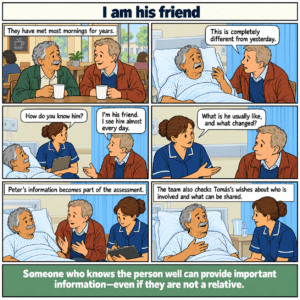
Read story C26: I am his friend (image and text)
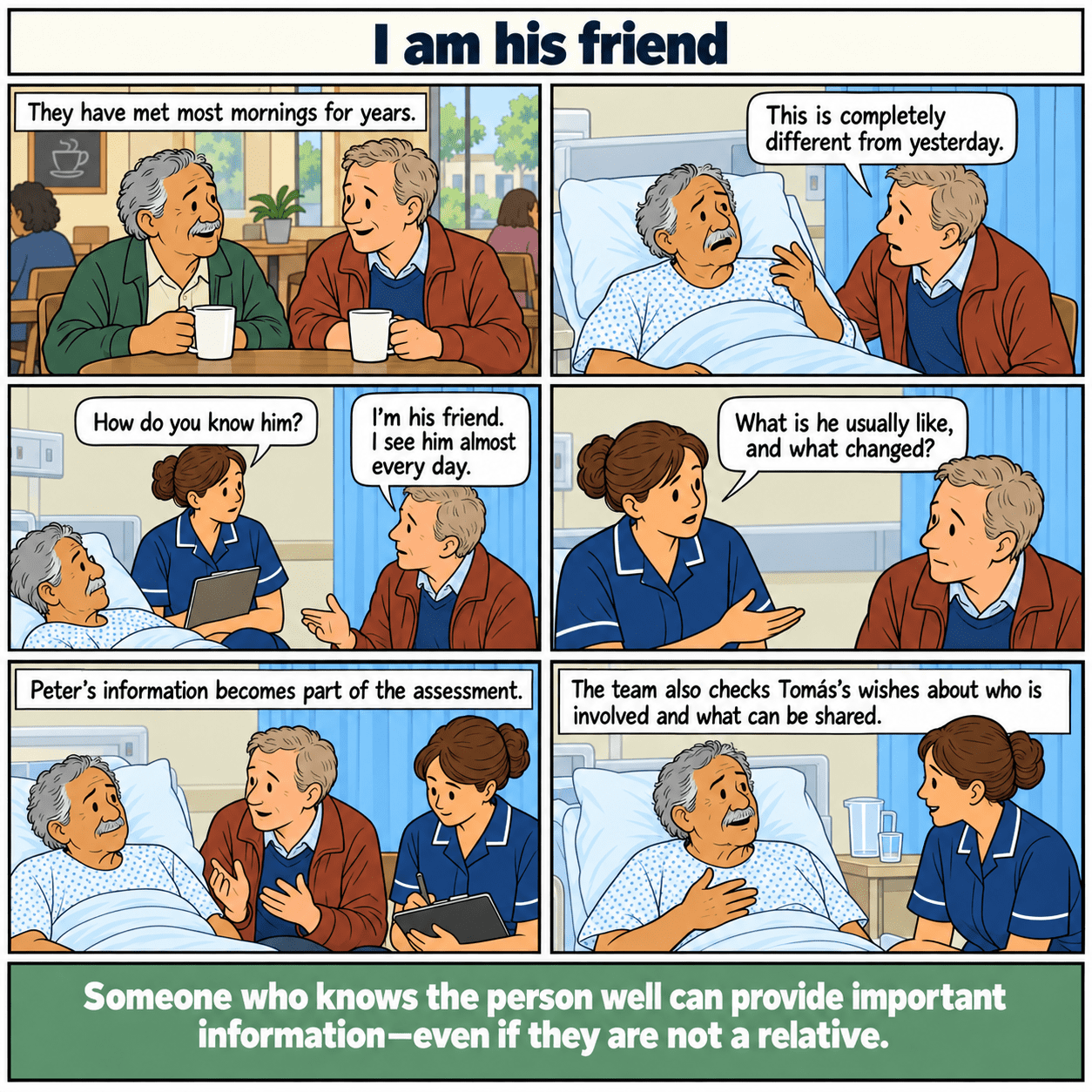
How a friend can help staff recognise delirium
Peter knows Tomás through years of daily contact. When Tomás becomes acutely confused, Peter can describe his usual abilities and the new change. Useful information is not limited to biological relatives. Staff can listen while respecting the person’s wishes and the rules about sharing confidential information.
Story text
Panel 1. They have met most mornings for years.
Panel 2.
- Peter: This is completely different from yesterday.
Panel 3.
- Nurse: How do you know him?
- Peter: I’m his friend. I see him almost every day.
Panel 4.
- Nurse: What is he usually like, and what changed?
Panel 5. Peter’s information becomes part of the assessment.
Panel 6. The team also checks Tomás’s wishes about who is involved and what can be shared.
Bottom band. Someone who knows the person well can provide important information—even if they are not a relative.
Story C37 · Example case
The conversation moved without me
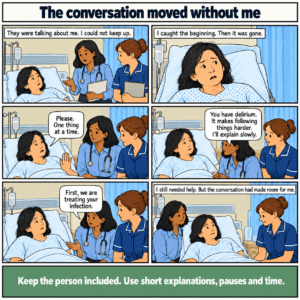
Read story C37: The conversation moved without me (image and text)
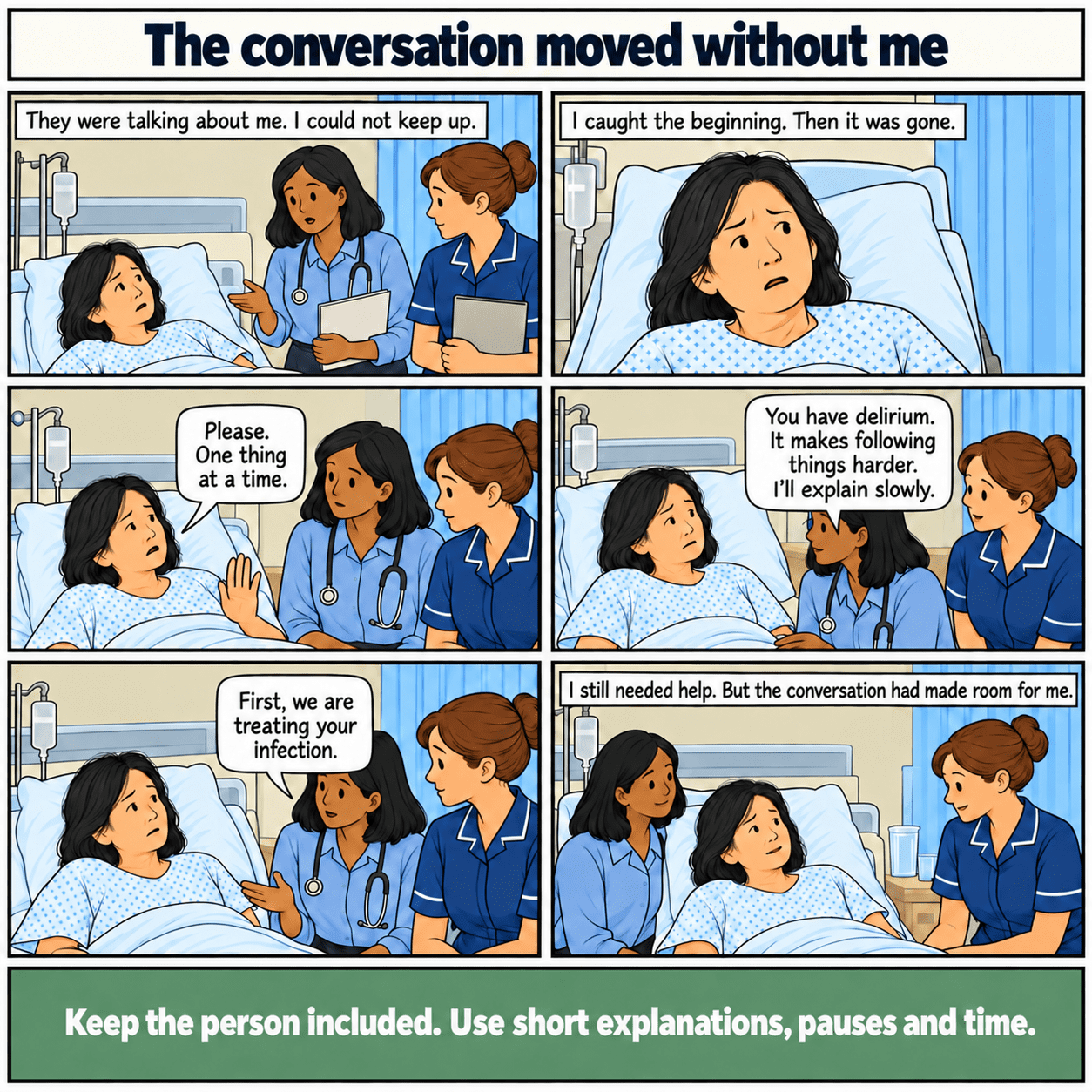
What delirium can feel like: difficulty following a ward-round conversation
Mina hears people speaking but can’t keep hold of the meaning. When staff slow down, speak one at a time and explain a single next step, she can participate a little more. The story gives a patient’s perspective on inattention. It is not a promise that simplified language immediately restores understanding or decision-making.
Story text
Panel 1. They were talking about me. I could not keep up.
Panel 2. I caught the beginning. Then it was gone.
Panel 3.
- Mina: Please. One thing at a time.
Panel 4.
- Doctor: You have delirium. It makes following things harder. I’ll explain slowly.
Panel 5.
- Doctor: First, we are treating your infection.
Panel 6. I still needed help. But the conversation had made room for me.
Bottom band. Keep the person included. Use short explanations, pauses and time.
Story C39 · Example case
Ask me as well
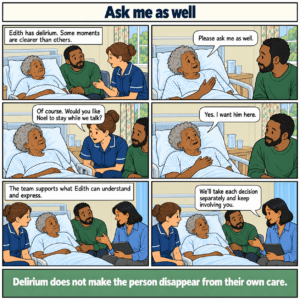
Read story C39: Ask me as well (image and text)
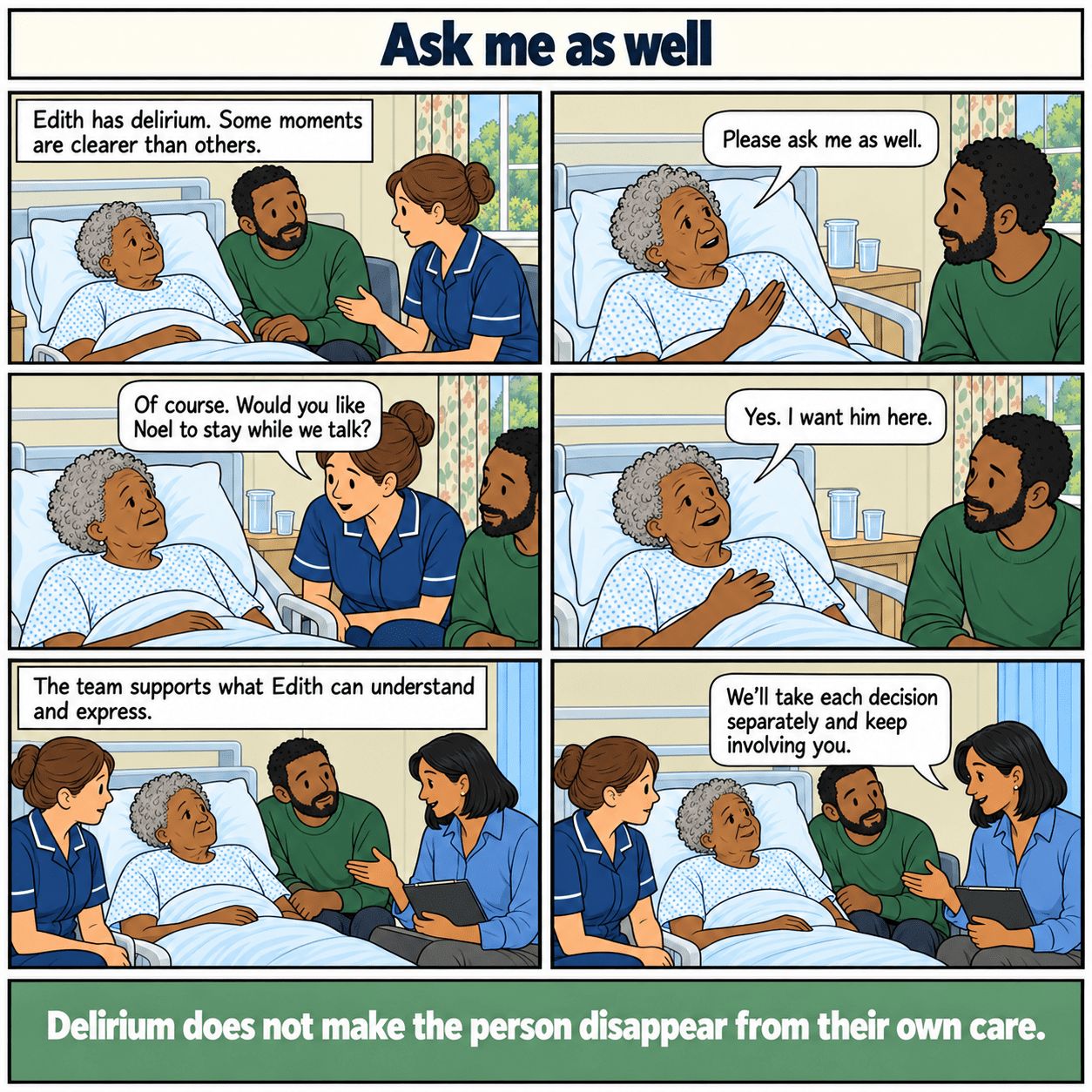
Including a person with delirium in choices about their care
Edith’s family and staff are discussing her care when she asks to be included. The team slows down and starts with a simple choice she can express. Delirium does not remove the person from the conversation. The help needed depends on the particular decision and the person’s ability at the time.
Story text
Panel 1. Edith has delirium. Some moments are clearer than others.
Panel 2.
- Edith: Please ask me as well.
Panel 3.
- Nurse: Of course. Would you like Noel to stay while we talk?
Panel 4.
- Edith: Yes. I want him here.
Panel 5. The team supports what Edith can understand and express.
Panel 6.
- Doctor: We’ll take each decision separately and keep involving you.
Bottom band. Delirium does not make the person disappear from their own care.
Story C40 · Example case
A long way from home
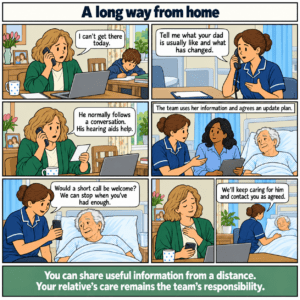
Read story C40: A long way from home (image and text)
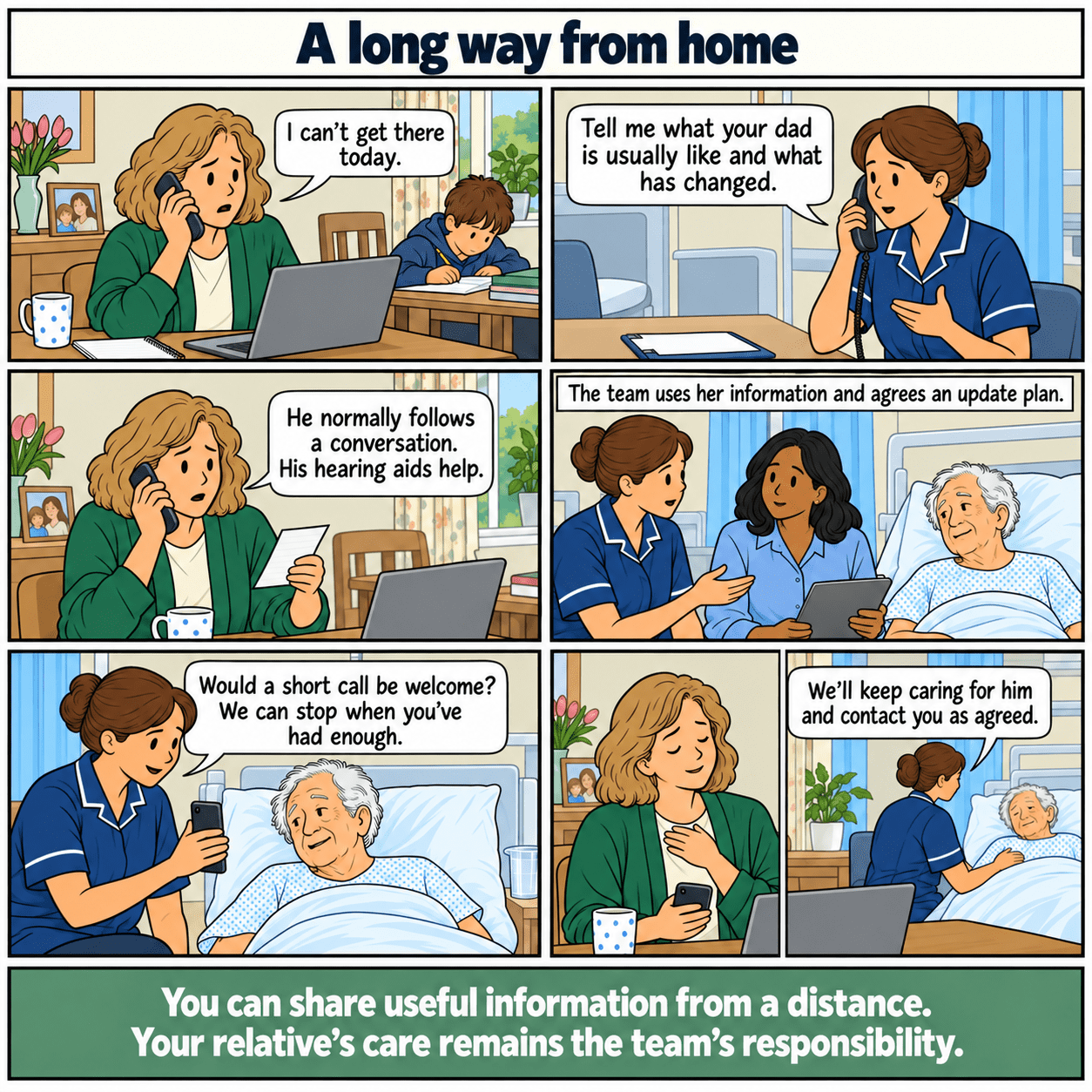
Supporting someone with delirium when visiting is difficult
Mia can’t reach the hospital immediately. By phone, she tells the nurse what Carlo is usually like, what changed and what helps him communicate. They agree a manageable update plan. A short call with Carlo is offered only if it suits him. His clinical care does not depend on someone from the family being at the bedside.
Story text
Panel 1.
- Mia: I can’t get there today.
Panel 2.
- Nurse: Tell me what your dad is usually like and what has changed.
Panel 3.
- Mia: He normally follows a conversation. His hearing aids help.
Panel 4. The team uses her information and agrees an update plan.
Panel 5.
- Nurse: Would a short call be welcome? We can stop when you’ve had enough.
Panel 6.
- Nurse: We’ll keep caring for him and contact you as agreed.
Bottom band. You can share useful information from a distance. Your relative’s care remains the team’s responsibility.
Story C41 · Example case
Sent home too soon
Read story C41: Sent home too soon (image and text)
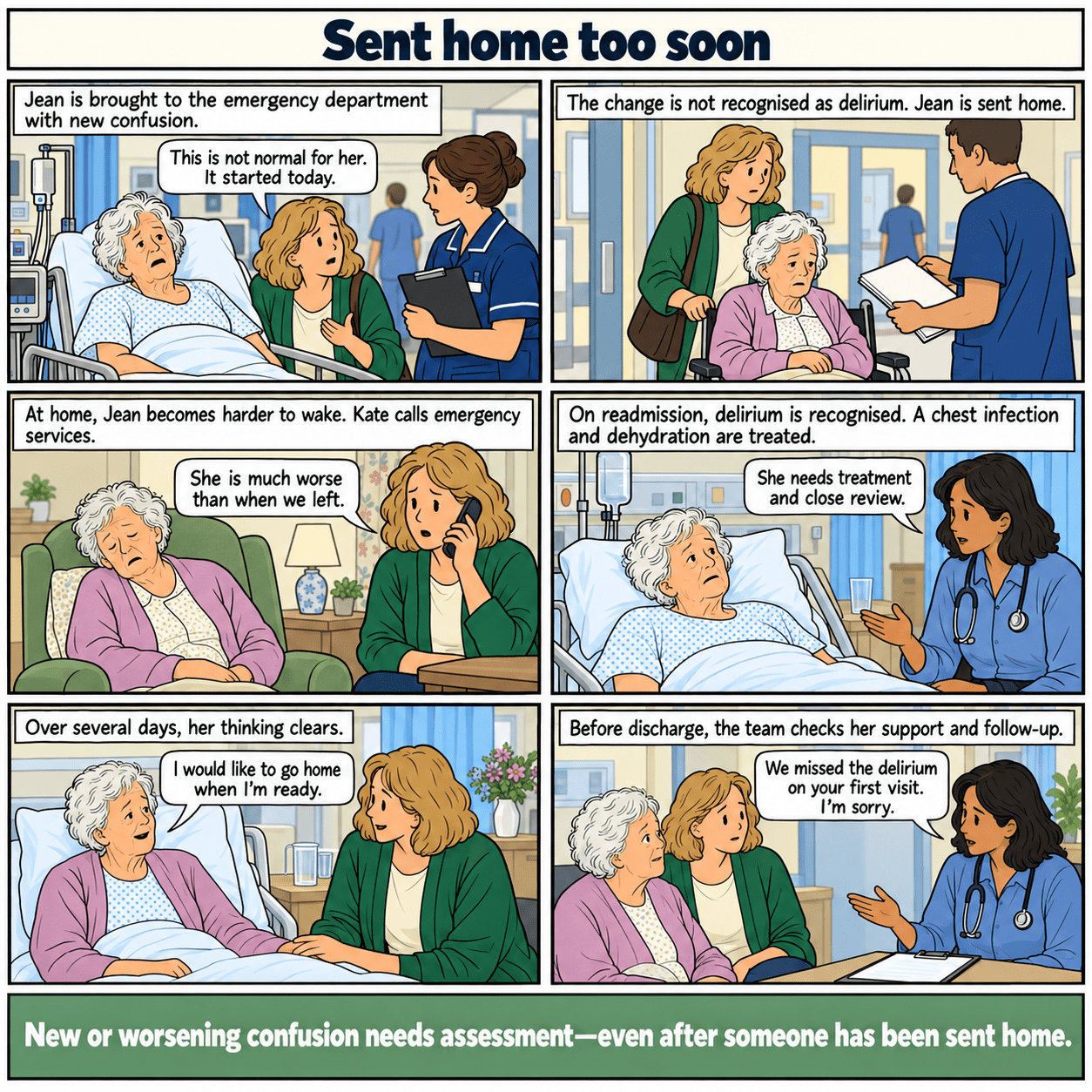
Sent home too soon
Jean is suddenly confused, but the change is not recognised as delirium when she first attends hospital. After discharge she becomes more unwell. Her daughter seeks urgent help; on her return, the team recognises delirium and treats the contributing illness. The missed assessment is acknowledged before a safer discharge.
Story text
Panel 1. Jean is brought to the emergency department with new confusion.
- Kate: This is not normal for her. It started today.
Panel 2. The change is not recognised as delirium. Jean is sent home.
Panel 3. At home, Jean becomes harder to wake. Kate calls emergency services.
- Kate: She is much worse than when we left.
Panel 4. On readmission, delirium is recognised. A chest infection and dehydration are treated.
- Doctor: She needs treatment and close review.
Panel 5. Over several days, her thinking clears.
- Jean: I would like to go home when I’m ready.
Panel 6. Before discharge, the team checks her support and follow-up.
- Doctor: We missed the delirium on your first visit. I’m sorry.
Bottom band. New or worsening confusion needs assessment—even after someone has been sent home.
Story D10 · Example case
I'm going home
Read story D10: I'm going home (image and text)
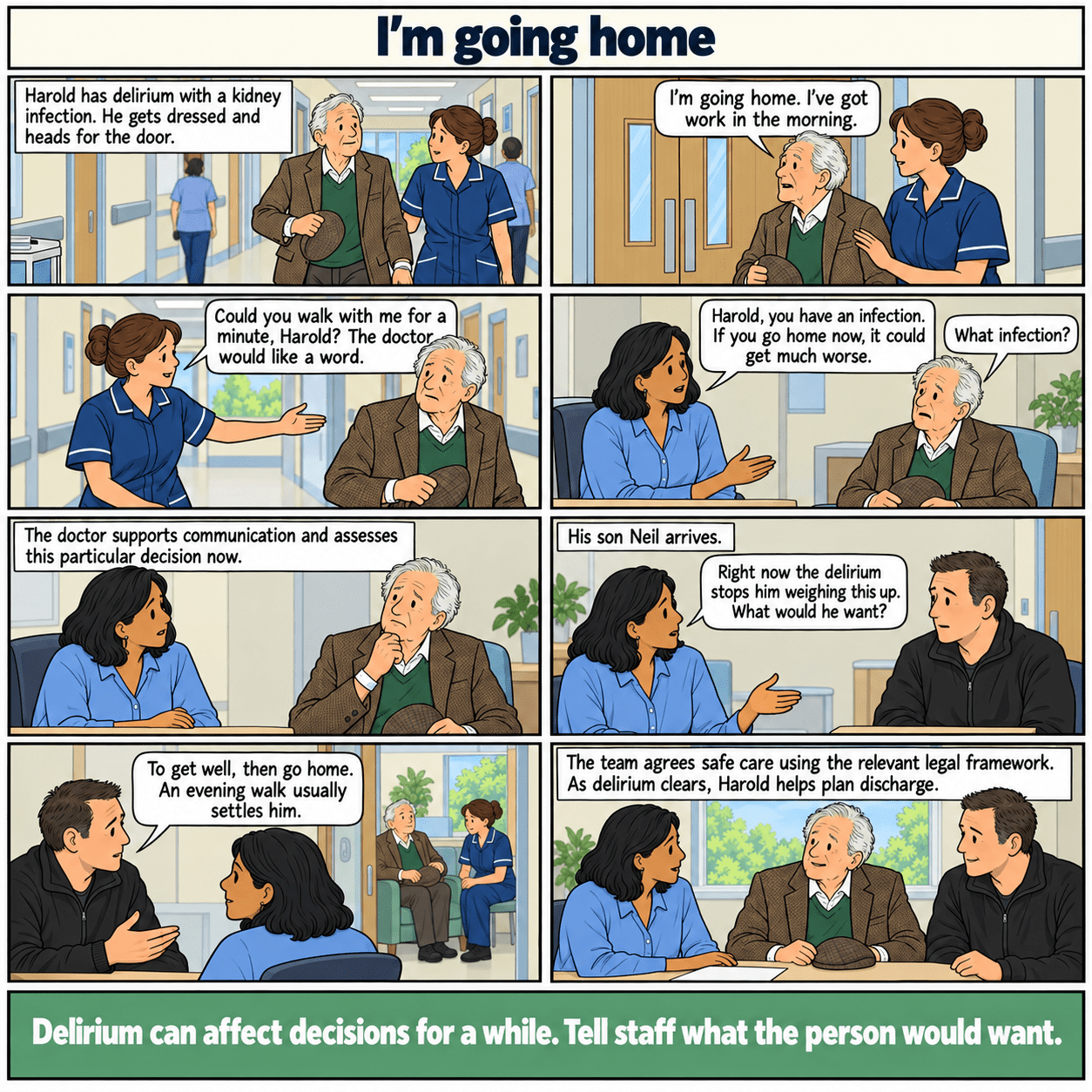
I'm going home
Harold wants to leave hospital while delirium affects his understanding of the illness. The team supports communication and assesses this particular decision at that time.
Delirium does not automatically remove someone’s ability to make every decision. Staff should keep the person involved, consider whether a decision can wait and use the relevant local legal framework. Where a decision is needed on the person’s behalf, their wishes and the least restrictive appropriate option should guide the plan. Tell staff about any relevant legal representative.
Story text
Panel 1. Harold has delirium with a kidney infection. He gets dressed and heads for the door.
Panel 2.
- Harold: I'm going home. I've got work in the morning.
Panel 3.
- Nurse: Could you walk with me for a minute, Harold? The doctor would like a word.
Panel 4.
- Doctor: Harold, you have an infection. If you go home now, it could get much worse.
- Harold: What infection?
Panel 5. The doctor supports communication and assesses this particular decision now.
Panel 6. His son Neil arrives.
- Doctor: Right now the delirium stops him weighing this up. What would he want?
Panel 7.
- Neil: To get well, then go home. An evening walk usually settles him.
Panel 8. The team agrees safe care using the relevant legal framework. As delirium clears, Harold helps plan discharge.
Bottom band. Delirium can affect decisions for a while. Tell staff what the person would want.
Story D11 · Example case
Not his usual illness
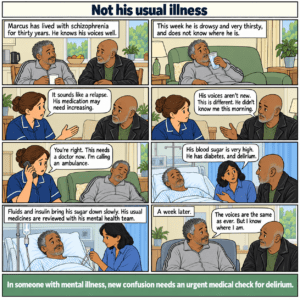
Read story D11: Not his usual illness (image and text)
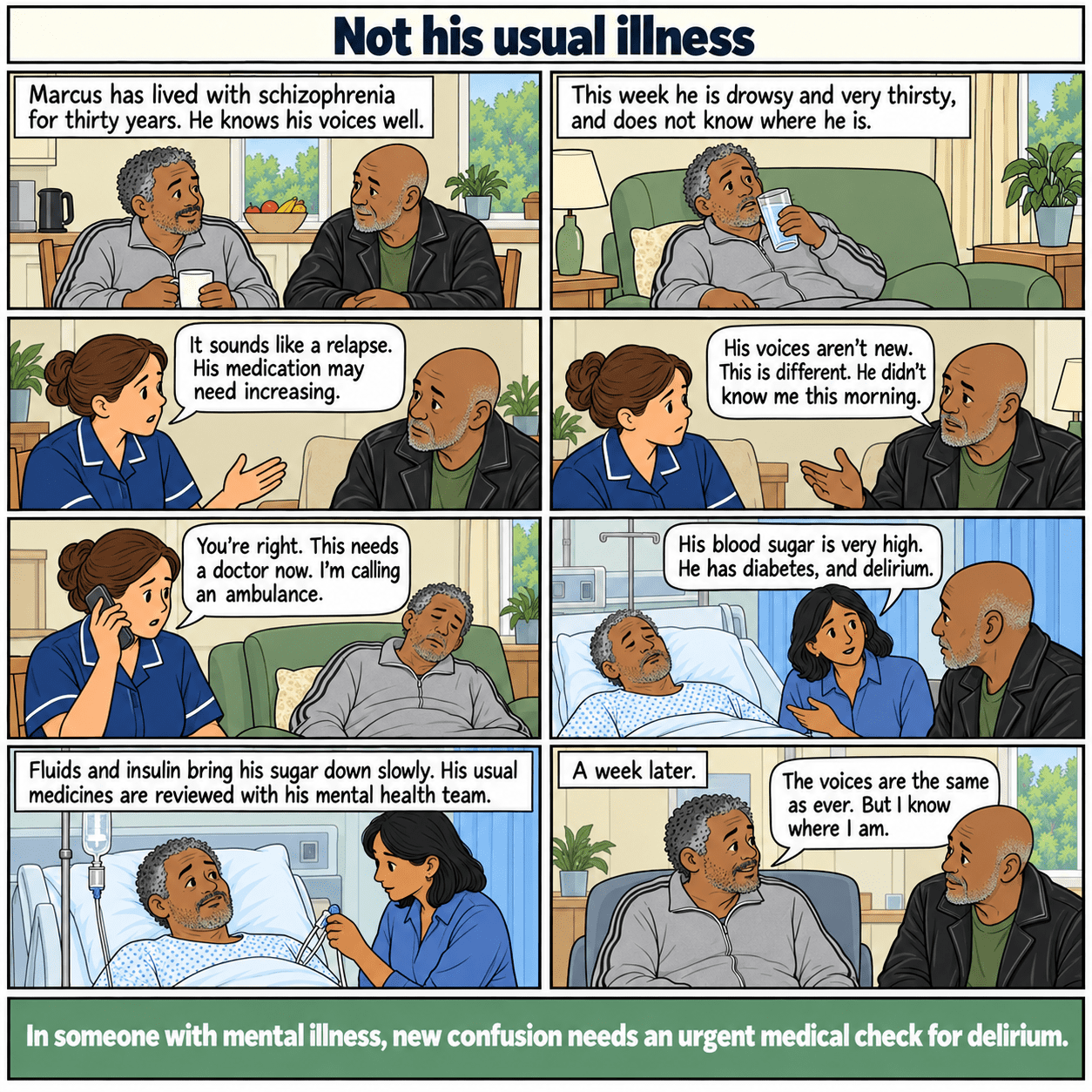
Not his usual illness
Marcus has longstanding schizophrenia. New thirst, drowsiness and disorientation are different from his usual experiences. Urgent physical assessment finds very high blood sugar and delirium.
A person with a mental illness can develop delirium from a physical illness. Describe what is new, when it began and what the person is normally like. Sudden confusion or reduced responsiveness needs urgent medical help. The physical and mental health teams should coordinate care, including a review of regular medicines.
Story text
Panel 1. Marcus has lived with schizophrenia for thirty years. He knows his voices well.
Panel 2. This week he is drowsy and very thirsty, and does not know where he is.
Panel 3.
- Mental health nurse: It sounds like a relapse. His medication may need increasing.
Panel 4.
- Leon: His voices aren't new. This is different. He didn't know me this morning.
Panel 5.
- Mental health nurse: You're right. This needs a doctor now. I'm calling an ambulance.
Panel 6.
- Doctor: His blood sugar is very high. He has diabetes, and delirium.
Panel 7. Fluids and insulin bring his sugar down slowly. His usual medicines are reviewed with his mental health team.
Panel 8. A week later.
- Marcus: The voices are the same as ever. But I know where I am.
Bottom band. In someone with mental illness, new confusion needs an urgent medical check for delirium.
Story D14 · Example case
This time we knew
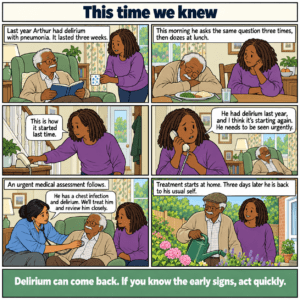
Read story D14: This time we knew (image and text)
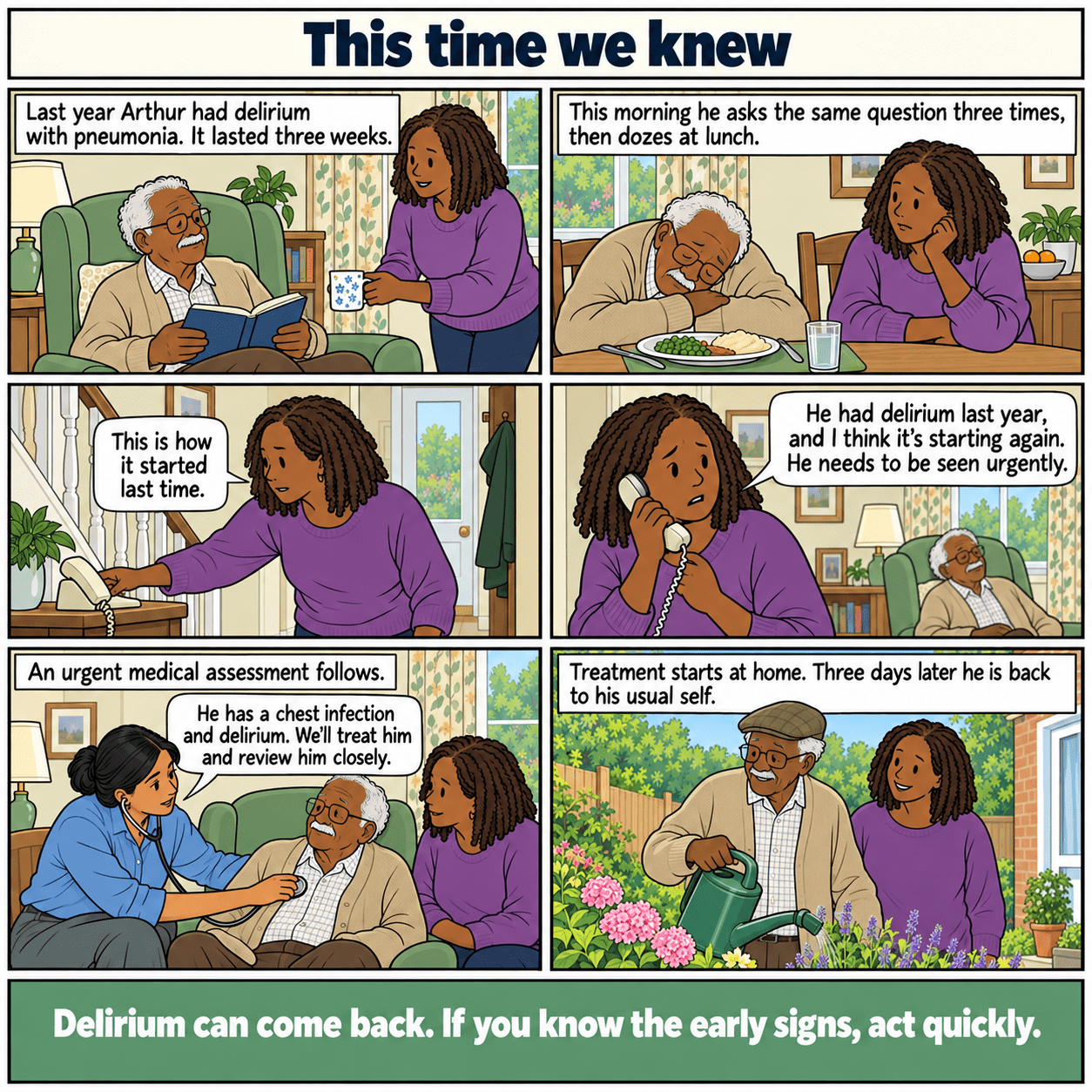
This time we knew
Wendy recognises a change like the start of her father’s previous delirium. She seeks urgent help and explains both the new symptoms and the earlier episode.
Having had delirium before is useful information for the treating team. A new episode still needs assessment for its causes. Tell staff what changed and when, even if the person seems better for part of the day. This example improves after treatment; early recognition does not guarantee a short or uncomplicated recovery.
Story text
Panel 1. Last year Arthur had delirium with pneumonia. It lasted three weeks.
Panel 2. This morning he asks the same question three times, then dozes at lunch.
Panel 3.
- Wendy: This is how it started last time.
Panel 4.
- Wendy: He had delirium last year, and I think it's starting again. He needs to be seen urgently.
Panel 5. An urgent medical assessment follows.
- GP: He has a chest infection and delirium. We’ll treat him and review him closely.
Panel 6. Treatment starts at home. Three days later he is back to his usual self.
Bottom band. Delirium can come back. If you know the early signs, act quickly.
Care and causes
Story A05
Glasses, hearing aids, teeth, water
Read story A05: Glasses, hearing aids, teeth, water (image and text)
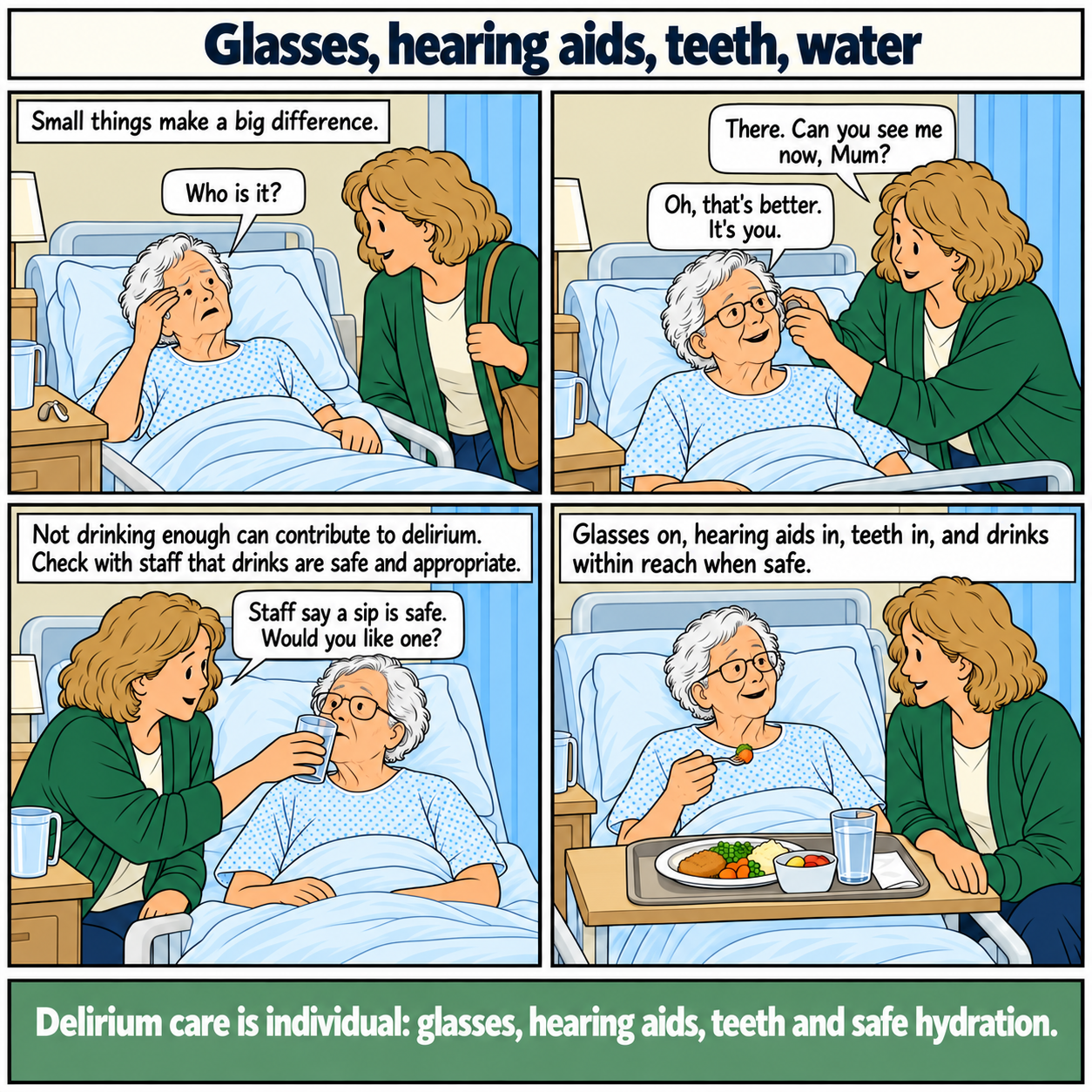
Glasses, hearing aids and dentures can help a person with delirium make sense of what is around them. Check that they are available, working and comfortable.
Drinking may also help when the person has too little fluid in their body, but first check with staff that drinks are safe and appropriate. Some people have swallowing difficulties or need their fluids limited. Offer rather than force, and follow the person’s care plan.
Story text
-
Panel 1. Small things make a big difference.
- Mum: Who is it?
-
Panel 2.
- Karen: There. Can you see me now, Mum?
- Mum: Oh, that’s better. It’s you.
-
Panel 3. Not drinking enough can contribute to delirium. Check with staff that drinks are safe and appropriate.
- Karen: Staff say a sip is safe. Would you like one?
-
Panel 4. Glasses on, hearing aids in, teeth in, and drinks within reach when safe.
Bottom band. Delirium care is individual: glasses, hearing aids, teeth and safe hydration.
Story B03
Several things at once
Read story B03: Several things at once (image and text)
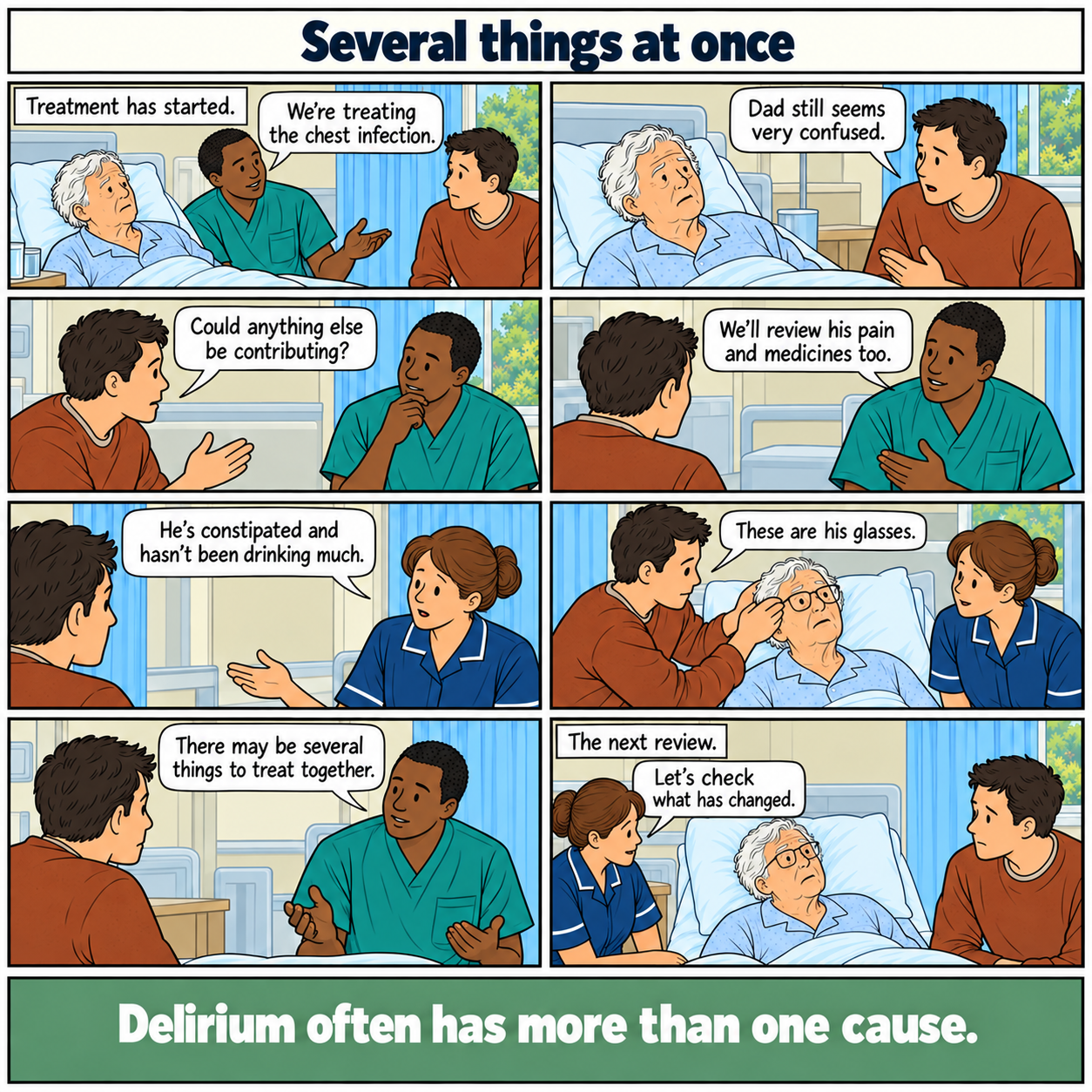
Finding one cause of delirium does not always explain everything. Infection, pain, medicines, difficulty passing stools and eating or drinking too little may contribute together.
If your relative remains confused, ask what the team is treating and what else has been checked. Share what you know about their usual medicines, eating, drinking and daily routine. Treatment and everyday care continue together, with further review as the person’s condition changes.
Story text
-
Panel 1. Treatment has started.
- Doctor: We’re treating the chest infection.
-
Panel 2.
- Liam: Dad still seems very confused.
-
Panel 3.
- Liam: Could anything else be contributing?
-
Panel 4.
- Doctor: We’ll review his pain and medicines too.
-
Panel 5.
- Nurse: He’s constipated and hasn’t been drinking much.
-
Panel 6.
- Liam: These are his glasses.
-
Panel 7.
- Doctor: There may be several things to treat together.
-
Panel 8. The next review.
- Nurse: Let’s check what has changed.
Bottom band. Delirium often has more than one cause.
Story B04
The person in this bed
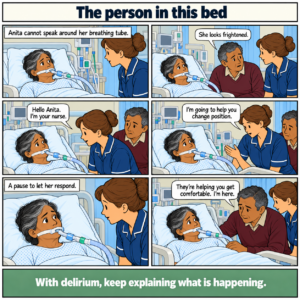
Read story B04: The person in this bed (image and text)
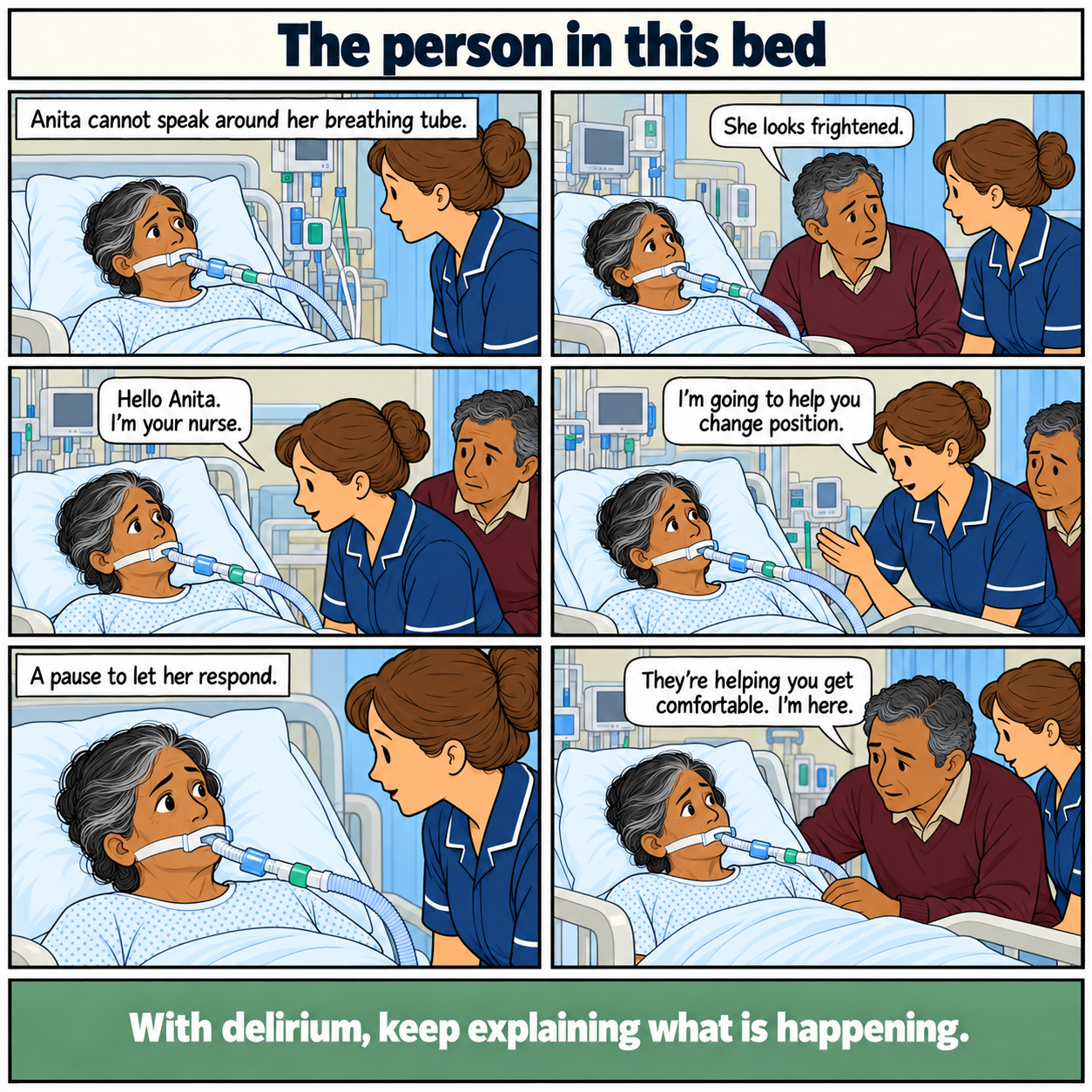
When someone has delirium, ordinary care may feel unfamiliar or frightening. Being unable to speak can make it harder to ask what is happening.
A short explanation, given directly to the person, can help. Staff can introduce themselves, explain the next step and allow time for a response. Families can share what usually helps communication. Keep including the person, even when their answers are limited or they can’t use words.
Story text
-
Panel 1. Anita cannot speak around her breathing tube.
-
Panel 2.
- Raj: She looks frightened.
-
Panel 3.
- Nurse: Hello Anita. I’m your nurse.
-
Panel 4.
- Nurse: I’m going to help you change position.
-
Panel 5. A pause to let her respond.
-
Panel 6.
- Raj: They’re helping you get comfortable. I’m here.
Bottom band. With delirium, keep explaining what is happening.
Story B07
A check without speaking
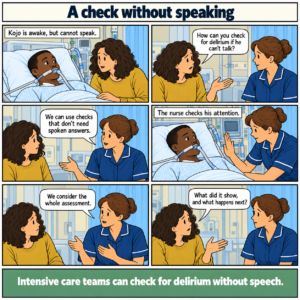
Read story B07: A check without speaking (image and text)
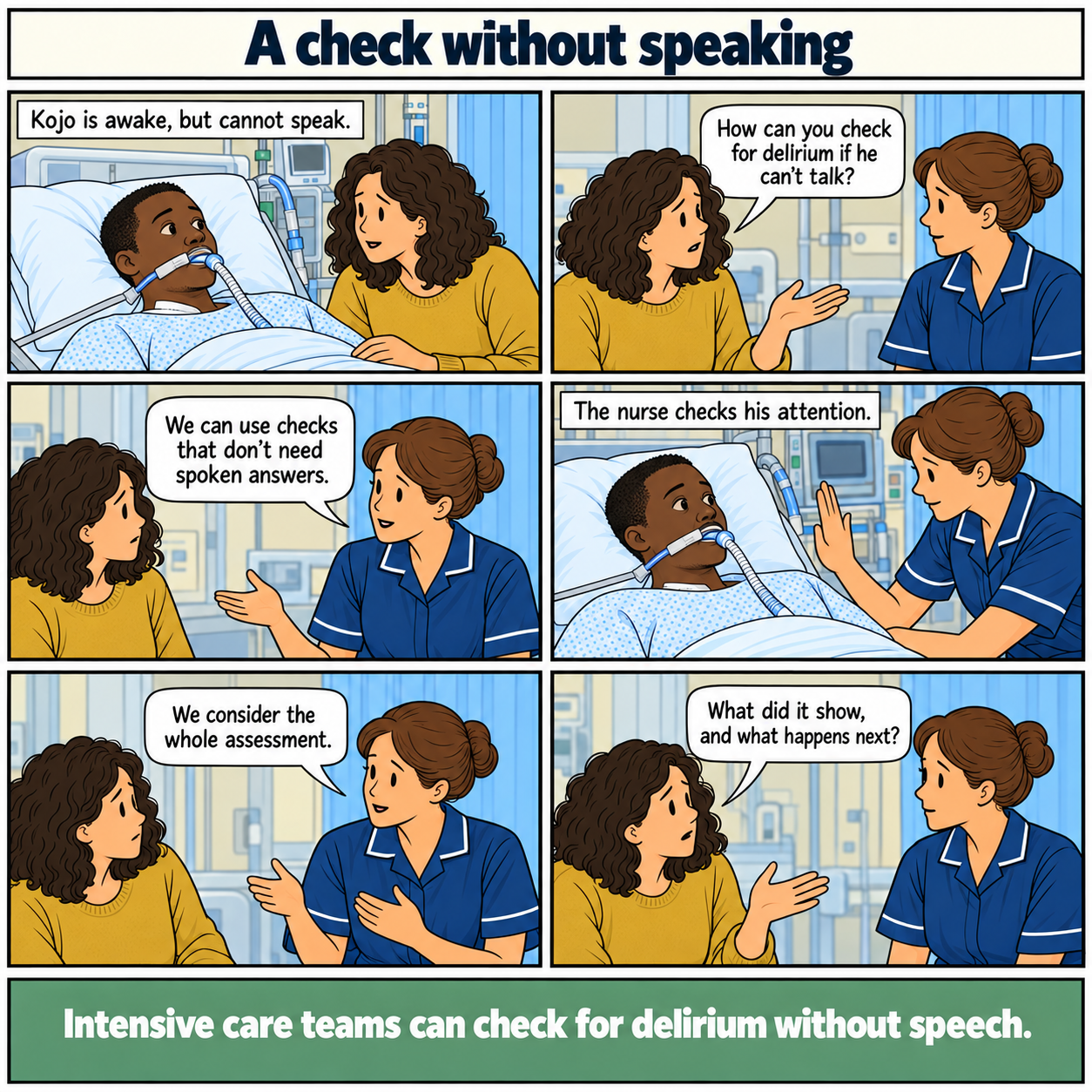
A breathing tube can stop someone speaking, but it does not prevent every assessment of delirium. Intensive care teams can use checks that do not need spoken answers when the person is awake enough.
You can ask what assessment was used, what it showed and what the team will do next. Information about the person’s usual thinking and communication is useful too. Being deeply sedated (made very sleepy by medicines) or in a coma (unconscious) is not the same as having delirium.
Story text
-
Panel 1. Kojo is awake, but cannot speak.
-
Panel 2.
- Emma: How can you check for delirium if he can’t talk?
-
Panel 3.
- Nurse: We can use checks that don’t need spoken answers.
-
Panel 4. The nurse checks his attention.
-
Panel 5.
- Nurse: We consider the whole assessment.
-
Panel 6.
- Emma: What did it show, and what happens next?
Bottom band. Intensive care teams can check for delirium without speech.
Story B08
Before the next sip
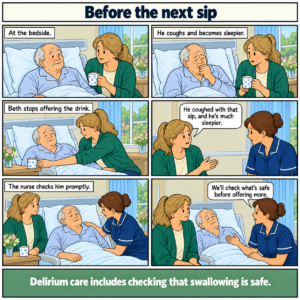
Read story B08: Before the next sip (image and text)
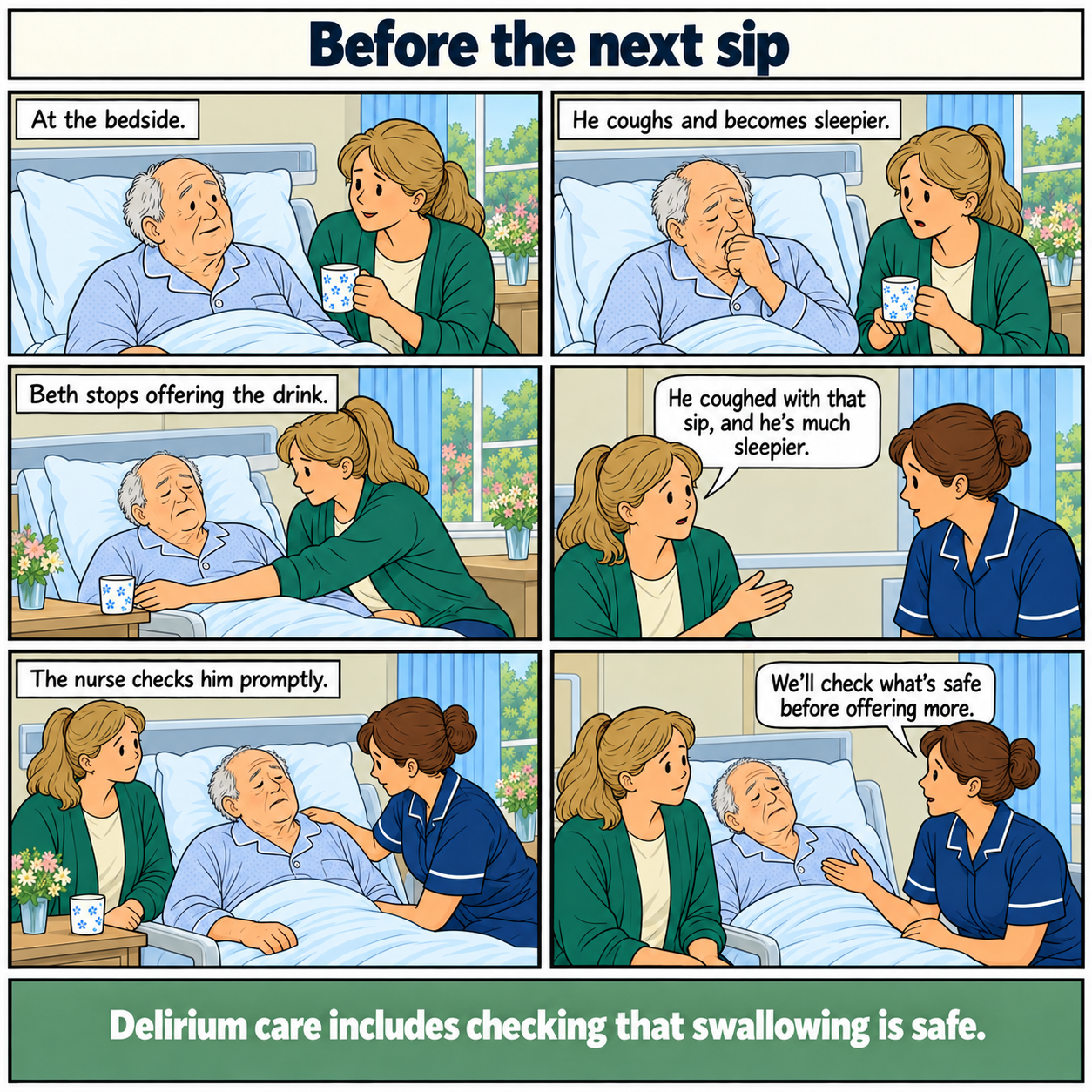
Delirium and the illness causing it can affect alertness and the ability to swallow safely. If your relative coughs with a drink, struggles to swallow or becomes much sleepier, stop offering that drink and tell staff promptly.
Ask how you can safely help with eating and drinking. The plan should fit the person’s current condition and may need to change. Do not force food or drink when someone can’t manage it.
Story text
-
Panel 1. At the bedside.
-
Panel 2. He coughs and becomes sleepier.
-
Panel 3. Beth stops offering the drink.
-
Panel 4.
- Beth: He coughed with that sip, and he’s much sleepier.
-
Panel 5. The nurse checks him promptly.
-
Panel 6.
- Nurse: We’ll check what’s safe before offering more.
Bottom band. Delirium care includes checking that swallowing is safe.
Story B10
Before the operation
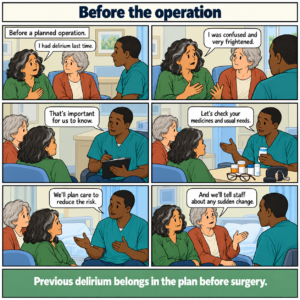
Read story B10: Before the operation (image and text)
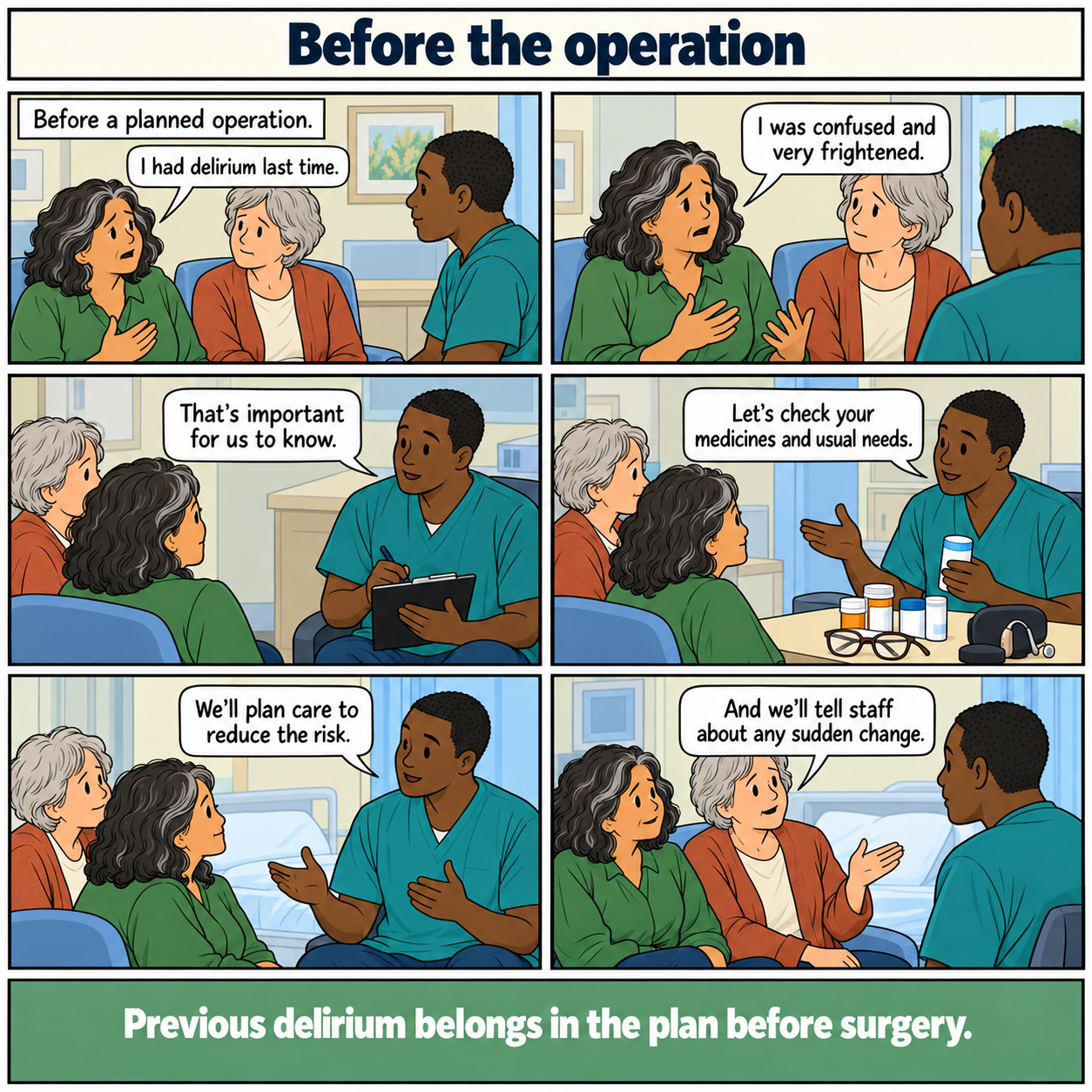
If you have had delirium before, tell the team before having an operation or going into hospital. Explain what happened and what you remember, including any distress.
Ask about the plan to reduce the risk, including medicines, pain relief, movement, sleep, glasses and hearing aids where needed. Prevention can’t guarantee that delirium will not happen. Knowing your usual abilities and recognising a new change promptly remain important parts of care.
Story text
-
Panel 1. Before a planned operation.
- Lucia: I had delirium last time.
-
Panel 2.
- Lucia: I was confused and very frightened.
-
Panel 3.
- Doctor: That’s important for us to know.
-
Panel 4.
- Doctor: Let’s check your medicines and usual needs.
-
Panel 5.
- Doctor: We’ll plan care to reduce the risk.
-
Panel 6.
- Elena: And we’ll tell staff about any sudden change.
Bottom band. Previous delirium belongs in the plan before surgery.
Story B11
What is the medicine for?
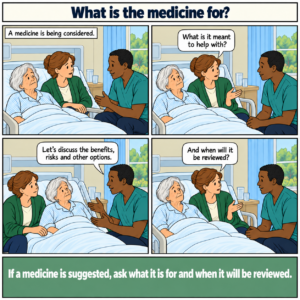
Read story B11: What is the medicine for? (image and text)
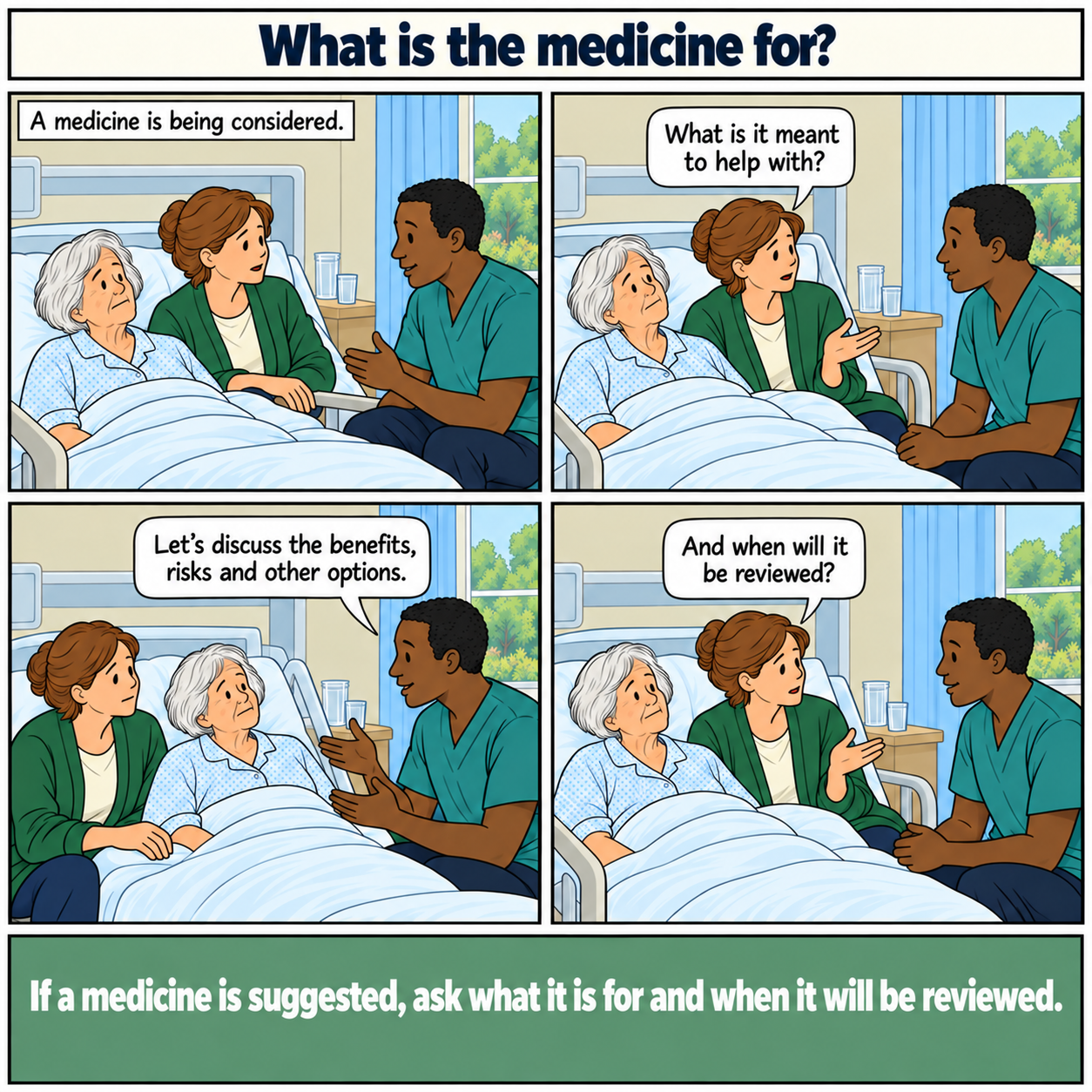
There are different reasons why medicines may be used when someone has delirium. A medicine may treat a cause of delirium, relieve pain, or be considered for particular distressing symptoms. Those are different aims.
Ask what the medicine is for, what benefit is expected, what the risks are for this person and when it will be reviewed. It is reasonable to ask about other ways of helping too. Changes should be agreed with the treating team.
Story text
-
Panel 1. A medicine is being considered.
-
Panel 2.
- Kate: What is it meant to help with?
-
Panel 3.
- Doctor: Let’s discuss the benefits, risks and other options.
-
Panel 4.
- Kate: And when will it be reviewed?
Bottom band. If a medicine is suggested, ask what it is for and when it will be reviewed.
Story B12
The chair beside the bed
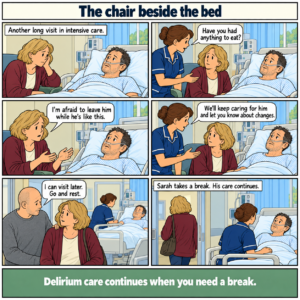
Read story B12: The chair beside the bed (image and text)
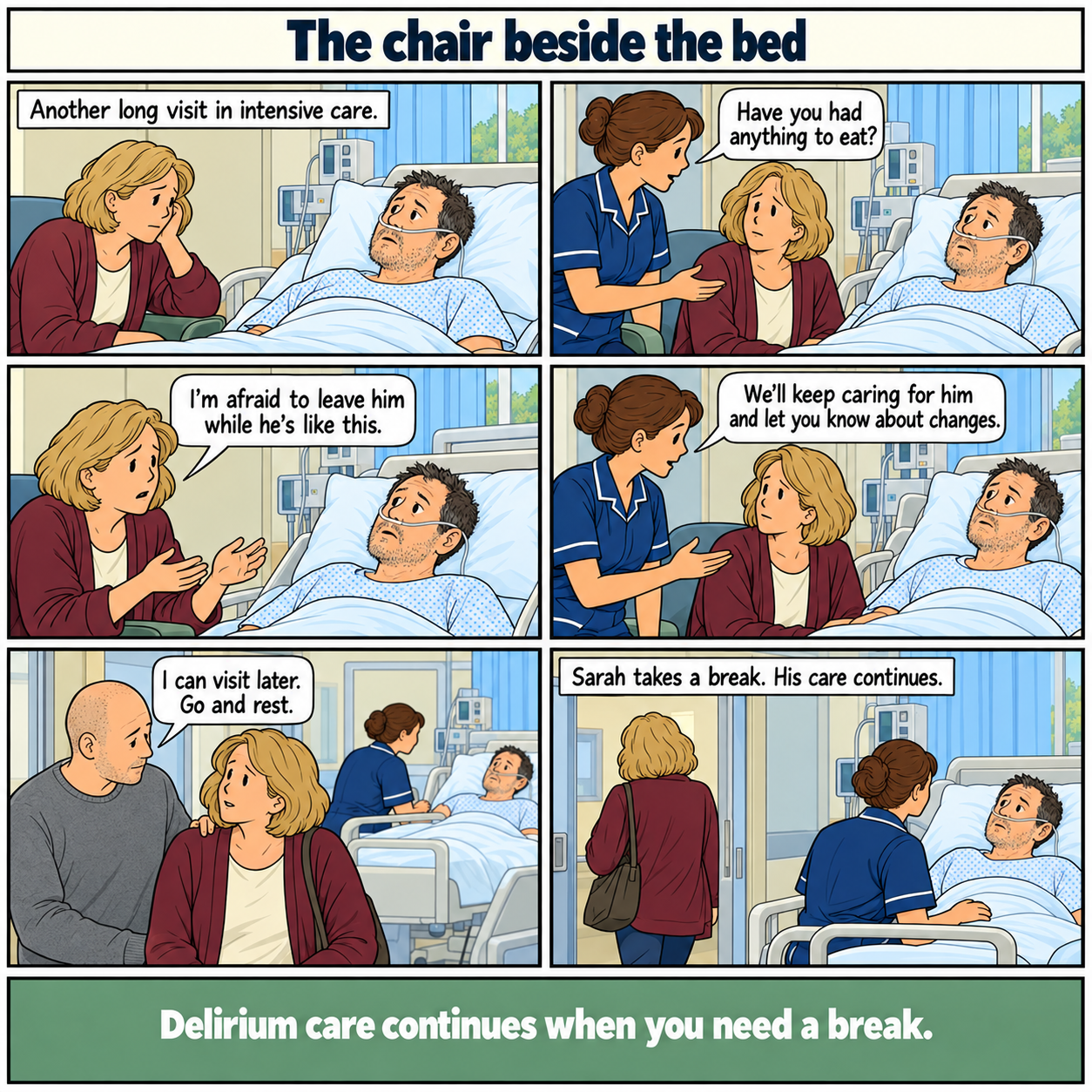
Being beside someone with delirium can be exhausting, especially during a long intensive care stay. You may feel guilty about leaving, even to eat or sleep.
Ask the team how they will keep you informed and how you can manage visits. Other relatives may be able to share visits, but not every family has that option. Taking a break does not mean you have stopped caring. Your relative’s care remains the team’s responsibility.
Story text
-
Panel 1. Another long visit in intensive care.
-
Panel 2.
- Nurse: Have you had anything to eat?
-
Panel 3.
- Sarah: I’m afraid to leave him while he’s like this.
-
Panel 4.
- Nurse: We’ll keep caring for him and let you know about changes.
-
Panel 5.
- David: I can visit later. Go and rest.
-
Panel 6. Sarah takes a break. His care continues.
Bottom band. Delirium care continues when you need a break.
Story B13
He knows this routine
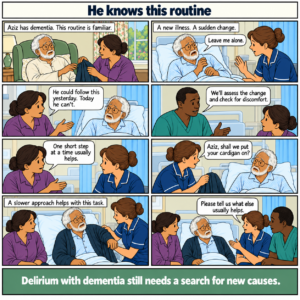
Read story B13: He knows this routine (image and text)
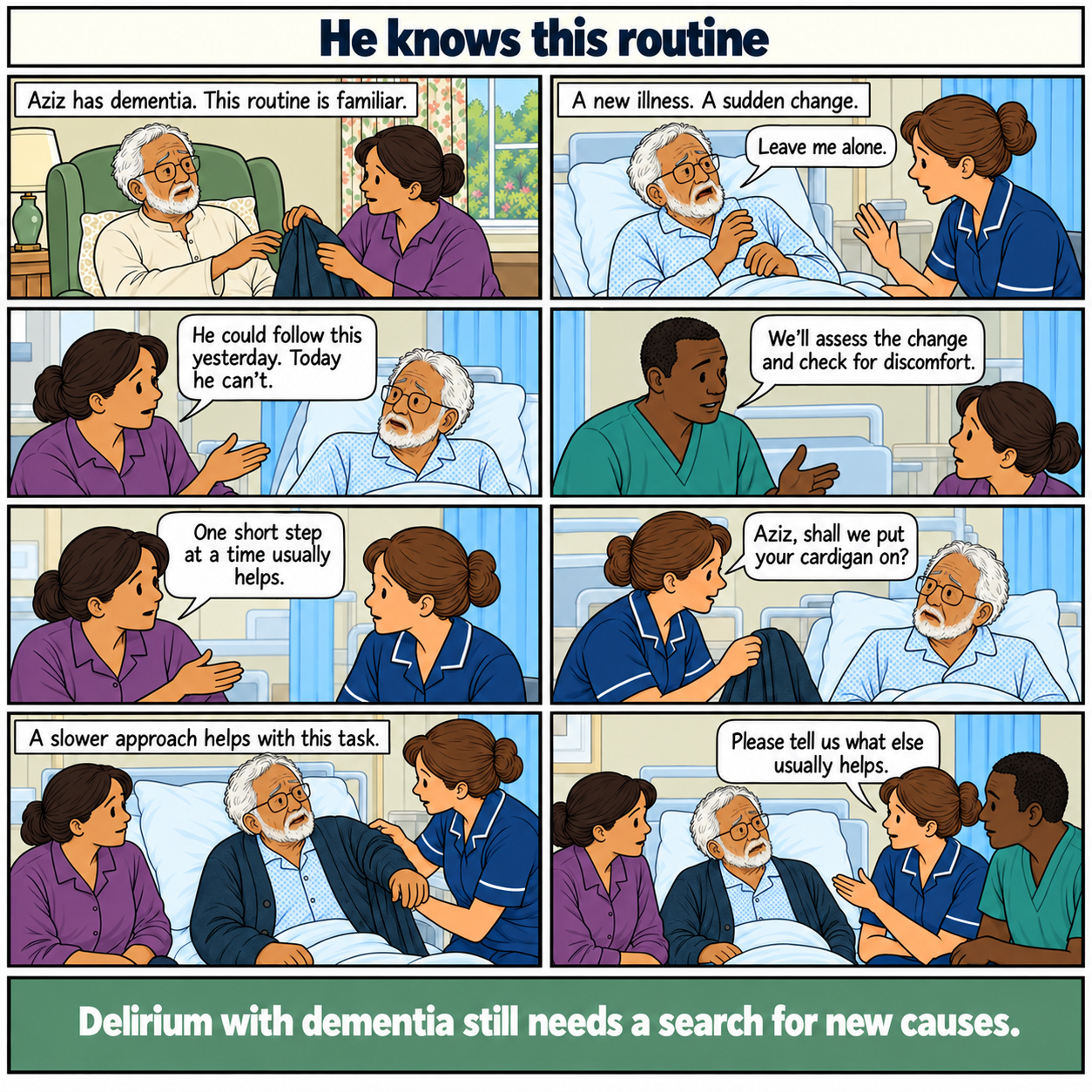
Delirium can occur in someone who already has dementia. A change from their usual abilities or behaviour still needs a doctor or nurse to check what is wrong.
Families often know small things that help: a familiar phrase, a slower pace, the order of a routine, or how the person shows pain. Share that knowledge with staff. It can help make care easier to understand while the team looks for and treats the new problems. A doctor or nurse still needs to check the person.
Story text
-
Panel 1. Aziz has dementia. This routine is familiar.
-
Panel 2. A new illness. A sudden change.
- Aziz: Leave me alone.
-
Panel 3.
- Farah: He could follow this yesterday. Today he can’t.
-
Panel 4.
- Doctor: We’ll assess the change and check for discomfort.
-
Panel 5.
- Farah: One short step at a time usually helps.
-
Panel 6.
- Nurse: Aziz, shall we put your cardigan on?
-
Panel 7. A slower approach helps with this task.
-
Panel 8.
- Nurse: Please tell us what else usually helps.
Bottom band. Delirium with dementia still needs a search for new causes.
Story B14
A room that feels unsafe
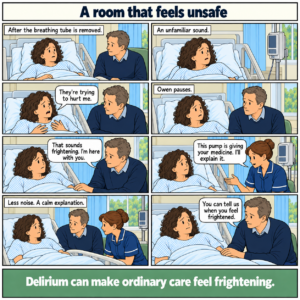
Read story B14: A room that feels unsafe (image and text)
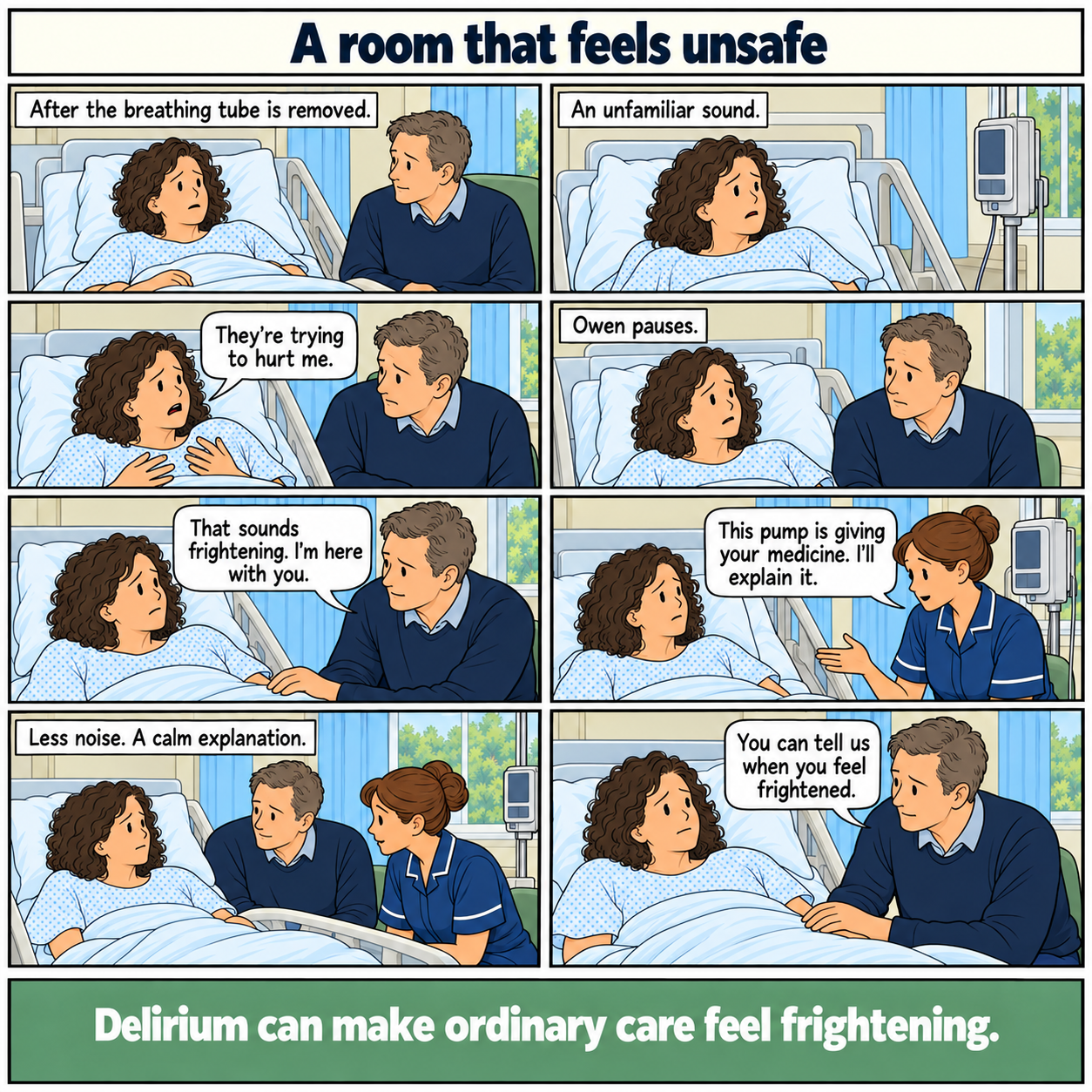
During delirium, a person may feel threatened by care that is intended to help them. The fear can feel completely real.
Listen to what they are experiencing and tell staff about their distress. A calm explanation and reassurance may help, while staff check for causes and provide treatment. Arguing is often unhelpful. At the same time, a concern about actual harm must still be taken seriously; having delirium does not mean that every report should be dismissed.
Story text
-
Panel 1. After the breathing tube is removed.
-
Panel 2. An unfamiliar sound.
-
Panel 3.
- Fiona: They’re trying to hurt me.
-
Panel 4. Owen pauses.
-
Panel 5.
- Owen: That sounds frightening. I’m here with you.
-
Panel 6.
- Nurse: This pump is giving your medicine. I’ll explain it.
-
Panel 7. Less noise. A calm explanation.
-
Panel 8.
- Owen: You can tell us when you feel frightened.
Bottom band. Delirium can make ordinary care feel frightening.
Story B18
The hospital bag
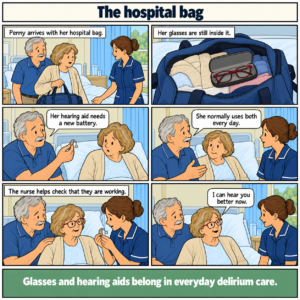
Read story B18: The hospital bag (image and text)
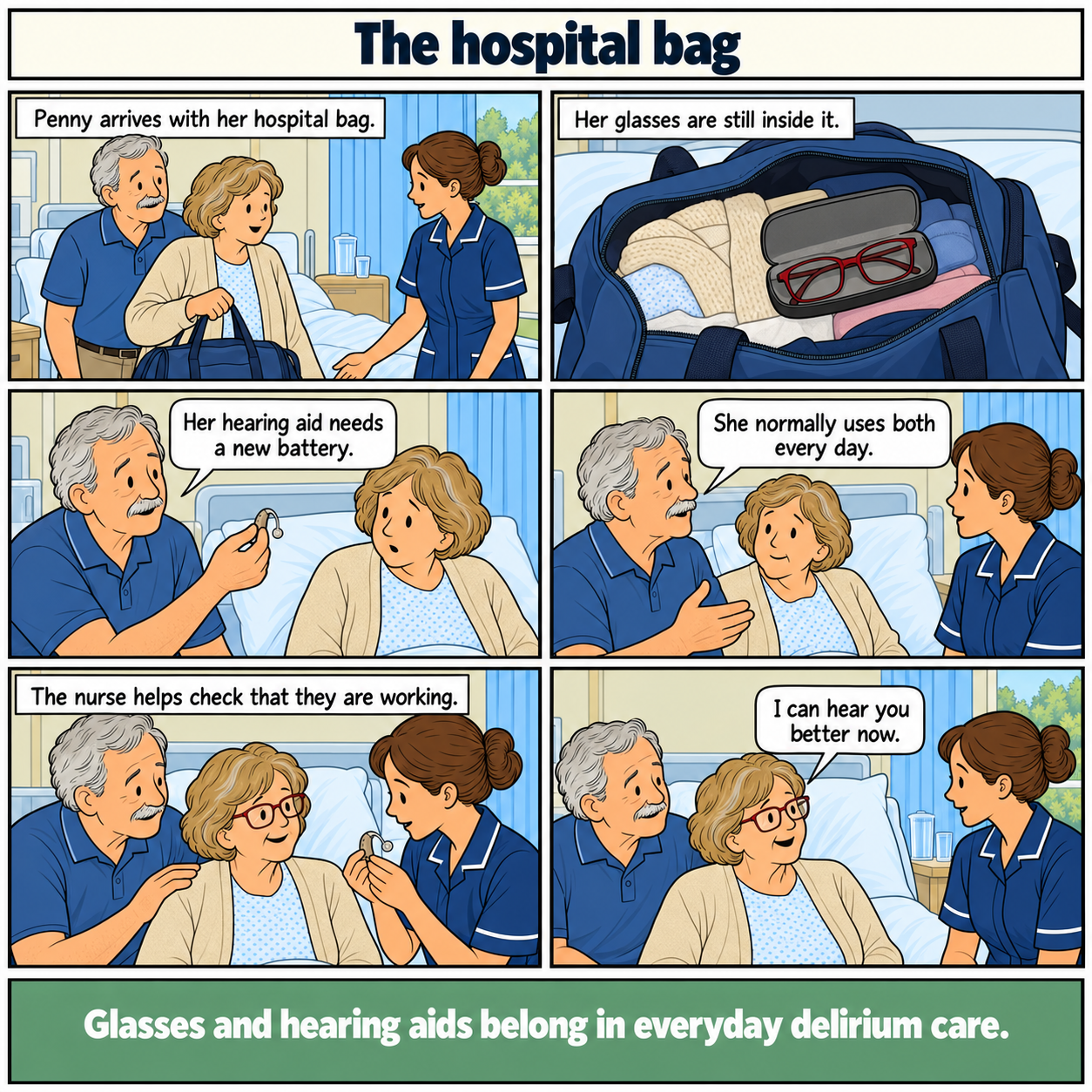
Glasses and hearing aids are easy to overlook when someone goes into hospital. Having them in a bag is not the same as being able to use them.
Tell staff what the person normally needs, check that aids are available and working, and ask for help if something is missing. Seeing and hearing more clearly help the person communicate and are part of delirium prevention and care. They are useful measures, but they do not replace staff checking and treating the illness.
Story text
-
Panel 1. Penny arrives with her hospital bag.
-
Panel 2. Her glasses are still inside it.
-
Panel 3.
- Rob: Her hearing aid needs a new battery.
-
Panel 4.
- Rob: She normally uses both every day.
-
Panel 5. The nurse helps check that they are working.
-
Panel 6.
- Penny: I can hear you better now.
Bottom band. Glasses and hearing aids belong in everyday delirium care.
Story B27
Different after the move
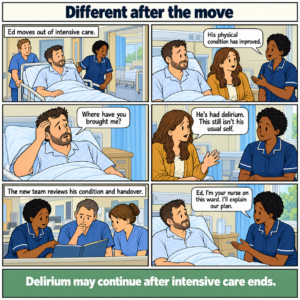
Read story B27: Different after the move (image and text)
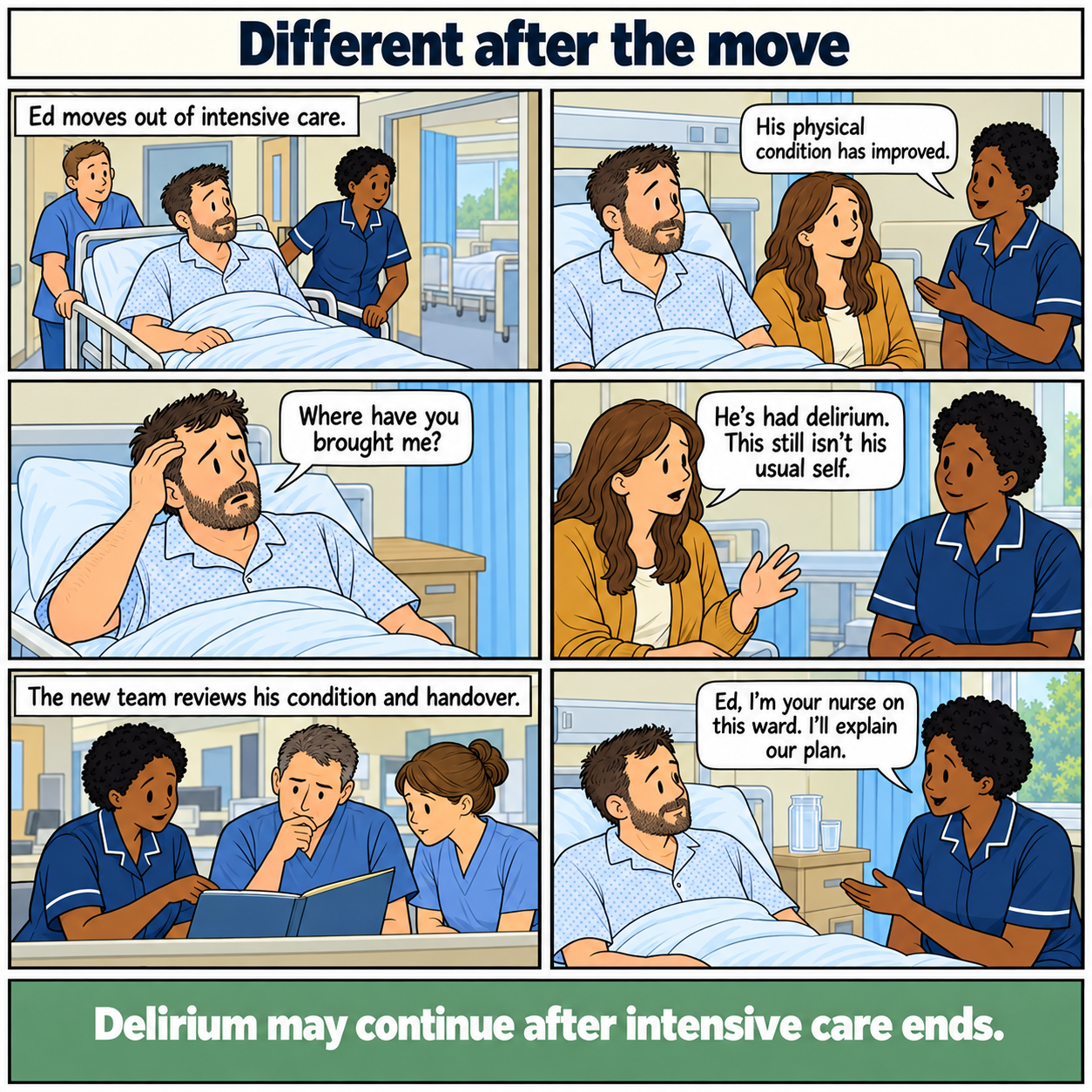
Leaving intensive care does not necessarily mean delirium has ended. A new ward may also feel unfamiliar.
Tell the new team about the delirium, the person’s usual abilities and what has helped communication or comfort. Ask whether the new team has received that information. Continuing confusion needs care, and any new worsening needs a prompt check by a doctor or nurse. A calm introduction and a clear explanation of the next stage can help.
Story text
-
Panel 1. Ed moves out of intensive care.
-
Panel 2.
- Nurse: His physical condition has improved.
-
Panel 3.
- Ed: Where have you brought me?
-
Panel 4.
- Lucy: He’s had delirium. This still isn’t his usual self.
-
Panel 5. The new team reviews his condition and handover.
-
Panel 6.
- Nurse: Ed, I’m your nurse on this ward. I’ll explain our plan.
Bottom band. Delirium may continue after intensive care ends.
Story B33
The tablets missing from the list
Read story B33: The tablets missing from the list (image and text)
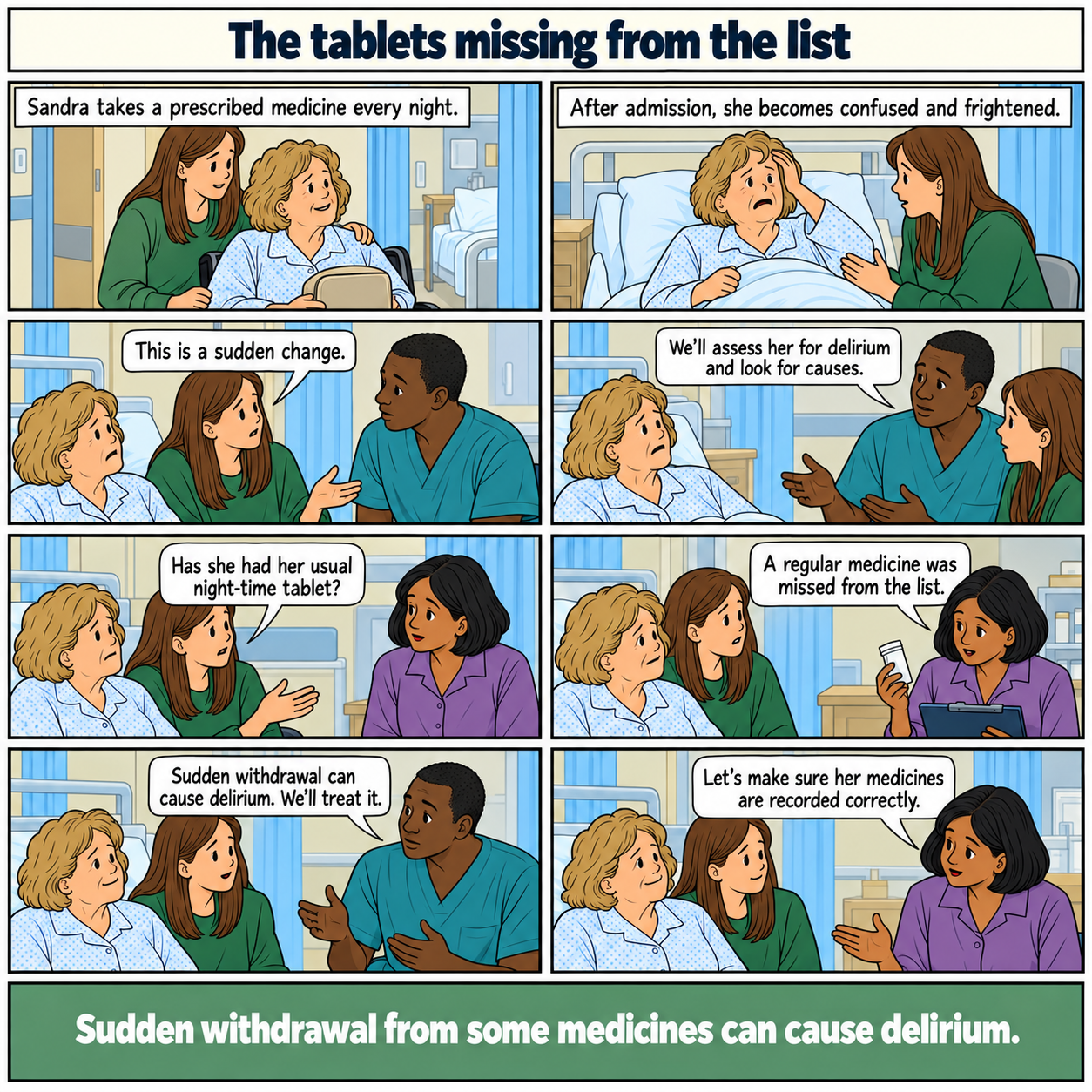
Stopping some prescribed medicines suddenly can cause serious withdrawal symptoms. These happen because the body has become used to the medicine. In this story, a regularly taken benzodiazepine, a type of medicine used for anxiety or sleep, was accidentally missed out when the person went into hospital.
An accurate medicines list and information from the family help the team identify the problem. Tell staff about regular medicines and recent changes. If sudden confusion develops, seek urgent medical help. Do not stop or restart medicines yourself to treat the confusion.
Story text
-
Panel 1. Sandra takes a prescribed medicine every night.
-
Panel 2. After admission, she becomes confused and frightened.
-
Panel 3.
- Holly: This is a sudden change.
-
Panel 4.
- Doctor: We’ll assess her for delirium and look for causes.
-
Panel 5.
- Holly: Has she had her usual night-time tablet?
-
Panel 6.
- Pharmacist: A regular medicine was missed from the list.
-
Panel 7.
- Doctor: Sudden withdrawal can cause delirium. We’ll treat it.
-
Panel 8.
- Pharmacist: Let’s make sure her medicines are recorded correctly.
Bottom band. Sudden withdrawal from some medicines can cause delirium.
Story B34
I thought stopping would help
Read story B34: I thought stopping would help (image and text)
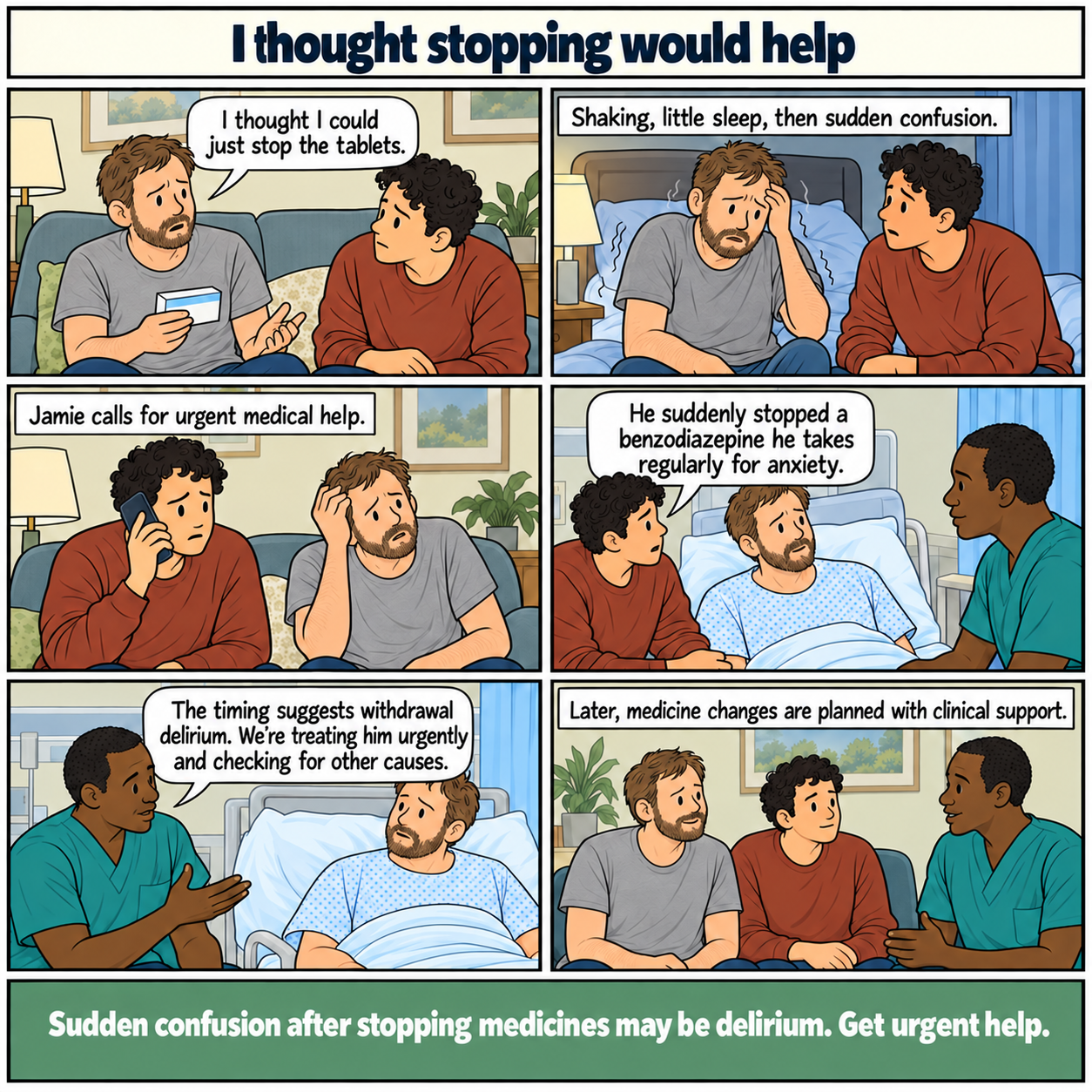
Benzodiazepines are medicines that may be used for anxiety or sleep. Stopping one suddenly after regular use can cause dangerous symptoms, including delirium. This can happen with prescribed use; the body becoming used to a medicine is not the same as addiction.
If someone becomes suddenly confused after a medicine change, get urgent medical help and explain what they have taken and when it changed. Do not try to manage delirium at home by adjusting the dose yourself. Planned reductions need advice and further checks suited to the person.
Story text
-
Panel 1.
- Ross: I thought I could just stop the tablets.
-
Panel 2. Shaking, little sleep, then sudden confusion.
-
Panel 3. Jamie calls for urgent medical help.
-
Panel 4.
- Jamie: He suddenly stopped a benzodiazepine he takes regularly for anxiety.
-
Panel 5.
- Doctor: The timing suggests withdrawal delirium. We’re treating him urgently and checking for other causes.
-
Panel 6. Later, medicine changes are planned with clinical support.
Bottom band. Sudden confusion after stopping medicines may be delirium. Get urgent help.
Story B35
Tell us what he usually drinks
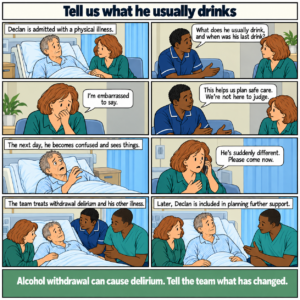
Read story B35: Tell us what he usually drinks (image and text)
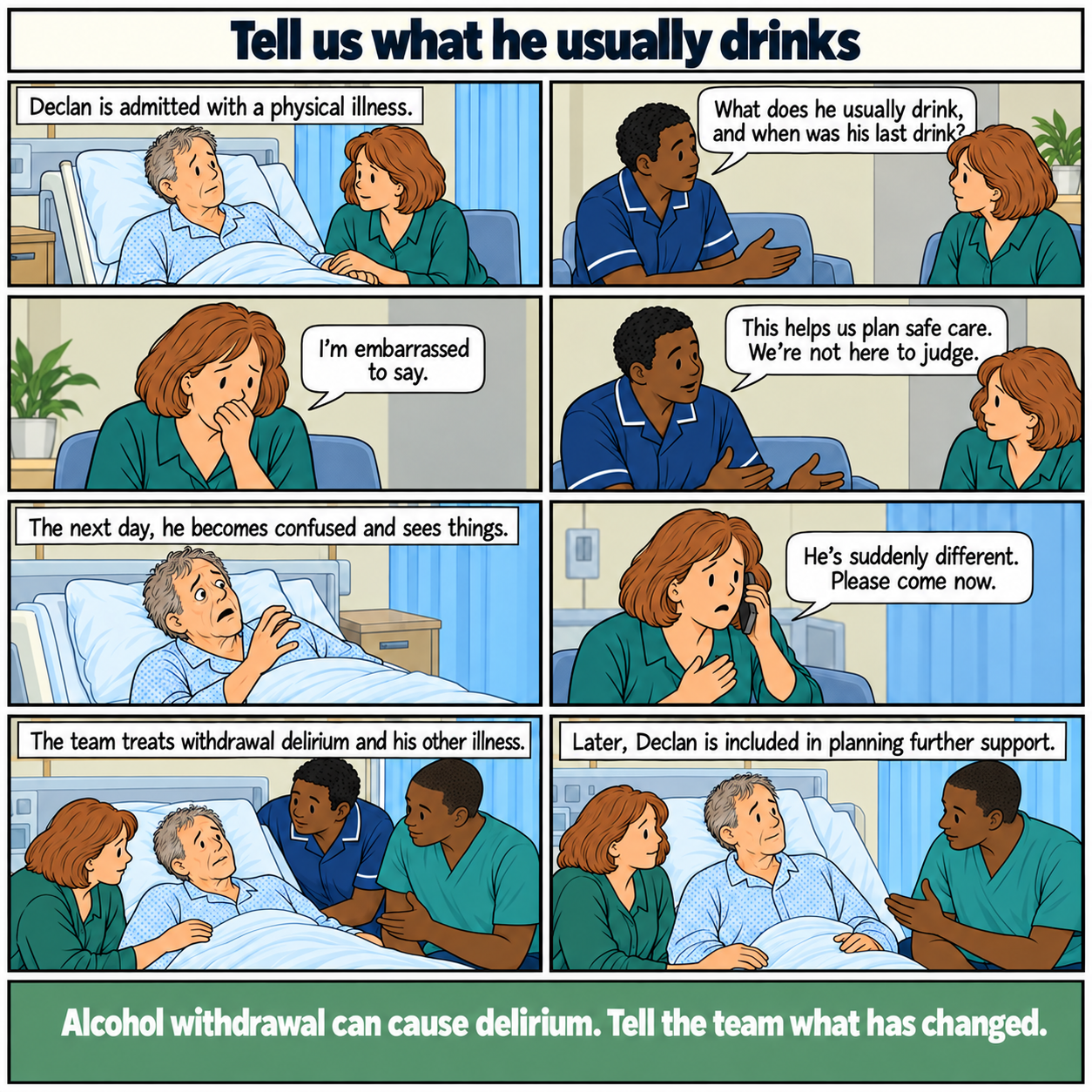
Stopping or sharply reducing alcohol after regular heavy drinking can cause withdrawal: symptoms that can include delirium. Alcohol withdrawal delirium needs urgent medical treatment. Staff need accurate information about usual drinking and when it last occurred, including when the person is in hospital with another illness.
It can feel difficult to talk about this. The purpose is safe care, not blame. Report new confusion, seeing or hearing things that are not there, or any other worsening promptly. Do not try to manage withdrawal delirium at home. The person should also be offered appropriate ongoing support when they are able to take part.
Story text
-
Panel 1. Declan is admitted with a physical illness.
-
Panel 2.
- Nurse: What does he usually drink, and when was his last drink?
-
Panel 3.
- Maureen: I’m embarrassed to say.
-
Panel 4.
- Nurse: This helps us plan safe care. We’re not here to judge.
-
Panel 5. The next day, he becomes confused and sees things.
-
Panel 6.
- Maureen: He’s suddenly different. Please come now.
-
Panel 7. The team treats withdrawal delirium and his other illness.
-
Panel 8. Later, Declan is included in planning further support.
Bottom band. Alcohol withdrawal can cause delirium. Tell the team what has changed.
Story B47
What changed overnight?
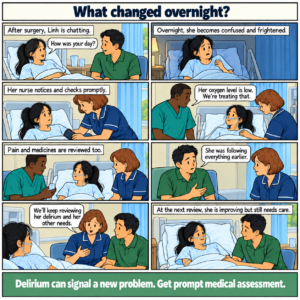
Read story B47: What changed overnight? (image and text)
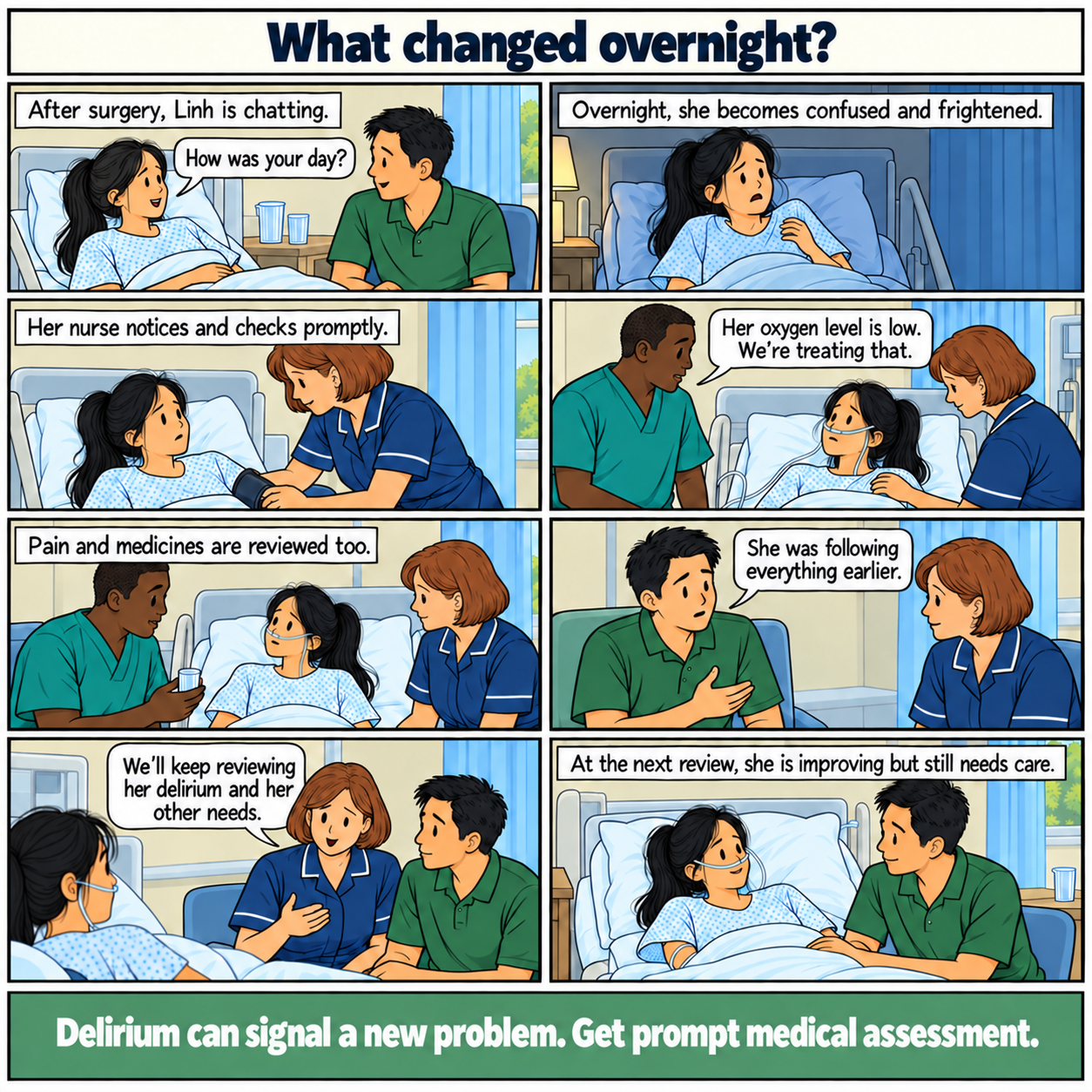
A new change after surgery can be a sign of a problem that needs a prompt check by a doctor or nurse. Good care includes noticing that change, checking for causes and keeping the person and their family informed.
In this illustrated story, staff identify low oxygen and also review pain and medicines. Delirium may have several causes, and improvement needs checking over time. Families can add useful information about what the person was like earlier and what seems different now.
Story text
-
Panel 1. After surgery, Linh is chatting.
- Linh: How was your day?
-
Panel 2. Overnight, she becomes confused and frightened.
-
Panel 3. Her nurse notices and checks promptly.
-
Panel 4.
- Doctor: Her oxygen level is low. We’re treating that.
-
Panel 5. Pain and medicines are reviewed too.
-
Panel 6.
- Minh: She was following everything earlier.
-
Panel 7.
- Nurse: We’ll keep reviewing her delirium and her other needs.
-
Panel 8. At the next review, she is improving but still needs care.
Bottom band. Delirium can signal a new problem. Get prompt medical assessment.
Story C01 · Example case
Not the shower
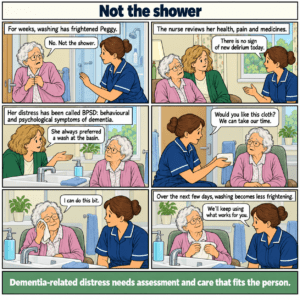
Read story C01: Not the shower (image and text)
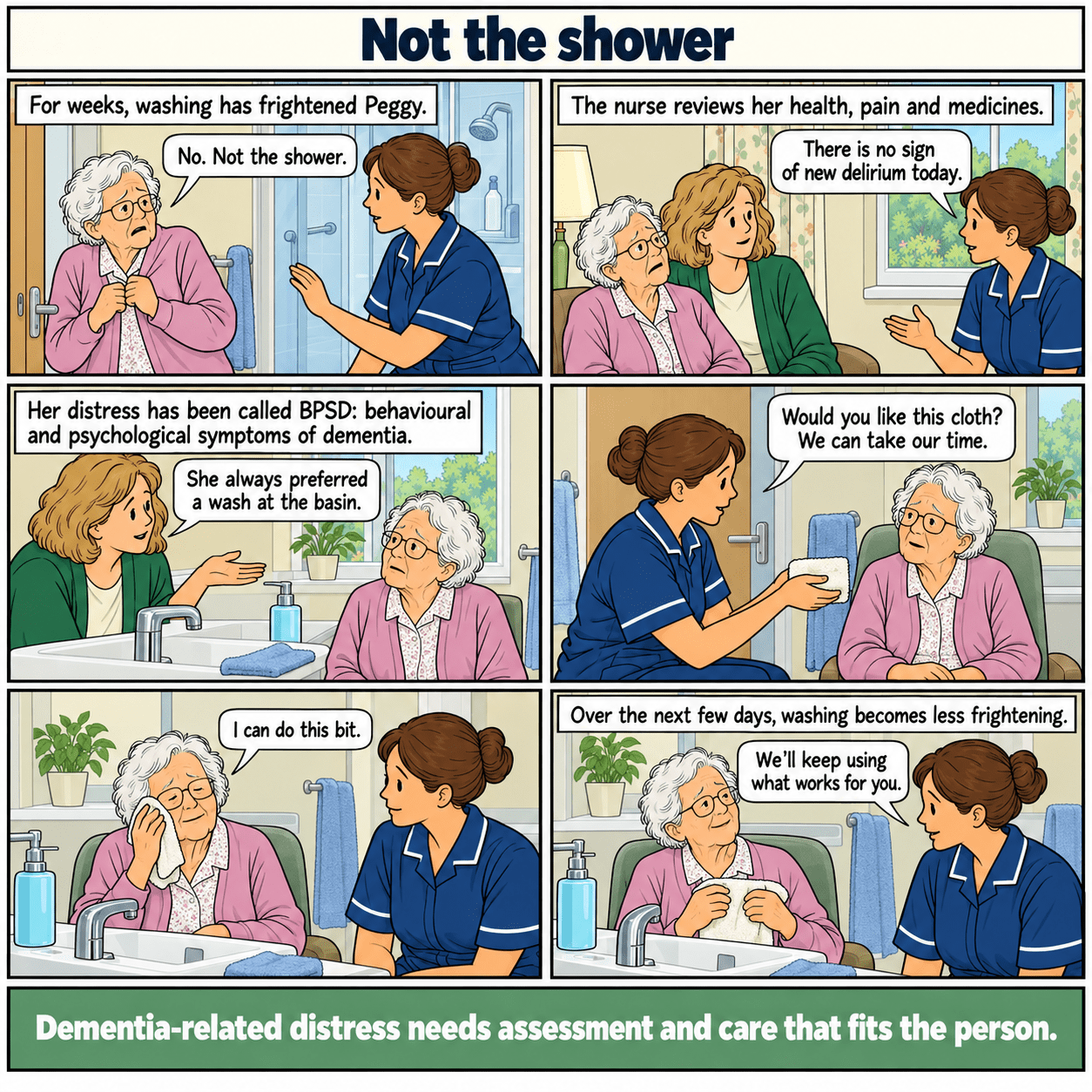
BPSD or delirium? Understanding distress during washing
Peggy has dementia and becomes frightened during washing. Staff assess her health and find no new delirium. Privacy, a familiar carer and a warm cloth make washing less distressing. Staff adapt care to her preferences and abilities. A new or sudden change would need another assessment.
Story text
Panel 1. For weeks, washing has frightened Peggy.
- Peggy: No. Not the shower.
Panel 2. The nurse reviews her health, pain and medicines.
- Nurse: There is no sign of new delirium today.
Panel 3. Her distress has been called BPSD: behavioural and psychological symptoms of dementia.
- Alison: She always preferred a wash at the basin.
Panel 4.
- Care worker: Would you like this cloth? We can take our time.
Panel 5.
- Peggy: I can do this bit.
Panel 6. Over the next few days, washing becomes less frightening.
- Care worker: We’ll keep using what works for you.
Bottom band. Dementia-related distress needs assessment and care that fits the person.
Story C02 · Example case
The plan we changed
Read story C02: The plan we changed (image and text)
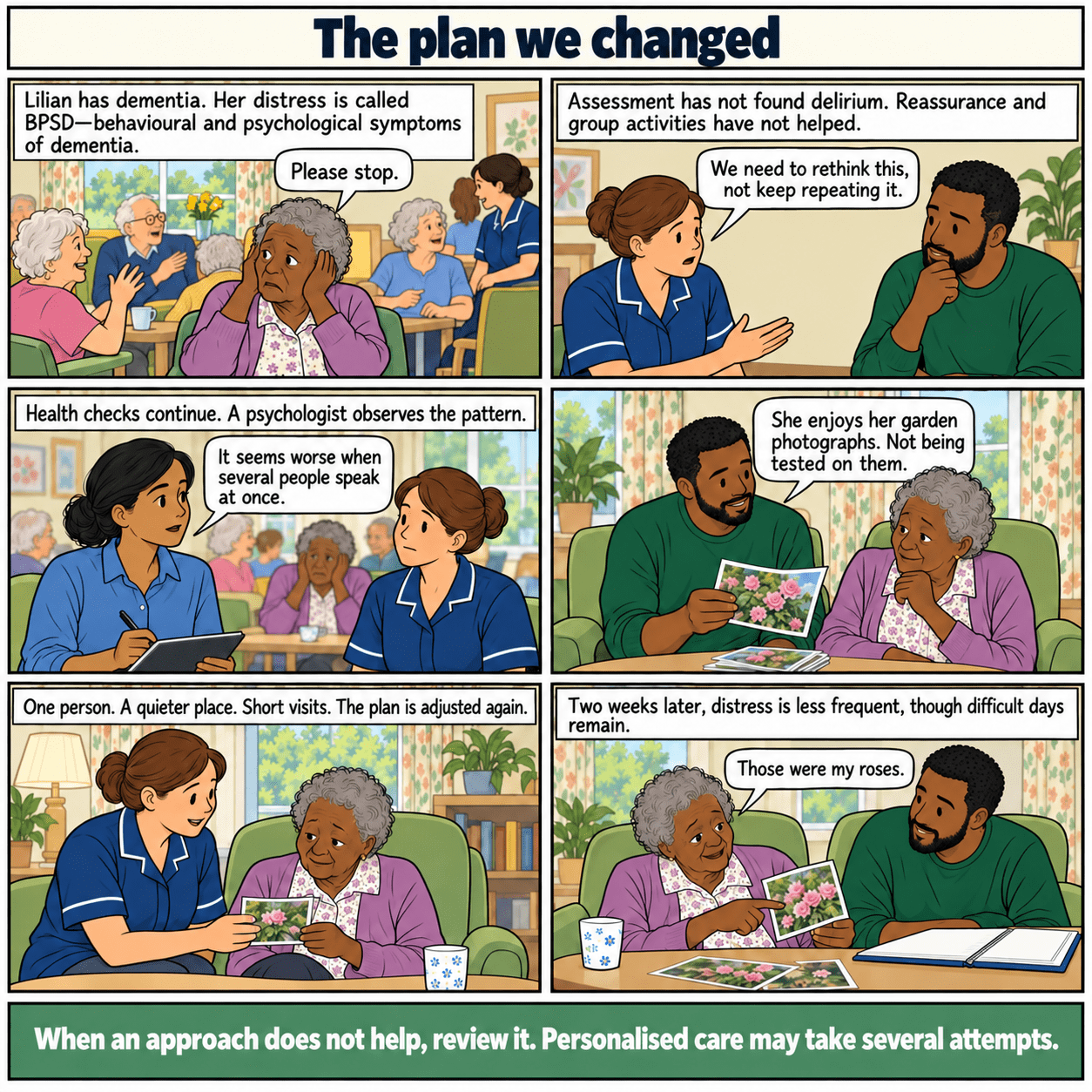
BPSD: when the first approach to dementia-related distress does not help
Lilian remains distressed despite reassurance and group activities. Health checks continue while a psychologist and care staff look closely at when the distress happens. The first plan is changed, tried consistently and reviewed. Improvement takes time. The aim is not to find a universal distraction, but to understand this person’s experience. BPSD means behavioural and psychological symptoms of dementia.
Story text
Panel 1. Lilian has dementia. Her distress is called BPSD—behavioural and psychological symptoms of dementia.
- Lilian: Please stop.
Panel 2. Assessment has not found delirium. Reassurance and group activities have not helped.
- Care worker: We need to rethink this, not keep repeating it.
Panel 3. Health checks continue. A psychologist observes the pattern.
- Psychologist: It seems worse when several people speak at once.
Panel 4.
- Marcus: She enjoys her garden photographs. Not being tested on them.
Panel 5. One person. A quieter place. Short visits. The plan is adjusted again.
Panel 6. Two weeks later, distress is less frequent, though difficult days remain.
- Lilian: Those were my roses.
Bottom band. When an approach does not help, review it. Personalised care may take several attempts.
Story C03 · Example case
Walk beside me
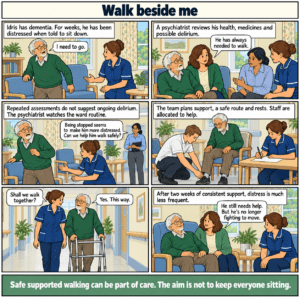
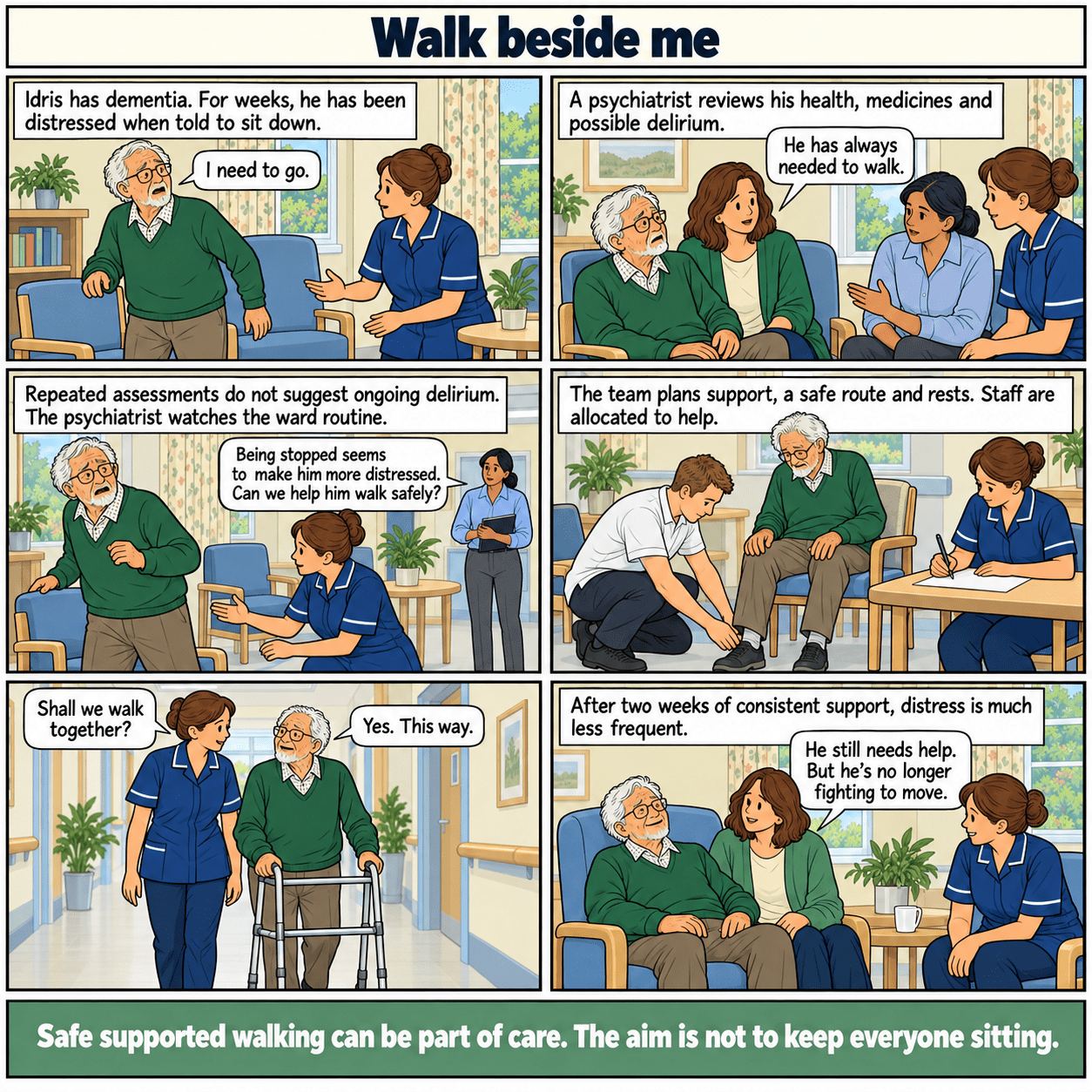
Read story C03: Walk beside me (image and text)
Dementia agitation and walking: when a different care plan helps
For weeks, Idris becomes distressed when staff ask him to remain seated. A psychiatrist reviews his health and medicines, listens to his daughter and watches what happens on the ward. Supported walking becomes part of a practical team plan. It takes consistent work, rather than one conversation, before his distress becomes much less frequent. BPSD means behavioural and psychological symptoms of dementia.
Story text
Panel 1. Idris has dementia. For weeks, he has been distressed when told to sit down.
- Idris: I need to go.
Panel 2. A psychiatrist reviews his health, medicines and possible delirium.
- Sara: He has always needed to walk.
Panel 3. Repeated assessments do not suggest ongoing delirium. The psychiatrist watches the ward routine.
- Psychiatrist: Being stopped seems to make him more distressed. Can we help him walk safely?
Panel 4. The team plans support, a safe route and rests. Staff are allocated to help.
Panel 5.
- Nurse: Shall we walk together?
- Idris: Yes. This way.
Panel 6. After two weeks of consistent support, distress is much less frequent.
- Sara: He still needs help. But he’s no longer fighting to move.
Bottom band. Safe supported walking can be part of care. The aim is not to keep everyone sitting.
Story C12 · Example case
Please give me space
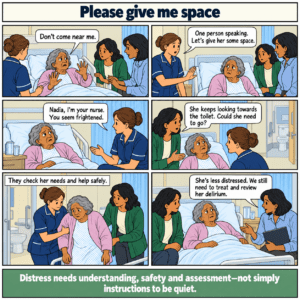
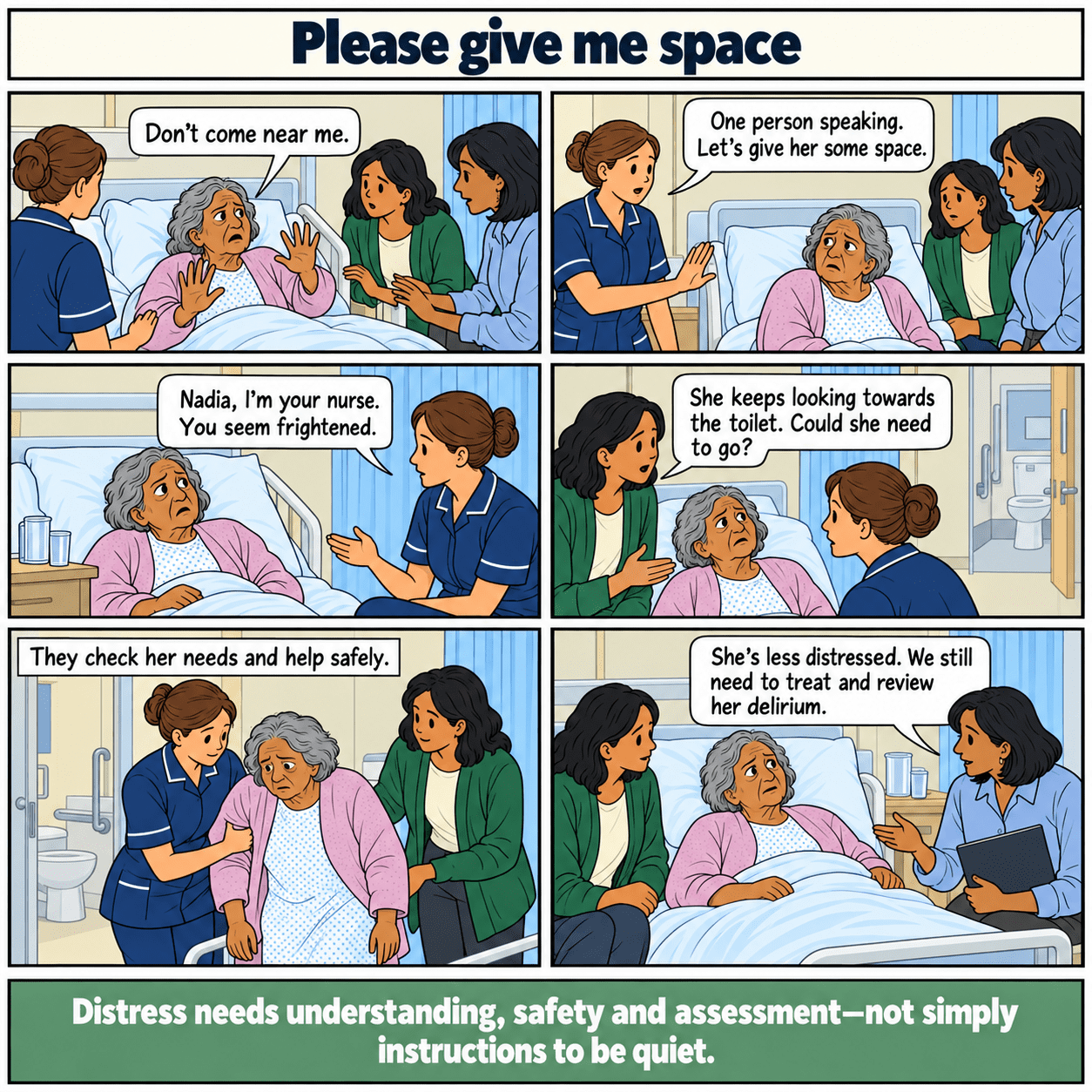
Read story C12: Please give me space (image and text)
Hyperactive delirium: fear, agitation and a calmer approach to care
Several people approach Nadia while she is frightened and confused. The nurse reduces the crowd, speaks simply and checks for discomfort. Her daughter explains what Nadia may be trying to communicate. A calmer encounter makes the immediate care easier, but the team continues treating delirium and assessing risk rather than assuming the problem is over.
Story text
Panel 1.
- Nadia: Don’t come near me.
Panel 2.
- Nurse: One person speaking. Let’s give her some space.
Panel 3.
- Nurse: Nadia, I’m your nurse. You seem frightened.
Panel 4.
- Yasmin: She keeps looking towards the toilet. Could she need to go?
Panel 5. They check her needs and help safely.
Panel 6.
- Doctor: She’s less distressed. We still need to treat and review her delirium.
Bottom band. Distress needs understanding, safety and assessment—not simply instructions to be quiet.
Story C27 · Example case
It hurt when she moved
Read story C27: It hurt when she moved (image and text)
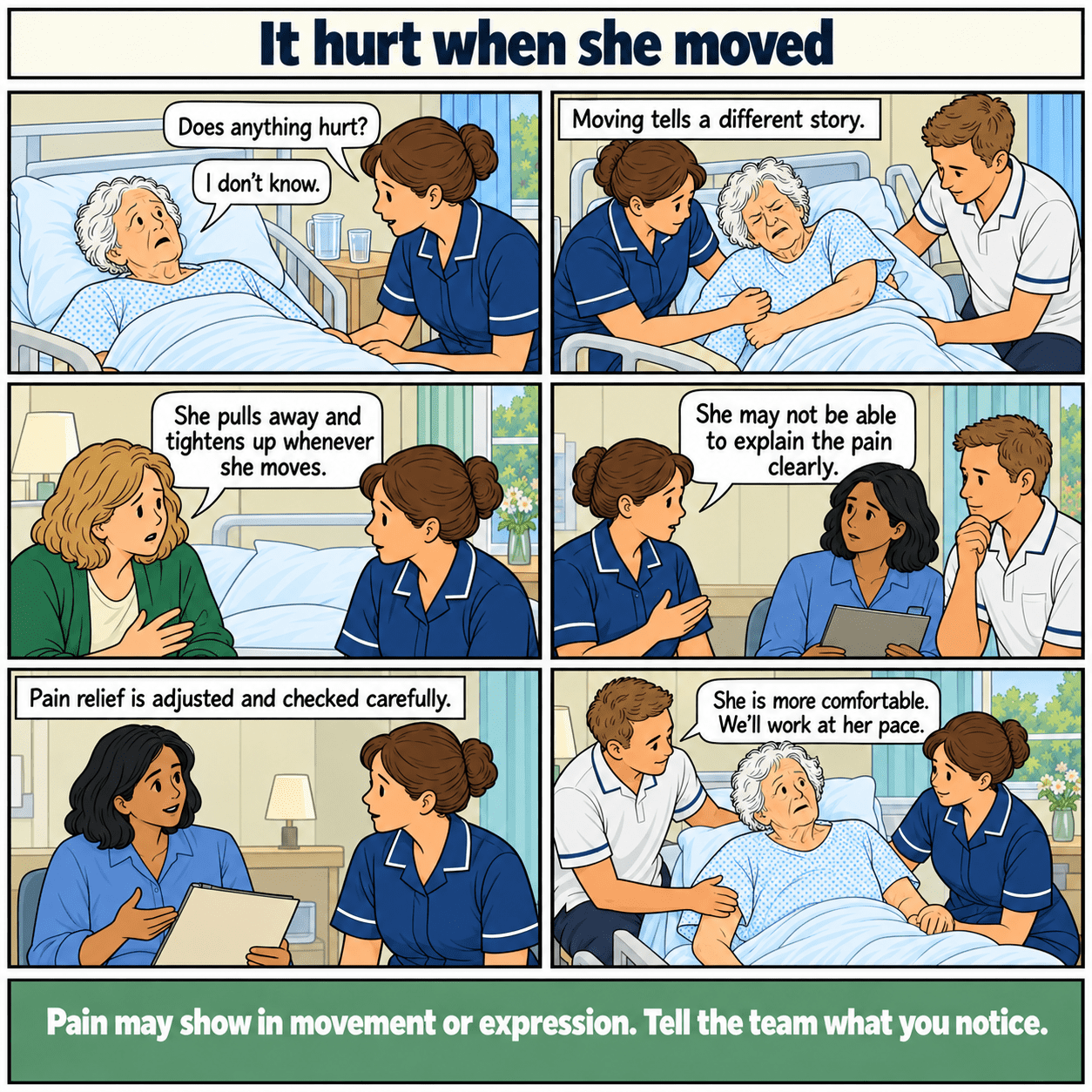
Pain and delirium: when explaining pain is difficult
Irene can’t give a consistent answer about pain, but she grimaces and protects her injured side when moving. Jess tells the team what she has noticed. Pain is assessed and treatment is reviewed. The team balances comfort and medicine effects rather than assuming that either all pain relief is harmful or a quiet person has no pain.
Story text
Panel 1.
- Nurse: Does anything hurt?
- Irene: I don’t know.
Panel 2. Moving tells a different story.
Panel 3.
- Jess: She pulls away and tightens up whenever she moves.
Panel 4.
- Nurse: She may not be able to explain the pain clearly.
Panel 5. Pain relief is adjusted and checked carefully.
Panel 6.
- Physiotherapist: She is more comfortable. We’ll work at her pace.
Bottom band. Pain may show in movement or expression. Tell the team what you notice.
Story C28 · Example case
He kept asking to go
Read story C28: He kept asking to go (image and text)
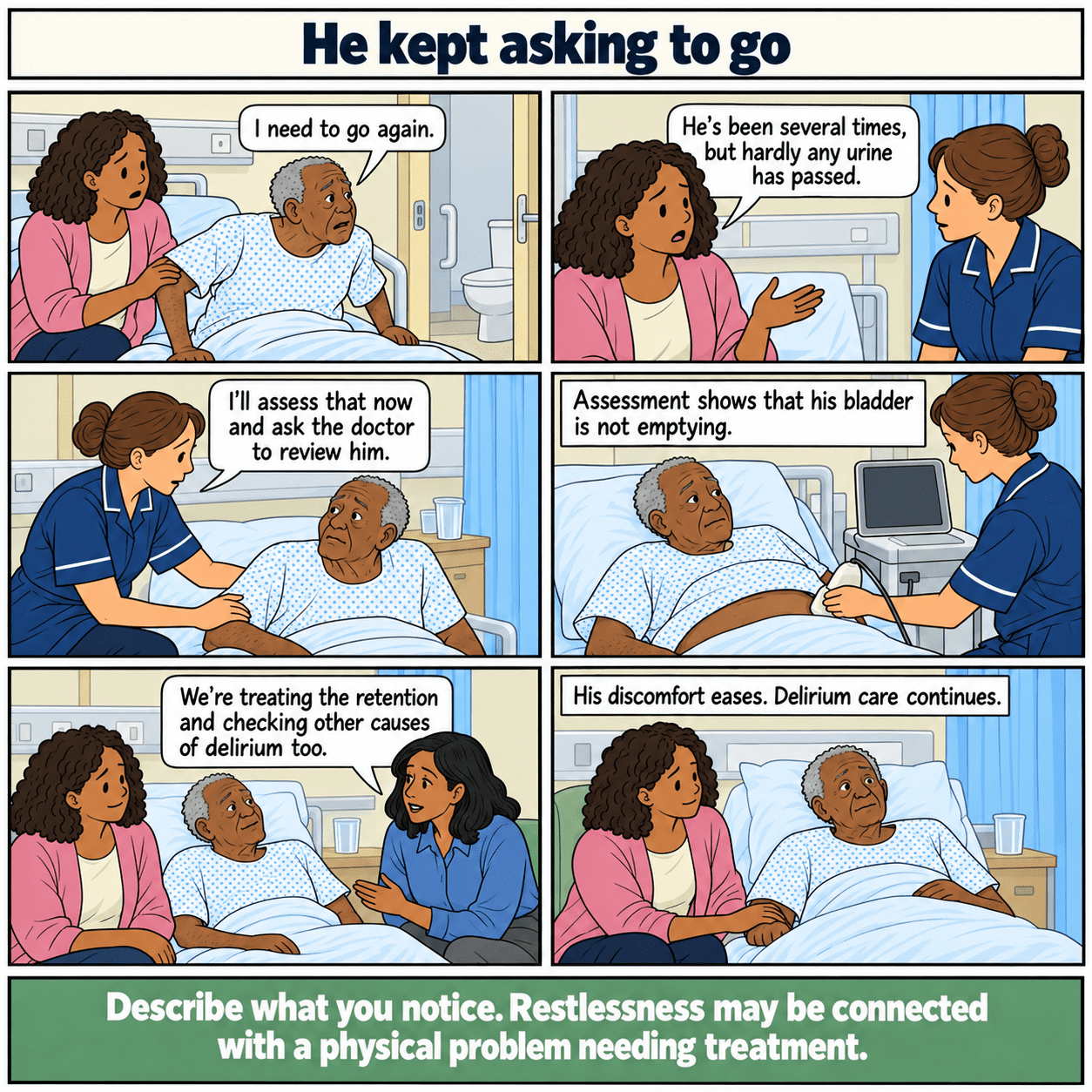
Delirium and difficulty passing urine: looking beyond apparent agitation
Arthur repeatedly tries to get up and says he needs the toilet. His daughter notices that he has passed very little urine. Staff assess him, find that his bladder is not emptying and treat the problem. His discomfort eases, but his delirium still needs care. A repeated action can be useful information about a physical need.
Story text
Panel 1.
- Arthur: I need to go again.
Panel 2.
- Mel: He’s been several times, but hardly any urine has passed.
Panel 3.
- Nurse: I’ll assess that now and ask the doctor to review him.
Panel 4. Assessment shows that his bladder is not emptying.
Panel 5.
- Doctor: We’re treating the retention and checking other causes of delirium too.
Panel 6. His discomfort eases. Delirium care continues.
Bottom band. Describe what you notice. Restlessness may be connected with a physical problem needing treatment.
Story C29 · Example case
The tablets from the chemist
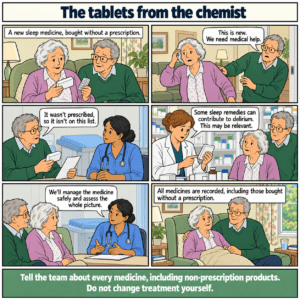
Read story C29: The tablets from the chemist (image and text)
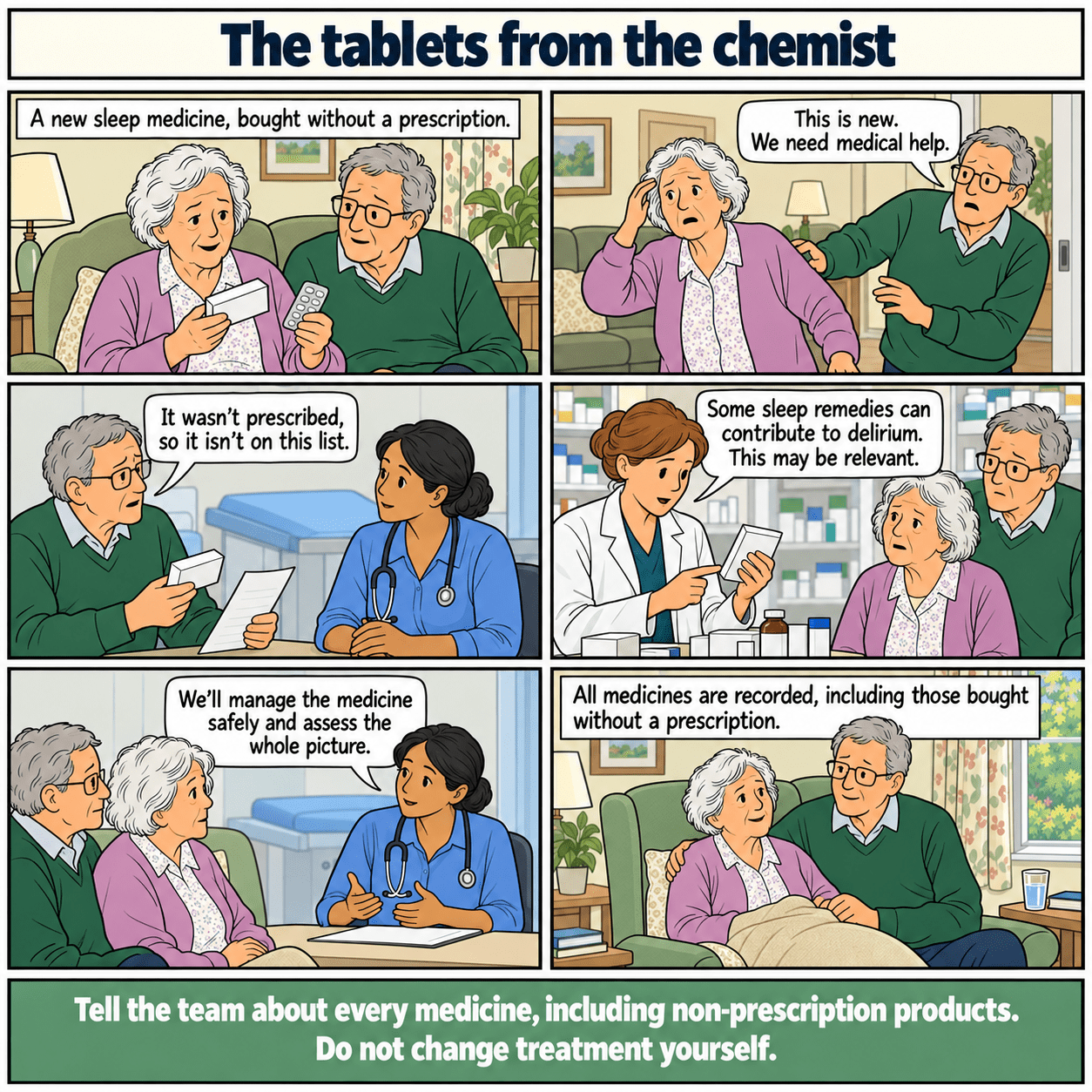
Can non-prescription sleep medicines contribute to delirium?
Elena becomes confused after starting a non-prescription sleep medicine. At assessment, Tomas brings the packet as well as her prescribed medicine list. The pharmacist identifies a possible contributor, and the doctor reviews the full picture. Include medicines bought without a prescription when telling staff what someone takes. New confusion needs medical help.
Story text
Panel 1. A new sleep medicine, bought without a prescription.
Panel 2.
- Tomas: This is new. We need medical help.
Panel 3.
- Tomas: It wasn’t prescribed, so it isn’t on this list.
Panel 4.
- Pharmacist: Some sleep remedies can contribute to delirium. This may be relevant.
Panel 5.
- Doctor: We’ll manage the medicine safely and assess the whole picture.
Panel 6. All medicines are recorded, including those bought without a prescription.
Bottom band. Tell the team about every medicine, including non-prescription products. Do not change treatment yourself.
Story C31 · Example case
More than a change in behaviour
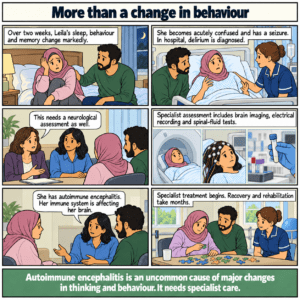
Read story C31: More than a change in behaviour (image and text)
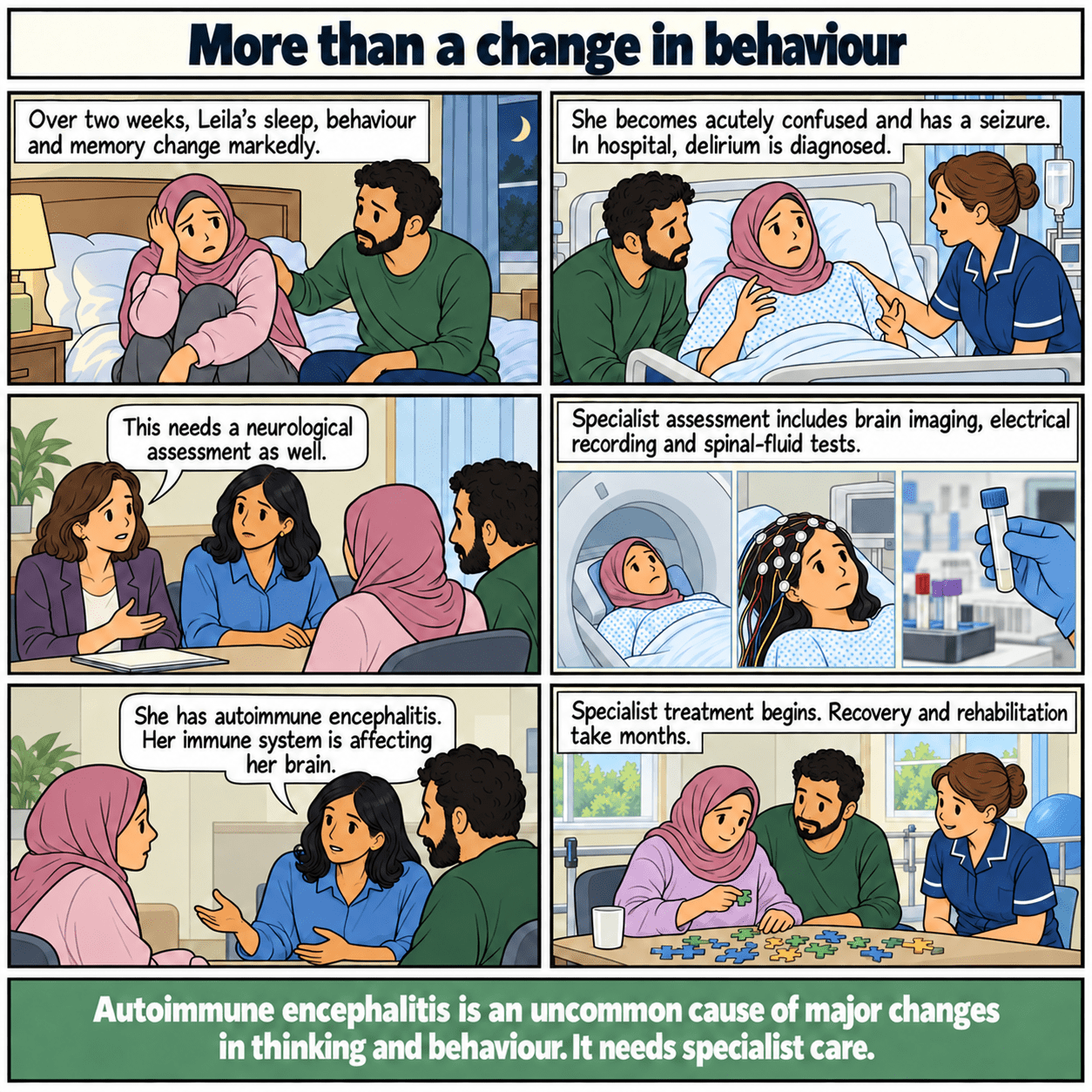
Autoimmune encephalitis and delirium: an uncommon cause of a major change
Over a short period, Leila’s behaviour and memory change markedly. She then becomes confused, can’t follow a conversation and has a seizure. Psychiatry and neurology work together to assess an uncommon neurological cause. Specialist investigations identify autoimmune encephalitis. Treatment and rehabilitation are prolonged. This is not a suggestion that most delirium or behavioural changes have this cause.
Story text
Panel 1. Over two weeks, Leila’s sleep, behaviour and memory change markedly.
Panel 2. She becomes acutely confused and has a seizure. In hospital, delirium is diagnosed.
Panel 3.
- Psychiatrist: This needs a neurological assessment as well.
Panel 4. Specialist assessment includes brain imaging, electrical recording and spinal-fluid tests.
Panel 5.
- Neurologist: She has autoimmune encephalitis. Her immune system is affecting her brain.
Panel 6. Specialist treatment begins. Recovery and rehabilitation take months.
Bottom band. Autoimmune encephalitis is an uncommon cause of major changes in thinking and behaviour. It needs specialist care.
Story C32 · Example case
Seizures without shaking
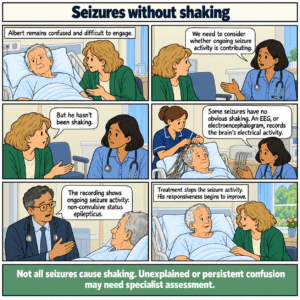
Read story C32: Seizures without shaking (image and text)
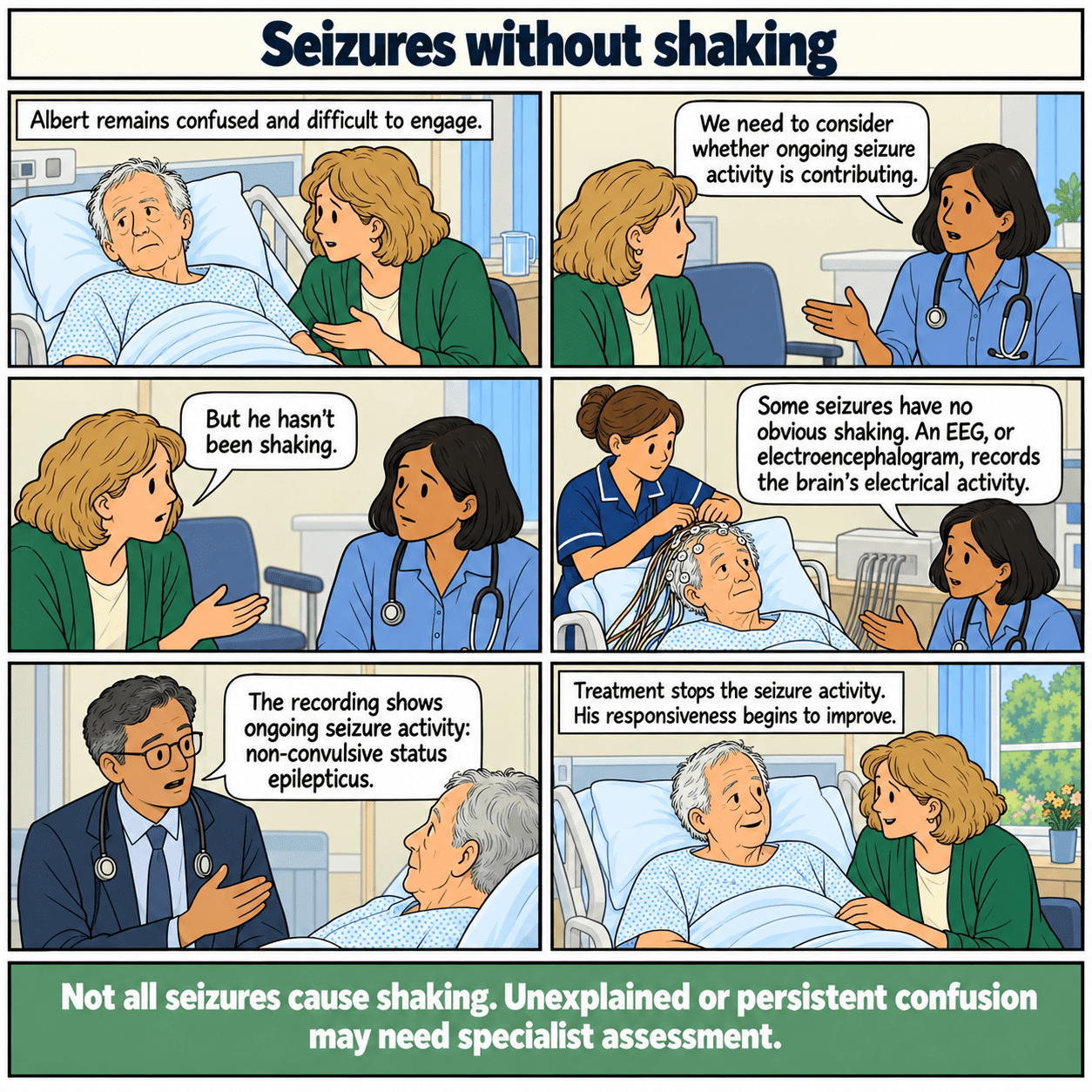
Non-convulsive status epilepticus: an uncommon cause of ongoing confusion
Albert remains confused and poorly responsive despite initial assessment and treatment. His team considers ongoing seizure activity and arranges a recording of his brain’s electrical activity. It identifies non-convulsive status epilepticus. Some seizures occur without obvious shaking. This is an uncommon diagnostic possibility, not a reason for every person with delirium to undergo the same tests.
Story text
Panel 1. Albert remains confused and difficult to engage.
Panel 2.
- Doctor: We need to consider whether ongoing seizure activity is contributing.
Panel 3.
- Vera: But he hasn’t been shaking.
Panel 4.
- Doctor: Some seizures have no obvious shaking. An EEG, or electroencephalogram, records the brain’s electrical activity.
Panel 5.
- Neurologist: The recording shows ongoing seizure activity: non-convulsive status epilepticus.
Panel 6. Treatment stops the seizure activity. His responsiveness begins to improve.
Bottom band. Not all seizures cause shaking. Unexplained or persistent confusion may need specialist assessment.
Story C33 · Example case
The calcium result
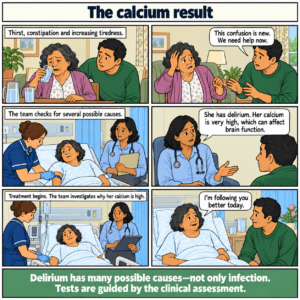
Read story C33: The calcium result (image and text)
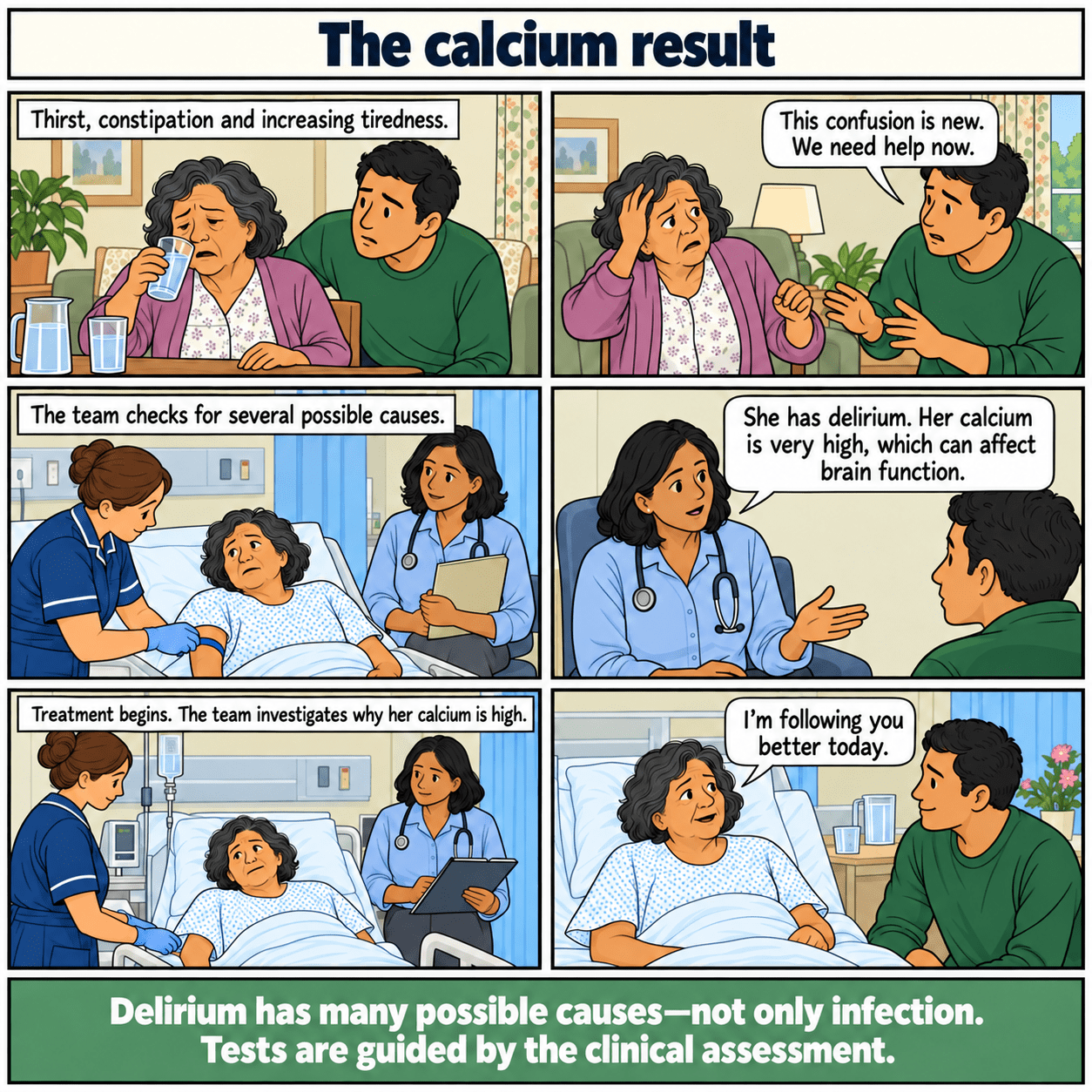
High blood calcium and delirium: a less familiar possible cause
Marisol has become thirsty, constipated and increasingly unwell before an acute change in her thinking. Blood tests show a markedly raised calcium level. Her team treats the problem and investigates its cause. This story illustrates why the search for delirium causes is broader than infection, without suggesting that these symptoms alone identify a diagnosis.
Story text
Panel 1. Thirst, constipation and increasing tiredness.
Panel 2.
- Luis: This confusion is new. We need help now.
Panel 3. The team checks for several possible causes.
Panel 4.
- Doctor: She has delirium. Her calcium is very high, which can affect brain function.
Panel 5. Treatment begins. The team investigates why her calcium is high.
Panel 6.
- Marisol: I’m following you better today.
Bottom band. Delirium has many possible causes—not only infection. Tests are guided by the clinical assessment.
Story C34 · Example case
Another broken night
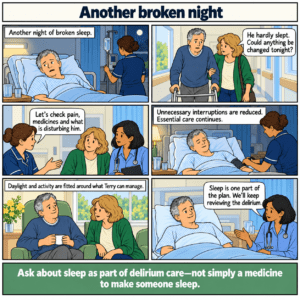
Read story C34: Another broken night (image and text)
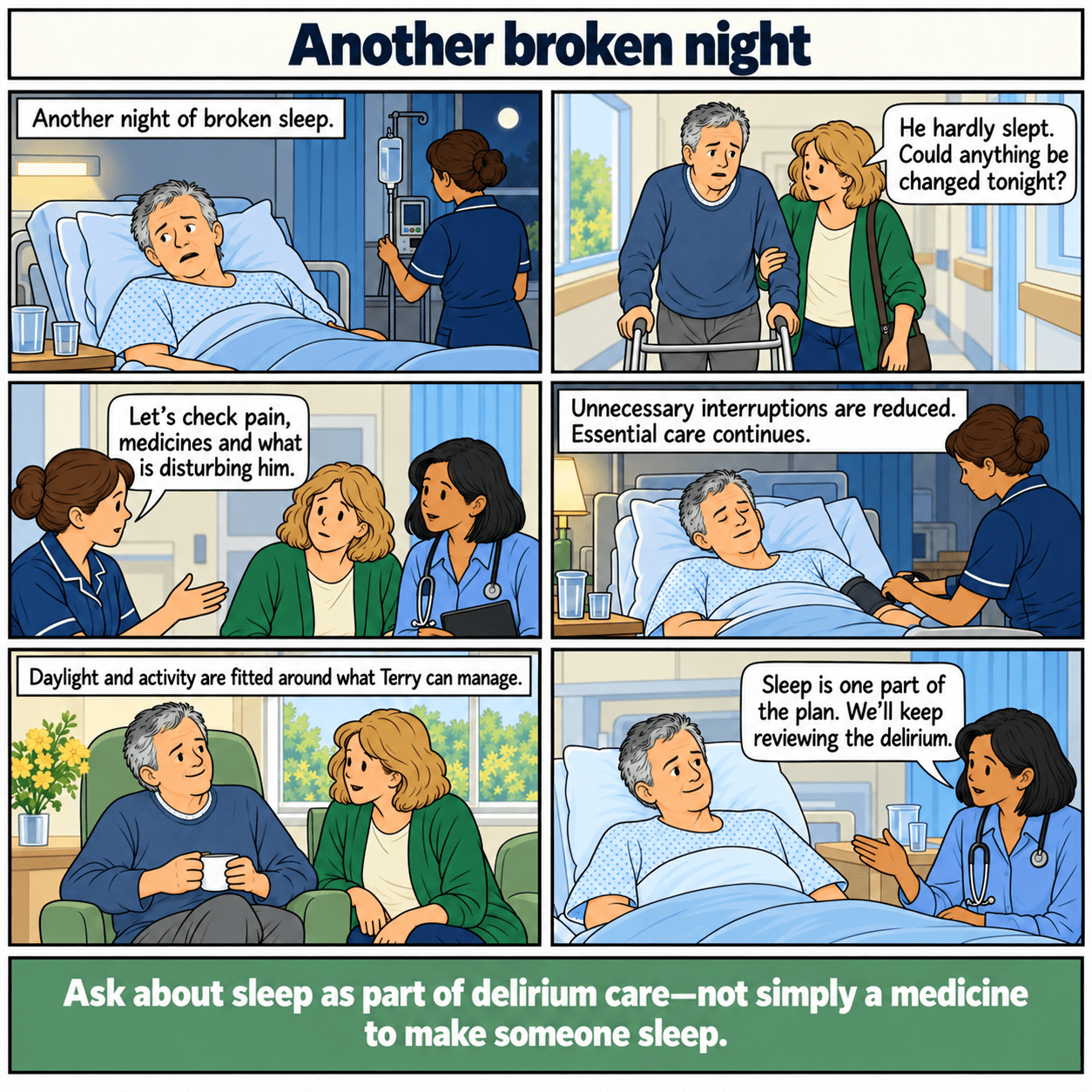
Sleep and delirium: helping without simply adding a sleeping tablet
Terry’s nights are repeatedly interrupted, and he is exhausted and confused during the day. The team reviews pain, medicines and sleep disruption. Some overnight interruptions are reduced where safe, while necessary checks continue. Better sleep is one part of care; sedation and recovery from delirium are not the same thing.
Story text
Panel 1. Another night of broken sleep.
Panel 2.
- Louise: He hardly slept. Could anything be changed tonight?
Panel 3.
- Nurse: Let’s check pain, medicines and what is disturbing him.
Panel 4. Unnecessary interruptions are reduced. Essential care continues.
Panel 5. Daylight and activity are fitted around what Terry can manage.
Panel 6.
- Doctor: Sleep is one part of the plan. We’ll keep reviewing the delirium.
Bottom band. Ask about sleep as part of delirium care—not simply a medicine to make someone sleep.
Story C35 · Example case
I thought the food was poisoned
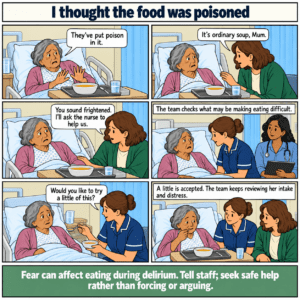
Read story C35: I thought the food was poisoned (image and text)
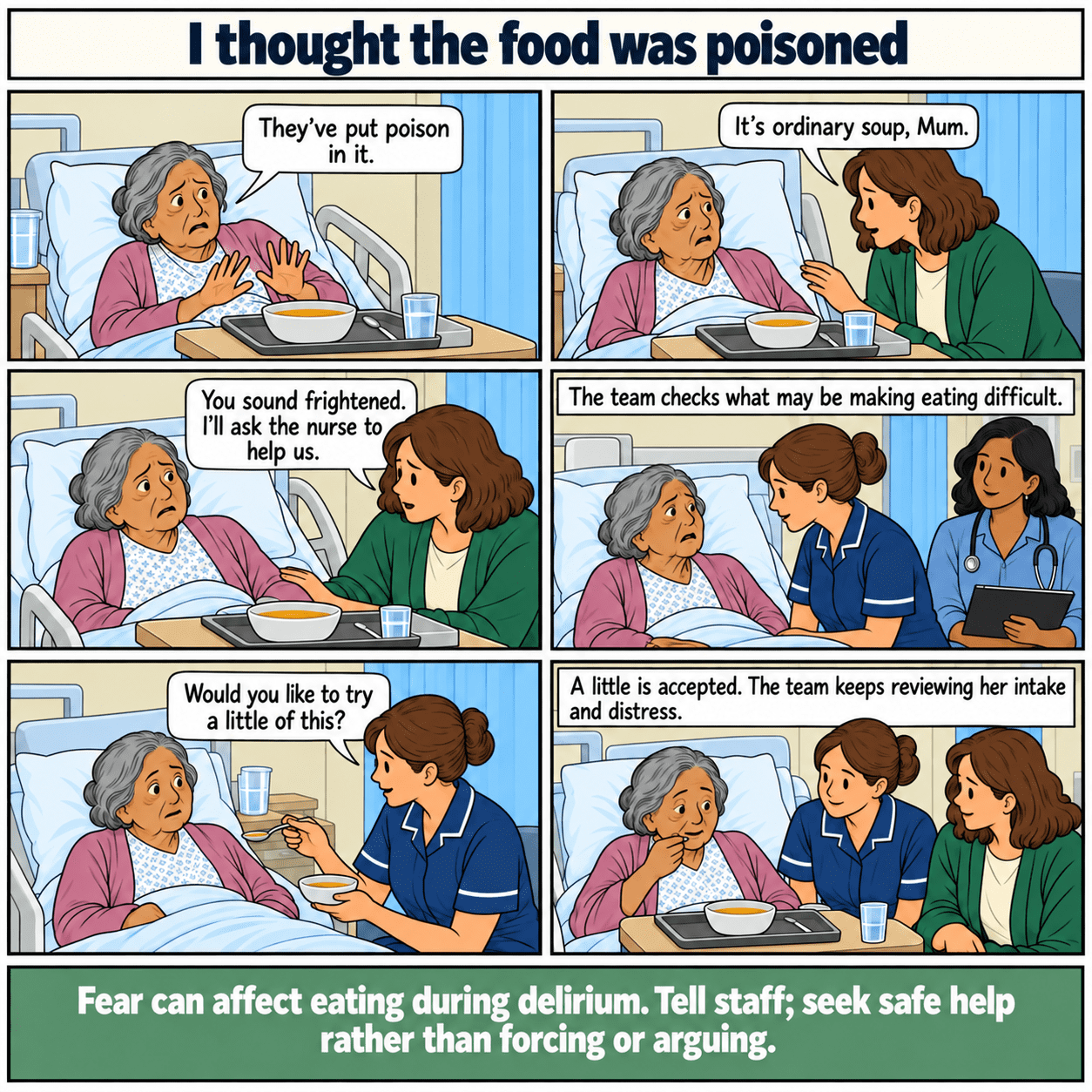
Delirium and refusing food: understanding fear and finding safe help
Fatima is frightened of the food on her tray. Arguing does not make the fear disappear. Her daughter tells staff, who check for physical problems and consider a safer, less distressing approach to meals. The team continues treatment and monitors nutrition. Neither force nor a single familiar snack is presented as the answer to every difficulty.
Story text
Panel 1.
- Fatima: They’ve put poison in it.
Panel 2.
- Mariam: It’s ordinary soup, Mum.
Panel 3.
- Mariam: You sound frightened. I’ll ask the nurse to help us.
Panel 4. The team checks what may be making eating difficult.
Panel 5.
- Nurse: Would you like to try a little of this?
Panel 6. A little is accepted. The team keeps reviewing her intake and distress.
Bottom band. Fear can affect eating during delirium. Tell staff; seek safe help rather than forcing or arguing.
Story C36 · Example case
We had done what we could
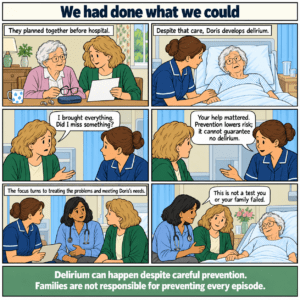
Read story C36: We had done what we could (image and text)
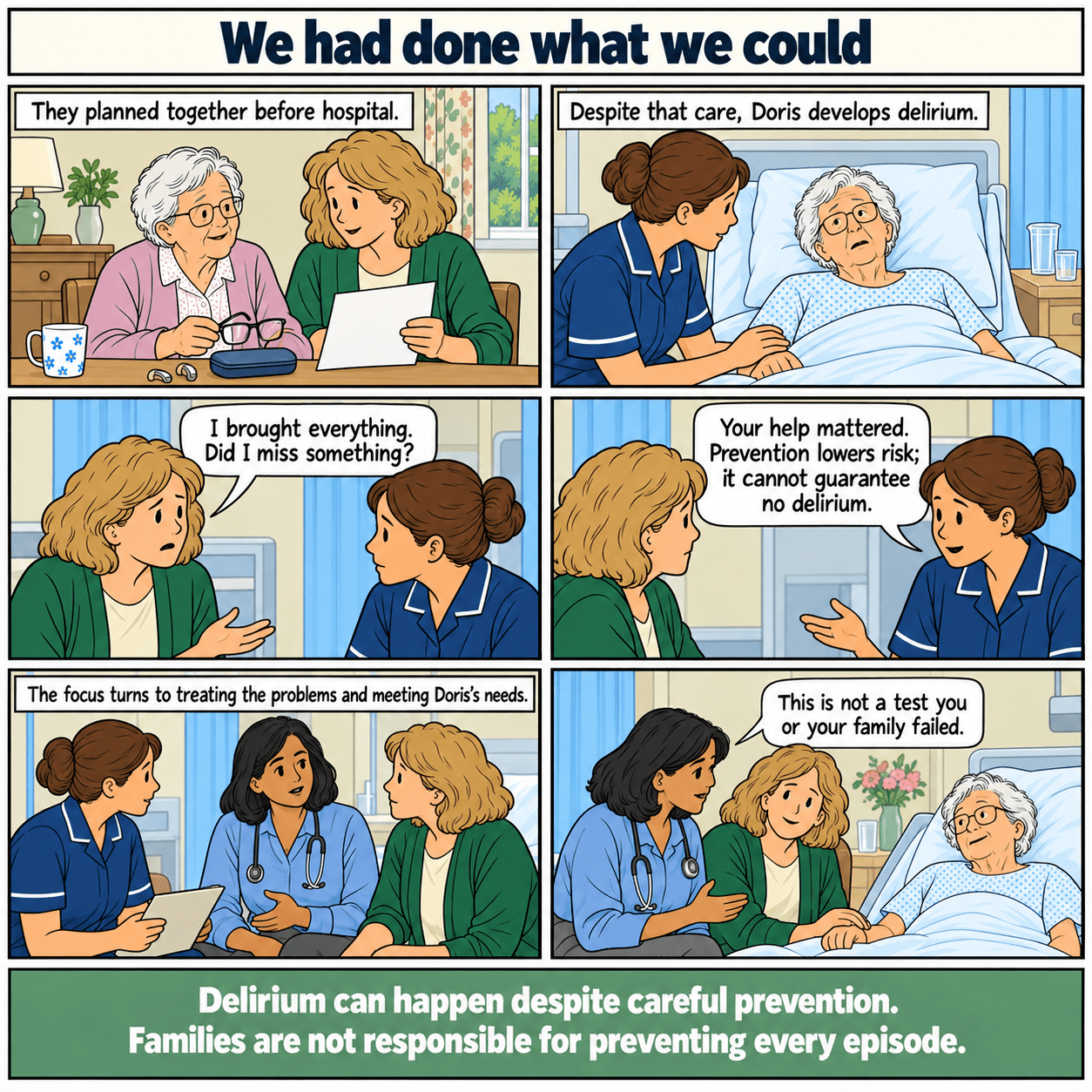
Delirium despite good prevention: it is not the family’s failure
Sue brought Doris’s glasses, shared her routines and helped with the agreed care plan. Doris still developed delirium. Sue wonders whether she failed. The team explains that prevention can reduce risk but can’t guarantee that delirium will not happen. The next task is assessment and care, not blaming the patient or family.
Story text
Panel 1. They planned together before hospital.
Panel 2. Despite that care, Doris develops delirium.
Panel 3.
- Sue: I brought everything. Did I miss something?
Panel 4.
- Nurse: Your help mattered. Prevention lowers risk; it cannot guarantee no delirium.
Panel 5. The focus turns to treating the problems and meeting Doris’s needs.
Panel 6.
- Doctor: This is not a test you or your family failed.
Bottom band. Delirium can happen despite careful prevention. Families are not responsible for preventing every episode.
Story C42 · Example case
After the fall
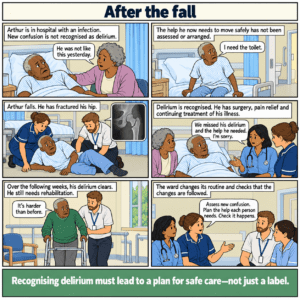
Read story C42: After the fall (image and text)
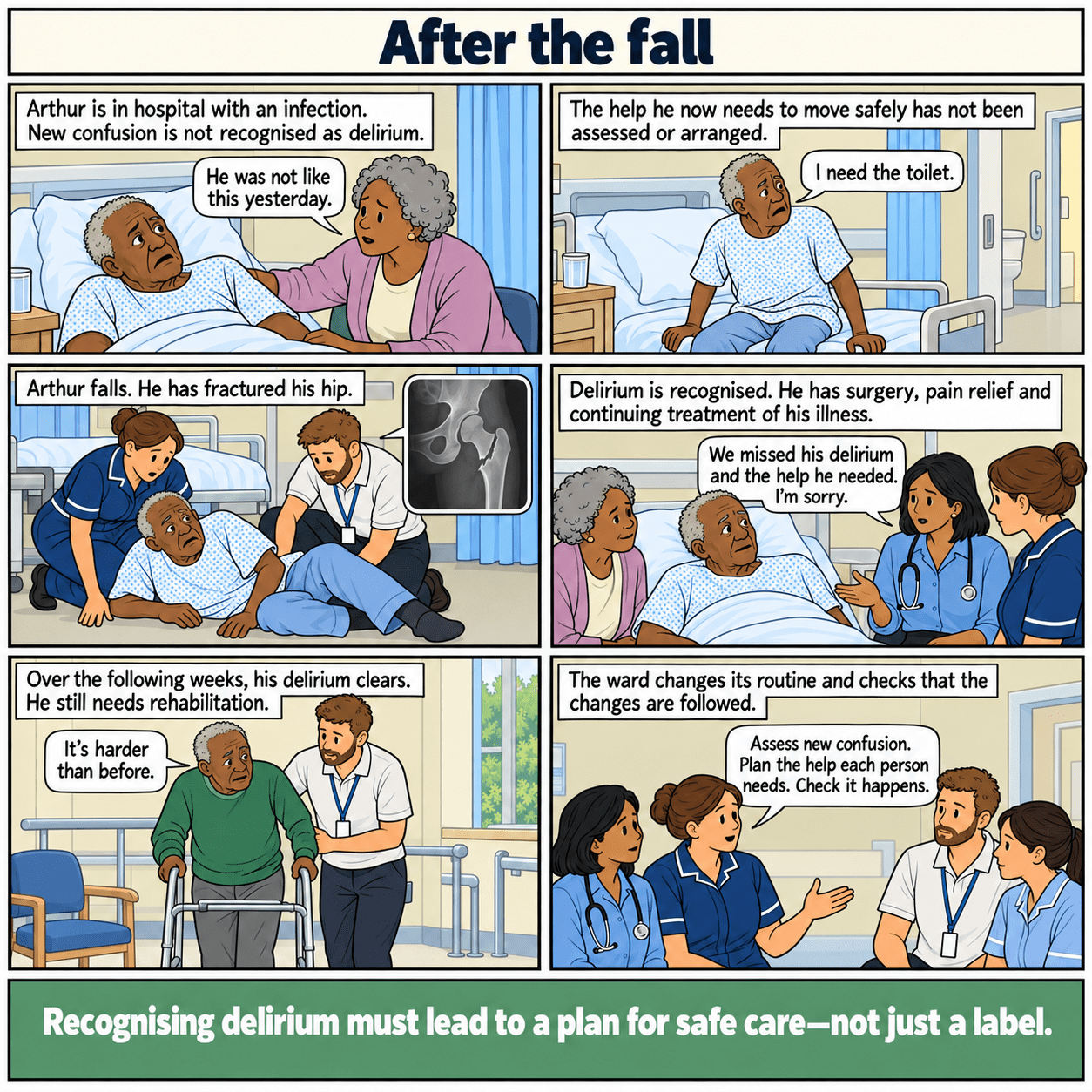
After the fall
Arthur becomes newly confused on the ward. Delirium is not recognised, and the help he needs to move safely is not arranged. He falls and fractures his hip. His treatment includes surgery, delirium care and rehabilitation. The ward acknowledges the failings and changes how it responds to new confusion.
Story text
Panel 1. Arthur is in hospital with an infection. New confusion is not recognised as delirium.
- Ruth: He was not like this yesterday.
Panel 2. The help he now needs to move safely has not been assessed or arranged.
- Arthur: I need the toilet.
Panel 3. Arthur falls. He has fractured his hip.
Panel 4. Delirium is recognised. He has surgery, pain relief and continuing treatment of his illness.
- Doctor: We missed his delirium and the help he needed. I’m sorry.
Panel 5. Over the following weeks, his delirium clears. He still needs rehabilitation.
- Arthur: It’s harder than before.
Panel 6. The ward changes its routine and checks that the changes are followed.
- Ward nurse: Assess new confusion. Plan the help each person needs. Check it happens.
Bottom band. Recognising delirium must lead to a plan for safe care—not just a label.
Story C43 · Example case
The pain we missed
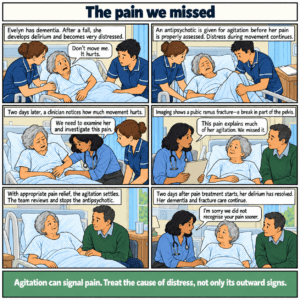
Read story C43: The pain we missed (image and text)
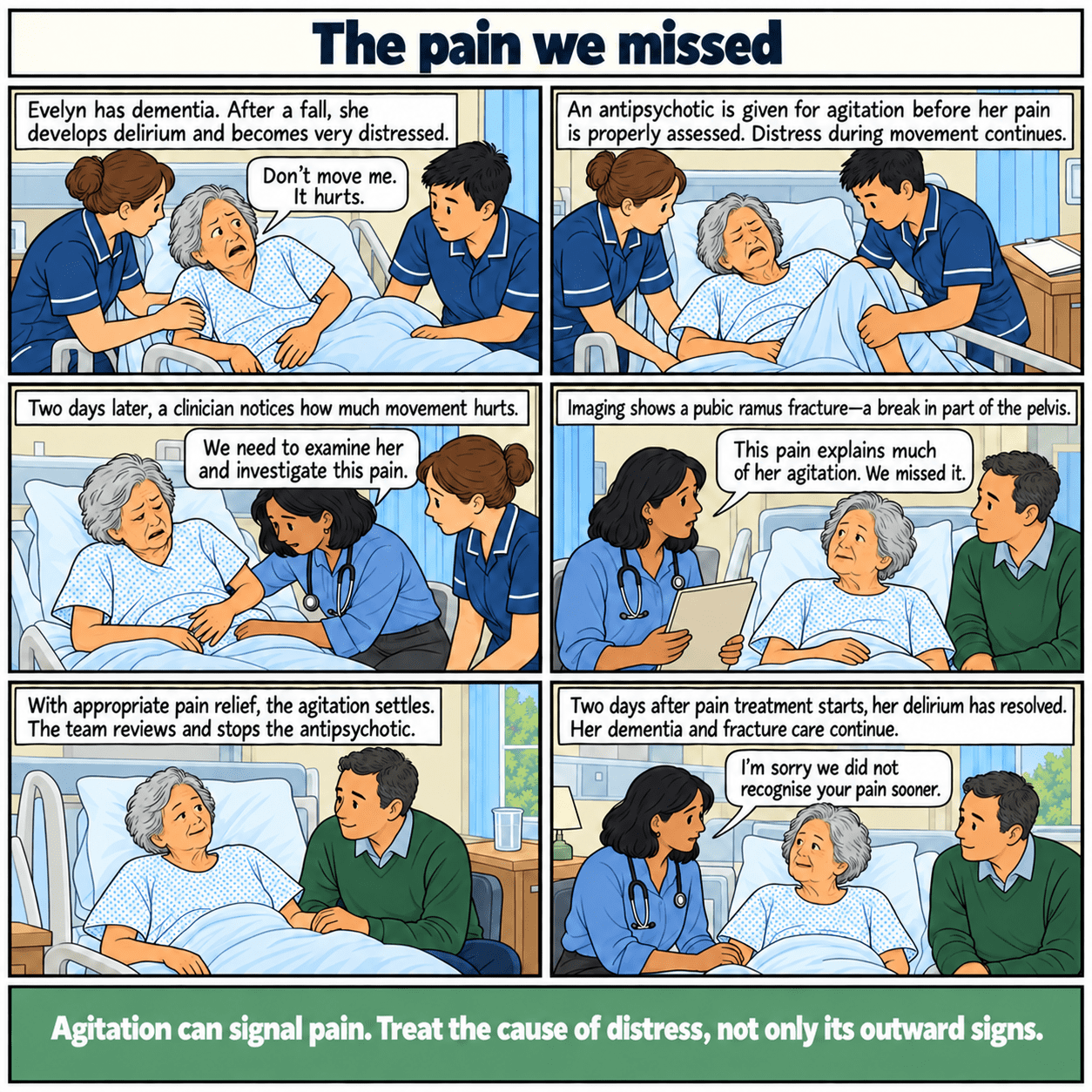
The pain we missed
Evelyn has dementia and develops delirium after a fall. An antipsychotic is given for agitation, but pain has not been properly assessed. Two days later, a pelvic fracture is found. With appropriate pain relief she is less distressed; her delirium resolves over the next two days, while fracture care continues.
Story text
Panel 1. Evelyn has dementia. After a fall, she develops delirium and becomes very distressed.
- Evelyn: Don’t move me. It hurts.
Panel 2. An antipsychotic is given for agitation before her pain is properly assessed. Distress during movement continues.
Panel 3. Two days later, a clinician notices how much movement hurts.
- Doctor: We need to examine her and investigate this pain.
Panel 4. Imaging shows a pubic ramus fracture—a break in part of the pelvis.
- Doctor: This pain explains much of her agitation. We missed it.
Panel 5. With appropriate pain relief, the agitation settles. The team reviews and stops the antipsychotic.
Panel 6. Two days after pain treatment starts, her delirium has resolved. Her dementia and fracture care continue.
- Doctor: I’m sorry we did not recognise your pain sooner.
Bottom band. Agitation can signal pain. Treat the cause of distress, not only its outward signs.
Story D01 · Example case
Tell them it's Lewy body dementia
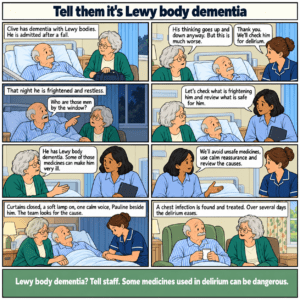
Read story D01: Tell them it's Lewy body dementia (image and text)
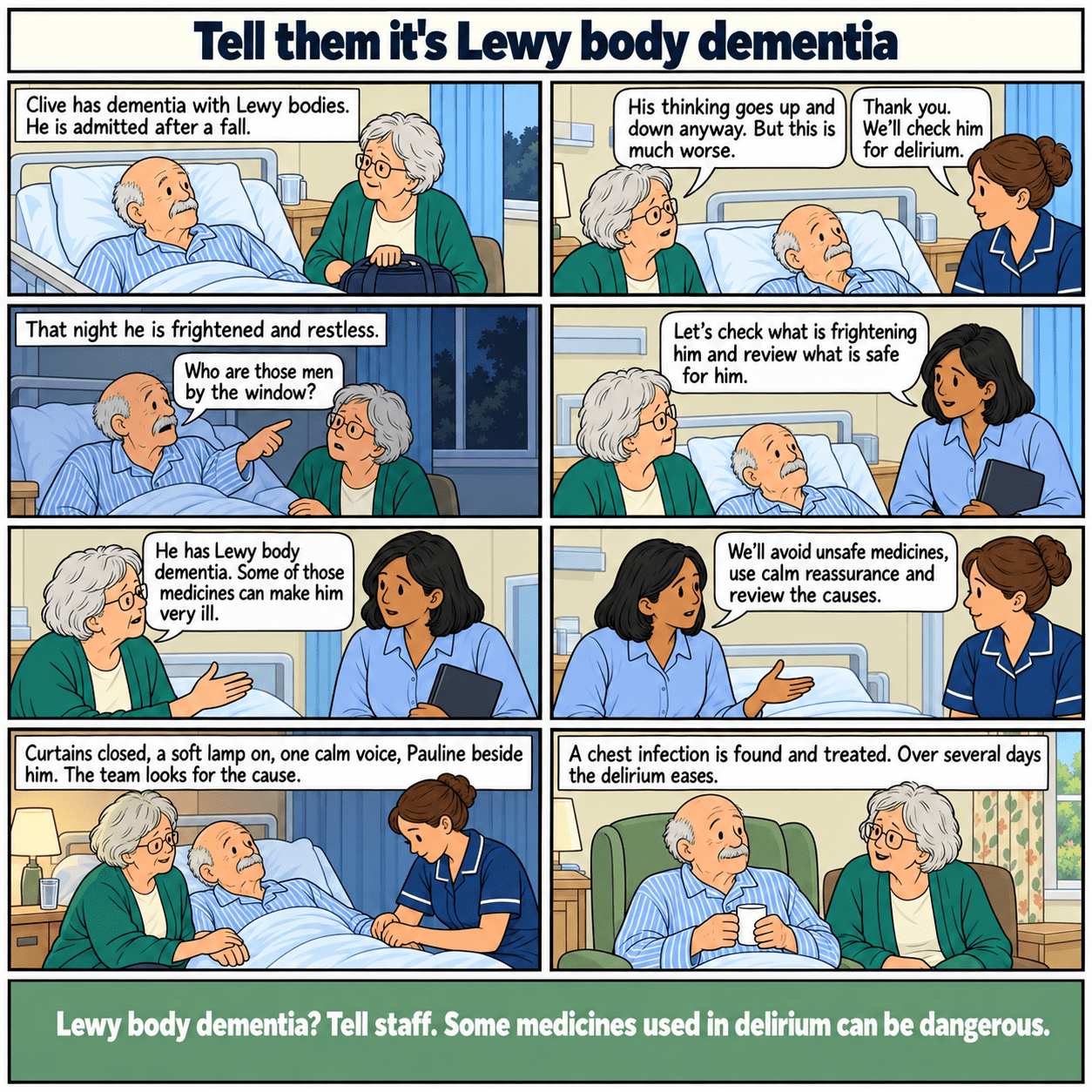
Tell them it's Lewy body dementia
A person with Lewy body dementia can also develop delirium. Tell staff about a sudden worsening from their usual pattern, including changes in attention, alertness or distress.
Some antipsychotic medicines can cause severe reactions in Lewy body dementia. Haloperidol must not be used in Lewy body dementia or Parkinson’s disease. Make sure the diagnosis is known when medicines are reviewed. Staff should check causes of distress, offer reassurance and seek specialist advice when needed.
Story text
Panel 1. Clive has dementia with Lewy bodies. He is admitted after a fall.
Panel 2.
- Pauline: His thinking goes up and down anyway. But this is much worse.
- Nurse: Thank you. We'll check him for delirium.
Panel 3. That night he is frightened and restless.
- Clive: Who are those men by the window?
Panel 4.
- Doctor: Let’s check what is frightening him and review what is safe for him.
Panel 5.
- Pauline: He has Lewy body dementia. Some of those medicines can make him very ill.
Panel 6.
- Doctor: We’ll avoid unsafe medicines, use calm reassurance and review the causes.
Panel 7. Curtains closed, a soft lamp on, one calm voice, Pauline beside him. The team looks for the cause.
Panel 8. A chest infection is found and treated. Over several days the delirium eases.
Bottom band. Lewy body dementia? Tell staff. Some medicines used in delirium can be dangerous.
Story D02 · Example case
Where it hurts
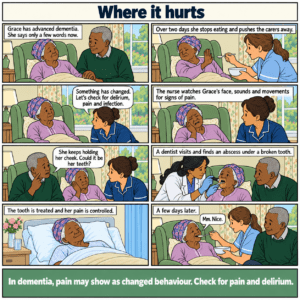
Read story D02: Where it hurts (image and text)
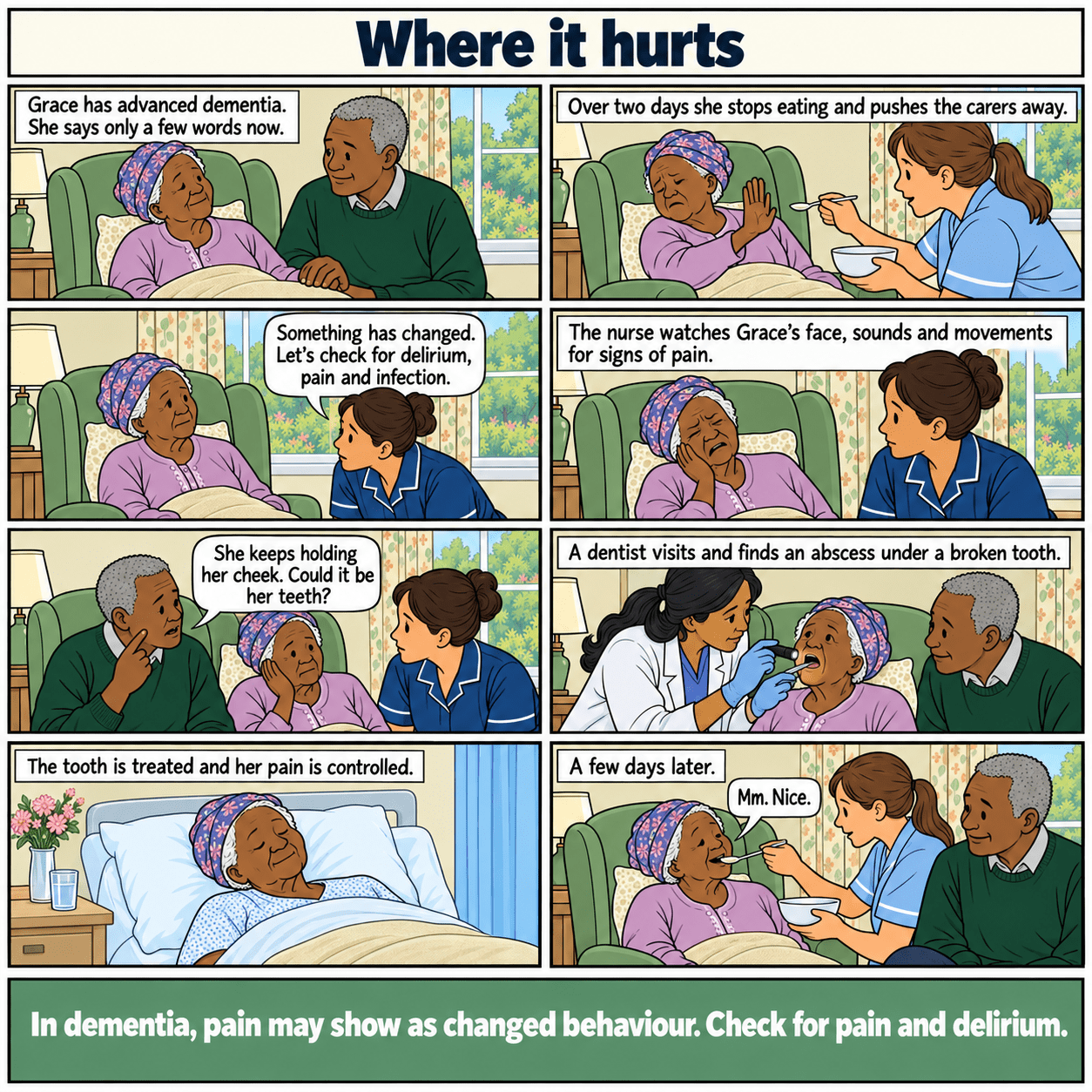
Where it hurts
Grace has advanced dementia and finds it hard to explain pain. Her son notices that she keeps holding her cheek. A dental assessment finds an abscess.
Pain may appear as refusing food, pulling away, calling out or a change in movement. Tell staff what you see and what is different from usual. A new change needs assessment for pain, delirium and other illness. In this example, dental treatment helps; the story does not establish that Grace has delirium.
Story text
Panel 1. Grace has advanced dementia. She says only a few words now.
Panel 2. Over two days she stops eating and pushes the carers away.
Panel 3.
- Nurse: Something has changed. Let's check for delirium, pain and infection.
Panel 4. The nurse watches Grace's face, sounds and movements for signs of pain.
Panel 5.
- Emeka: She keeps holding her cheek. Could it be her teeth?
Panel 6. A dentist visits and finds an abscess under a broken tooth.
Panel 7. The tooth is treated and her pain is controlled.
Panel 8. A few days later.
- Grace: Mm. Nice.
Bottom band. In dementia, pain may show as changed behaviour. Check for pain and delirium.
Story D03 · Example case
Just a urine infection?
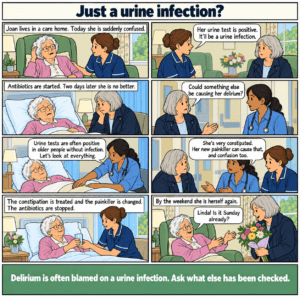
Read story D03: Just a urine infection? (image and text)
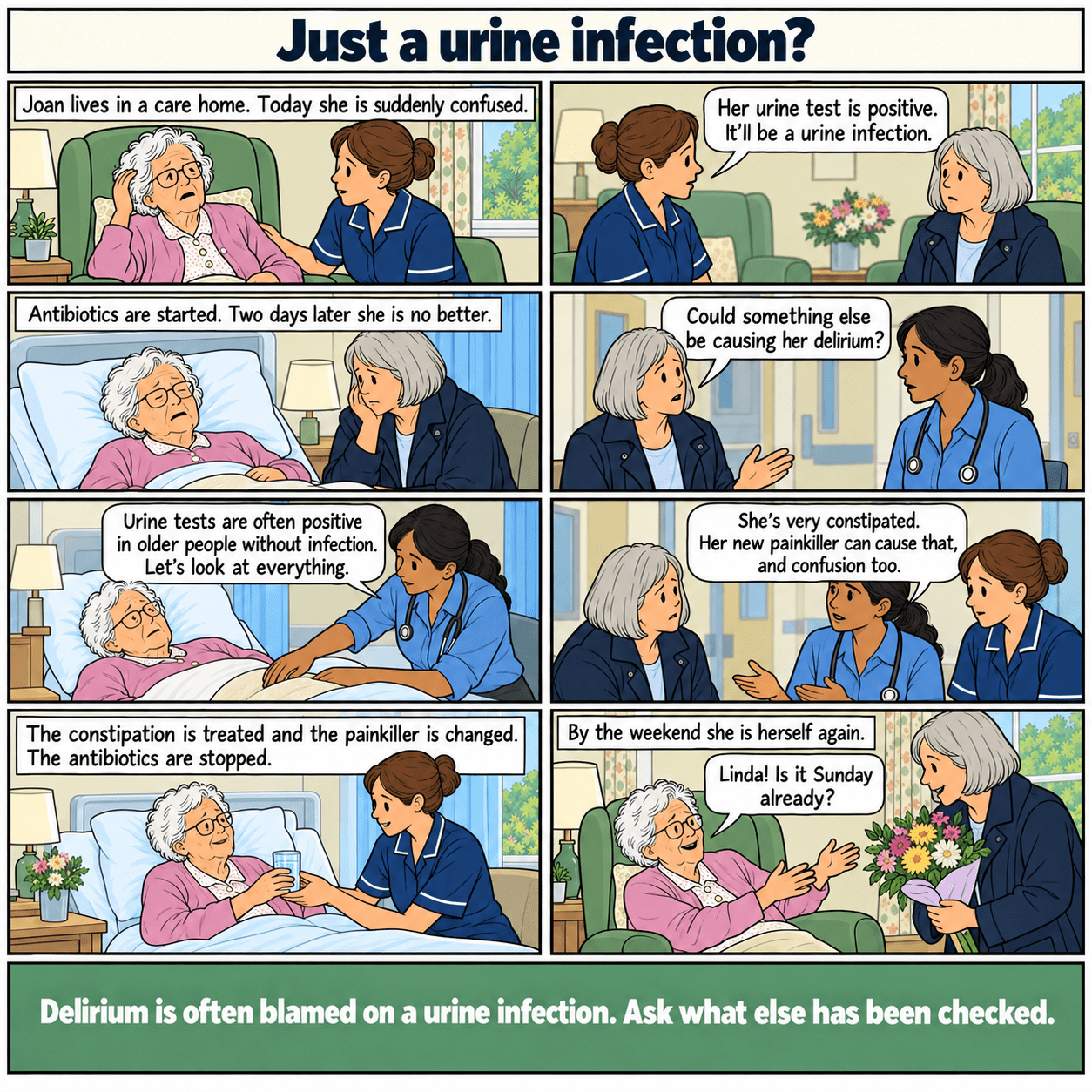
Just a urine infection?
Joan’s sudden confusion is initially blamed on a urine infection. A fuller review finds constipation and a medicine that may be contributing. Her treatment is changed by the team.
Bacteria may be present in urine without causing an infection. A positive urine test alone does not explain delirium, and UK guidance advises against urine dipsticks to diagnose infection in older adults over 65. Ask what symptoms and findings support the diagnosis and what else has been checked. Report any worsening promptly.
Story text
Panel 1. Joan lives in a care home. Today she is suddenly confused.
Panel 2.
- Care assistant: Her urine test is positive. It'll be a urine infection.
Panel 3. Antibiotics are started. Two days later she is no better.
Panel 4.
- Linda: Could something else be causing her delirium?
Panel 5.
- GP: Urine tests are often positive in older people without infection. Let's look at everything.
Panel 6.
- GP: She's very constipated. Her new painkiller can cause that, and confusion too.
Panel 7. The constipation is treated and the painkiller is changed. The antibiotics are stopped.
Panel 8. By the weekend she is herself again.
- Joan: Linda! Is it Sunday already?
Bottom band. Delirium is often blamed on a urine infection. Ask what else has been checked.
Story D06 · Example case
The fall three weeks ago
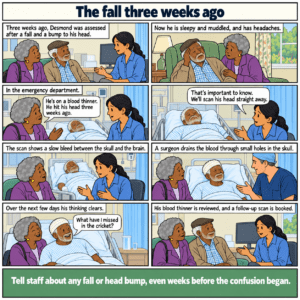
Read story D06: The fall three weeks ago (image and text)
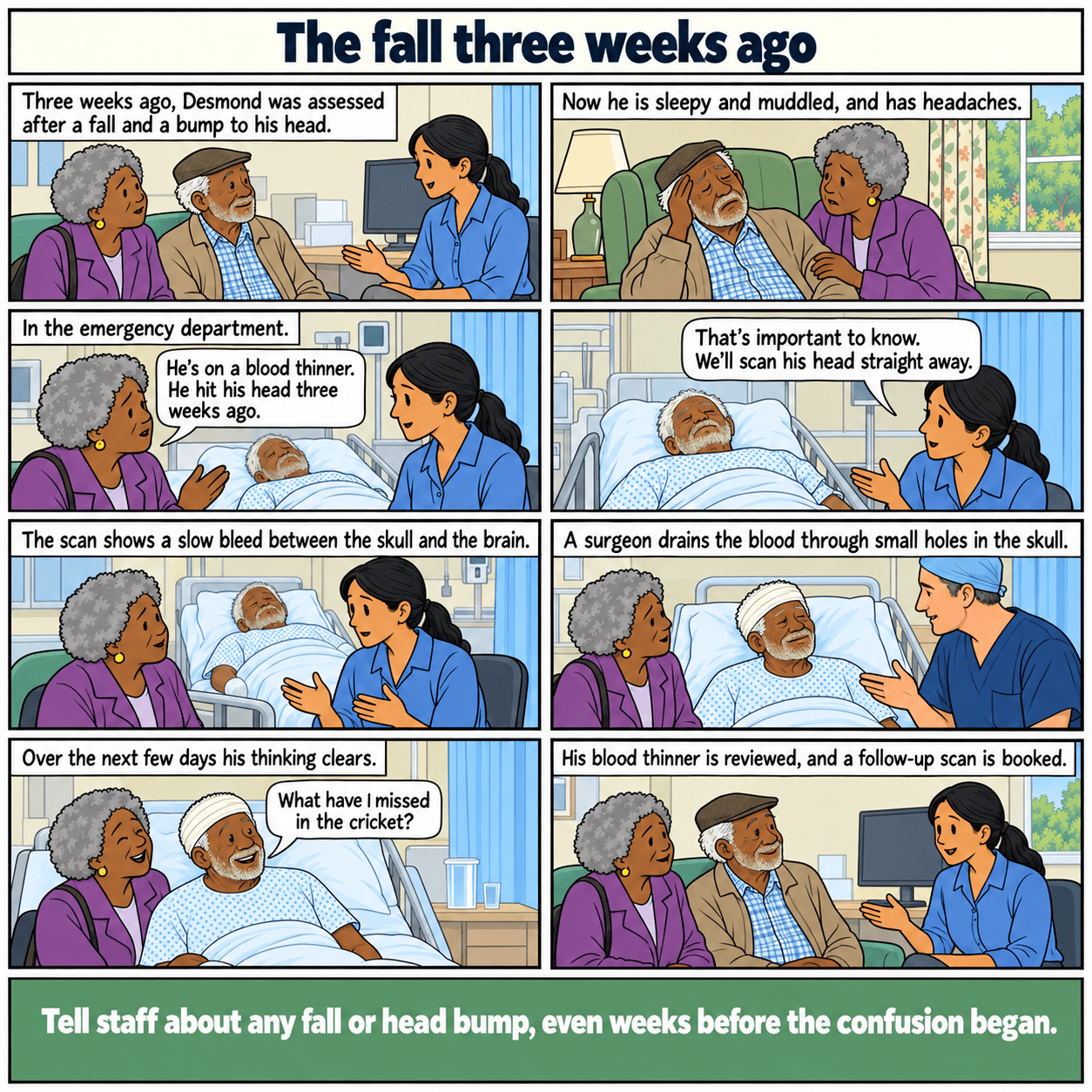
The fall three weeks ago
Desmond develops headaches, sleepiness and confusion weeks after a head injury. A scan finds a collection of blood beneath the outer covering of the brain, called a chronic subdural haematoma.
Tell staff about recent falls or head injuries and any blood thinning medicines. Symptoms may develop later, even after an initial assessment. A head injury while taking a blood thinner needs urgent medical advice at the time. New confusion, weakness, severe headache or difficulty waking needs emergency help. Treatment and recovery vary.
Story text
Panel 1. Three weeks ago, Desmond was assessed after a fall and a bump to his head.
Panel 2. Now he is sleepy and muddled, and has headaches.
Panel 3. In the emergency department.
- Gloria: He's on a blood thinner. He hit his head three weeks ago.
Panel 4.
- Doctor: That's important to know. We'll scan his head straight away.
Panel 5. The scan shows a slow bleed between the skull and the brain.
Panel 6. A surgeon drains the blood through small holes in the skull.
Panel 7. Over the next few days his thinking clears.
- Desmond: What have I missed in the cricket?
Panel 8. His blood thinner is reviewed, and a follow-up scan is booked.
Bottom band. Tell staff about any fall or head bump, even weeks before the confusion began.
Story D07 · Example case
Since the new tablet
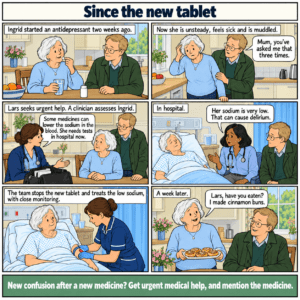
Read story D07: Since the new tablet (image and text)
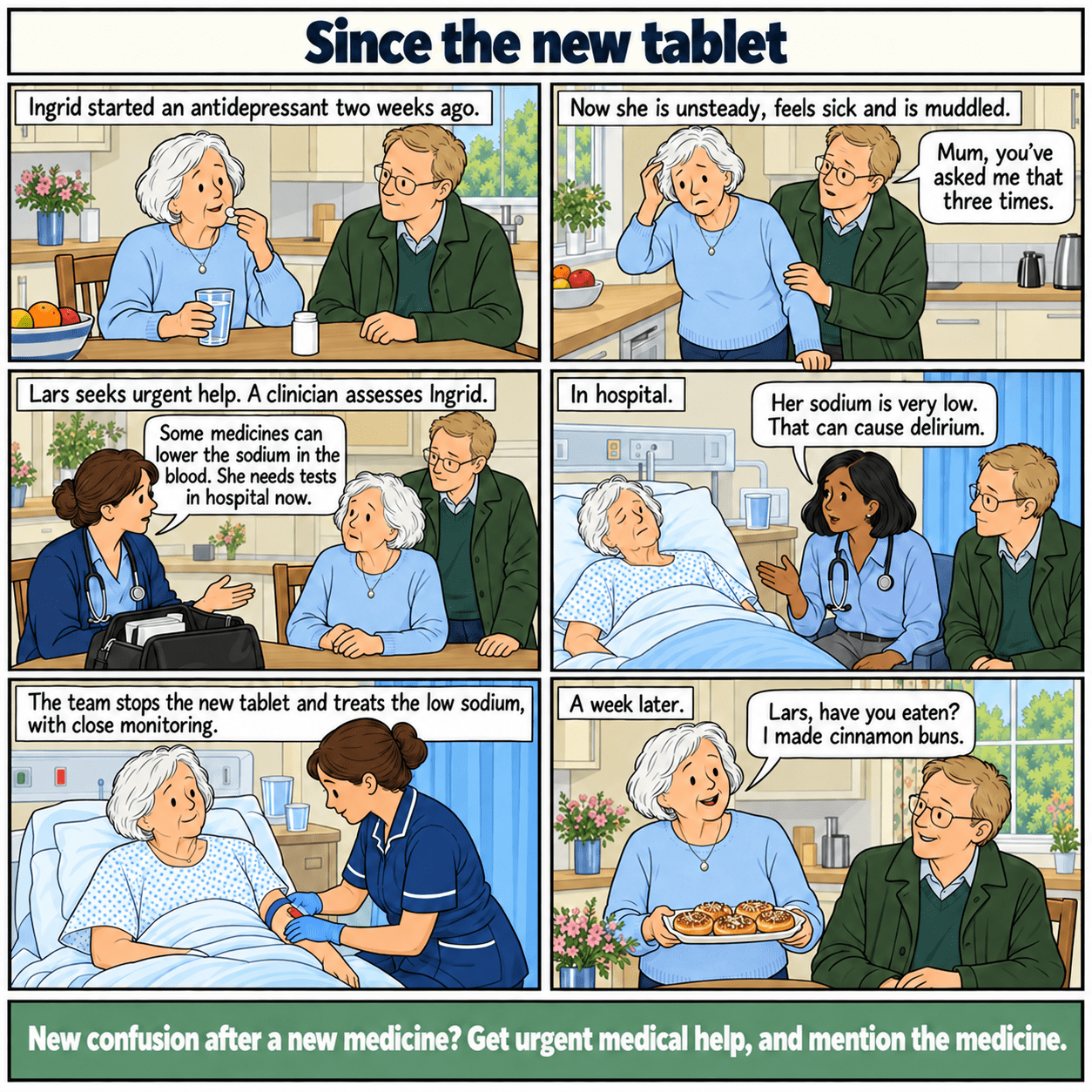
Since the new tablet
Ingrid becomes unsteady, sick and confused after starting a medicine. Blood tests show very low sodium. Some medicines can lower sodium, including certain antidepressants and water tablets.
Sudden confusion needs urgent assessment. Tell the team when a medicine was started or changed. They will check for other causes, review treatment and monitor correction of the sodium carefully. Do not adjust prescribed medicines yourself. This story shows one possible recovery; treatment and timing depend on the person’s condition.
Story text
Panel 1. Ingrid started an antidepressant two weeks ago.
Panel 2. Now she is unsteady, feels sick and is muddled.
- Lars: Mum, you've asked me that three times.
Panel 3. Lars seeks urgent help. A clinician assesses Ingrid.
- GP: Some medicines can lower the sodium in the blood. She needs tests in hospital now.
Panel 4. In hospital.
- Doctor: Her sodium is very low. That can cause delirium.
Panel 5. The team stops the new tablet and treats the low sodium, with close monitoring.
Panel 6. A week later.
- Ingrid: Lars, have you eaten? I made cinnamon buns.
Bottom band. New confusion after a new medicine? Get urgent medical help, and mention the medicine.
Story D08 · Example case
On time, every time
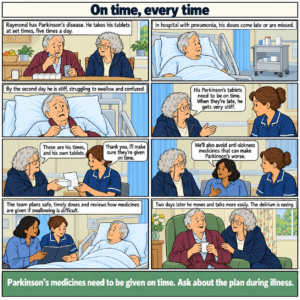
Read story D08: On time, every time (image and text)
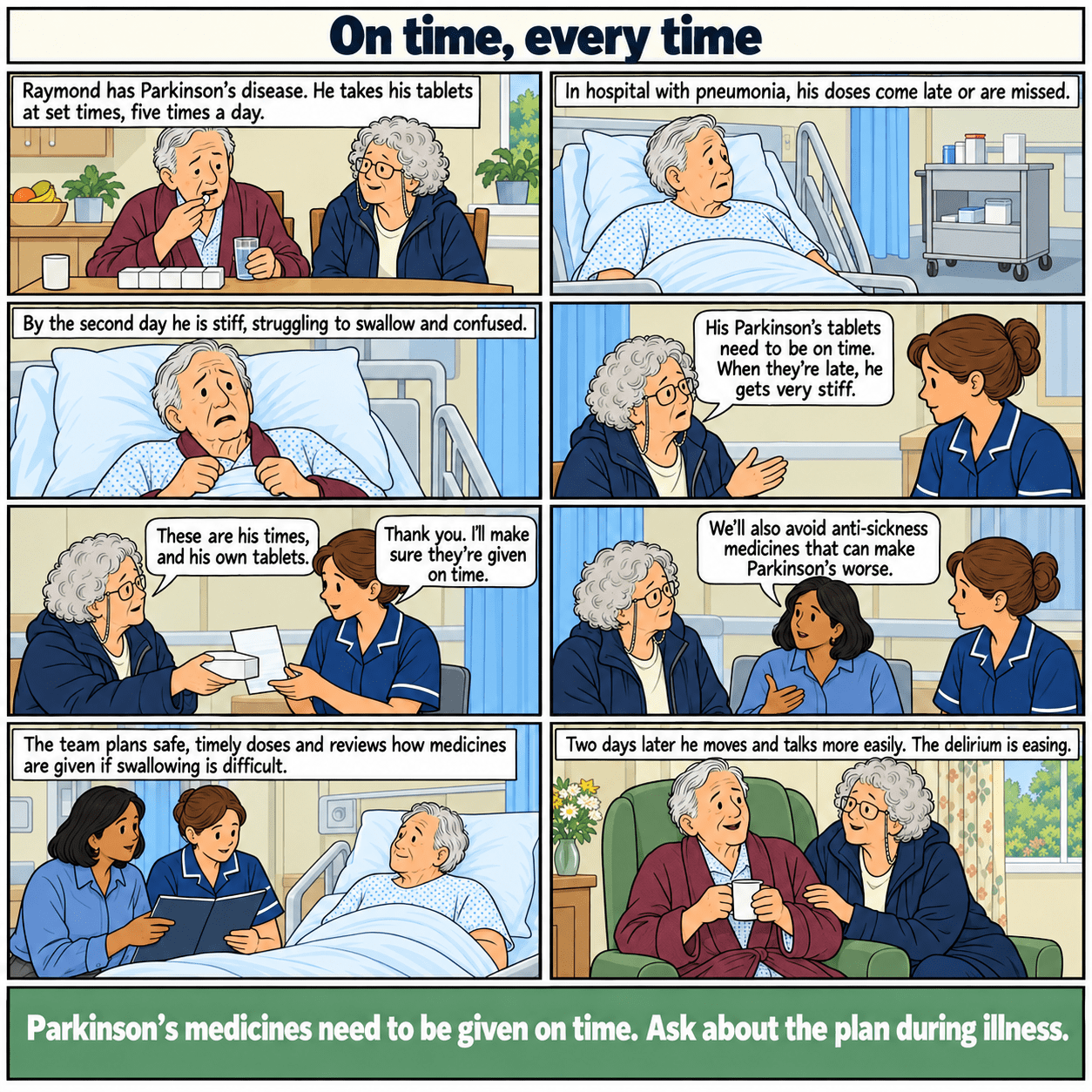
On time, every time
Raymond’s Parkinson’s medicines are missed during an admission for pneumonia. He becomes stiffer, has difficulty swallowing and develops delirium. Illness and medicine problems both need review.
Tell staff the person’s usual medicine times. Parkinson’s medicines need to be given on time, and swallowing problems need an urgent plan from the treating team. Some medicines used for sickness or distress worsen Parkinson’s; haloperidol must not be used. The team should involve Parkinson’s specialists when treatment needs changing.
Story text
Panel 1. Raymond has Parkinson's disease. He takes his tablets at set times, five times a day.
Panel 2. In hospital with pneumonia, his doses come late or are missed.
Panel 3. By the second day he is stiff, struggling to swallow and confused.
Panel 4.
- Brenda: His Parkinson's tablets need to be on time. When they're late, he gets very stiff.
Panel 5.
- Brenda: These are his times, and his own tablets.
- Nurse: Thank you. I'll make sure they're given on time.
Panel 6.
- Doctor: We'll also avoid anti-sickness medicines that can make Parkinson's worse.
Panel 7. The team plans safe, timely doses and reviews how medicines are given if swallowing is difficult.
Panel 8. Two days later he moves and talks more easily. The delirium is easing.
Bottom band. Parkinson’s medicines need to be given on time. Ask about the plan during illness.
Story D09 · Example case
After the broken hip
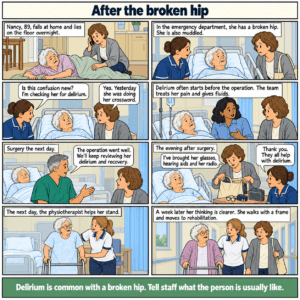
Read story D09: After the broken hip (image and text)
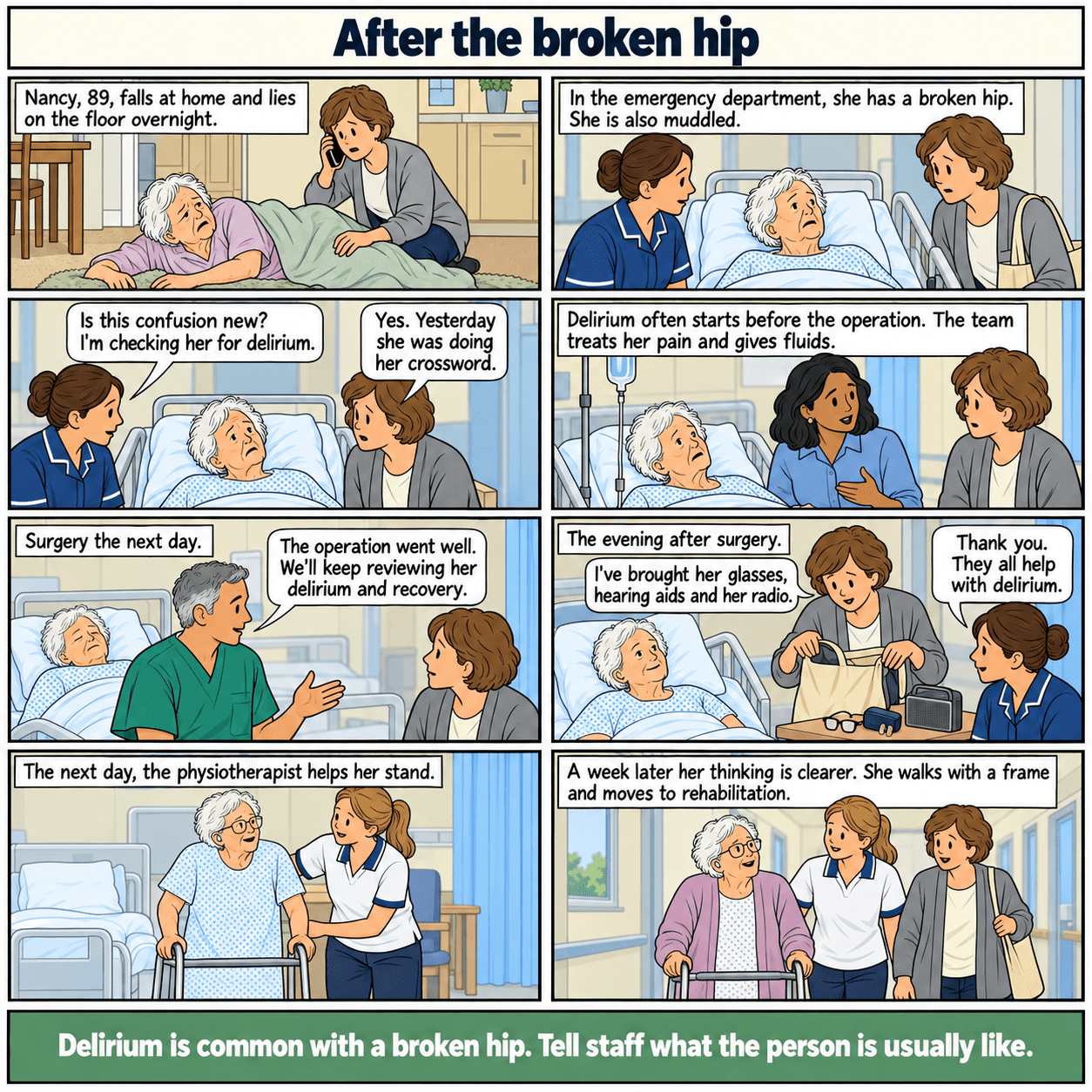
After the broken hip
Nancy is already confused when she reaches hospital with a broken hip. Delirium can begin before surgery as well as afterwards. Staff assess the new change and treat her pain and other needs.
Tell the team what the person was like before the fall. Care includes repeated assessment, appropriate pain relief, nutrition and fluids, help with movement, and hearing or vision aids where needed. Recovery varies. A clearer conversation does not mean that walking and other daily activities have fully recovered.
Story text
Panel 1. Nancy, 89, falls at home and lies on the floor overnight.
Panel 2. In the emergency department, she has a broken hip. She is also muddled.
Panel 3.
- Nurse: Is this confusion new? I'm checking her for delirium.
- Sue: Yes. Yesterday she was doing her crossword.
Panel 4. Delirium often starts before the operation. The team treats her pain and gives fluids.
Panel 5. Surgery the next day.
- Surgeon: The operation went well. We’ll keep reviewing her delirium and recovery.
Panel 6. The evening after surgery.
- Sue: I've brought her glasses, hearing aids and her radio.
- Nurse: Thank you. They all help with delirium.
Panel 7. The next day, the physiotherapist helps her stand.
Panel 8. A week later her thinking is clearer. She walks with a frame and moves to rehabilitation.
Bottom band. Delirium is common with a broken hip. Tell staff what the person is usually like.
Story D12 · Example case
Why is Grandad talking like that?
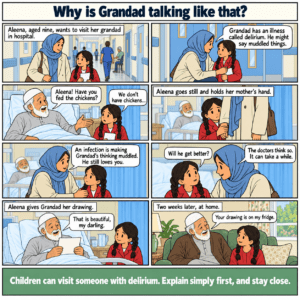
Read story D12: Why is Grandad talking like that? (image and text)

Why is Grandad talking like that?
Aleena wants to visit her grandad while he has delirium. Her mother explains beforehand that illness is affecting his thinking and stays beside her during the visit.
Check visiting arrangements with staff and consider what the child wants. Use simple, truthful explanations, allow questions and keep visits manageable. Let the child leave if they wish. Explain that the illness is not their fault. Recovery differs between people; this example shows one grandparent improving and returning home.
Story text
Panel 1. Aleena, aged nine, wants to visit her grandad in hospital.
Panel 2.
- Sana: Grandad has an illness called delirium. He might say muddled things.
Panel 3.
- Yusuf: Aleena! Have you fed the chickens?
- Aleena: We don't have chickens…
Panel 4. Aleena goes still and holds her mother's hand.
Panel 5.
- Sana: An infection is making Grandad's thinking muddled. He still loves you.
Panel 6.
- Aleena: Will he get better?
- Sana: The doctors think so. It can take a while.
Panel 7. Aleena gives Grandad her drawing.
- Yusuf: That is beautiful, my darling.
Panel 8. Two weeks later, at home.
- Yusuf: Your drawing is on my fridge.
Bottom band. Children can visit someone with delirium. Explain simply first, and stay close.
Story D13 · Example case
Treated at home
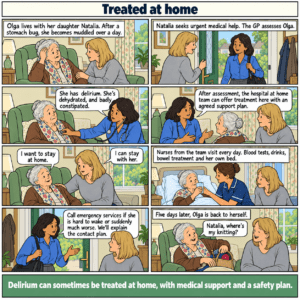
Read story D13: Treated at home (image and text)
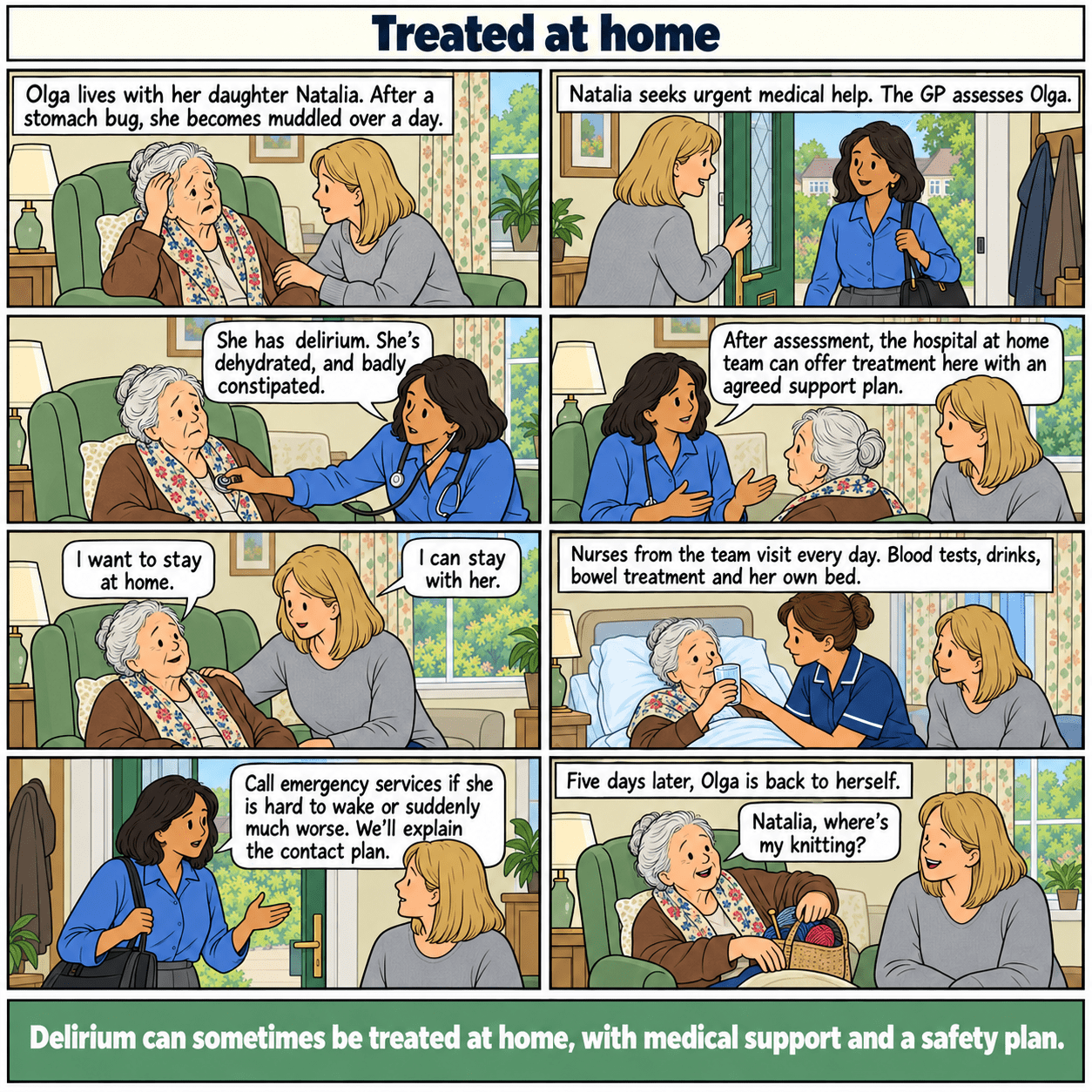
Treated at home
Olga develops delirium and receives urgent medical assessment. The team decides that hospital treatment at home is suitable in her circumstances, with regular clinical visits and an agreed support plan.
This service is available in some places. It is suitable only after assessment of the illness, treatment needs, safety and available support. Ask who is responsible, when visits will happen and how to get help between visits. Care should not depend on a relative providing more support than they can manage. Difficulty waking or severe deterioration needs emergency help.
Story text
Panel 1. Olga lives with her daughter Natalia. After a stomach bug, she becomes muddled over a day.
Panel 2. Natalia seeks urgent medical help. The GP assesses Olga.
Panel 3.
- GP: She has delirium. She's dehydrated, and badly constipated.
Panel 4.
- GP: After assessment, the hospital at home team can offer treatment here with an agreed support plan.
Panel 5.
- Olga: I want to stay at home.
- Natalia: I can stay with her.
Panel 6. Nurses from the team visit every day. Blood tests, drinks, bowel treatment and her own bed.
Panel 7.
- GP: Call emergency services if she is hard to wake or suddenly much worse. We’ll explain the contact plan.
Panel 8. Five days later, Olga is back to herself.
- Olga: Natalia, where's my knitting?
Bottom band. Delirium can sometimes be treated at home, with medical support and a safety plan.
When delirium lasts
Story B09
Another week
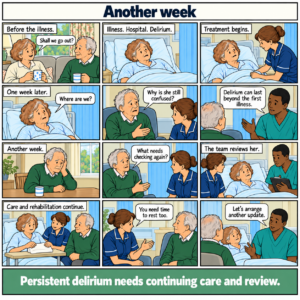
Read story B09: Another week (image and text)
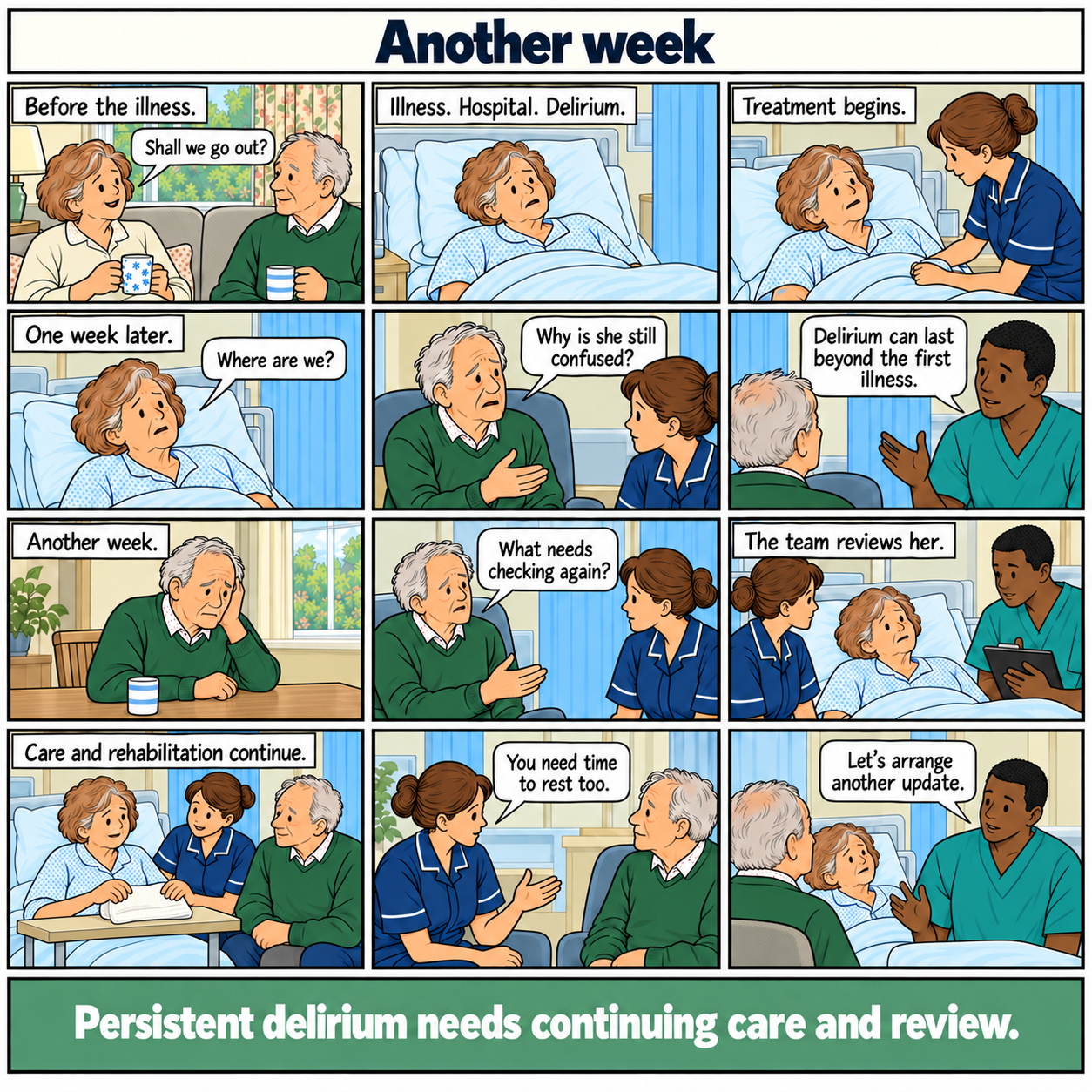
Some delirium episodes last for weeks or months. Families may wait for recovery while trying to manage work and visits when they are exhausted.
If confusion continues, ask the team to check again. Ask what has been treated, what still needs checking and what support or help to regain everyday skills is planned. It is also reasonable to ask for regular updates and help with a visiting plan you can manage. Nobody can promise a recovery date simply because the first illness has improved.
Story text
-
Panel 1. Before the illness.
- Eileen: Shall we go out?
-
Panel 2. Illness. Hospital. Delirium.
-
Panel 3. Treatment begins.
-
Panel 4. One week later.
- Eileen: Where are we?
-
Panel 5.
- Peter: Why is she still confused?
-
Panel 6.
- Doctor: Delirium can last beyond the first illness.
-
Panel 7. Another week.
-
Panel 8.
- Peter: What needs checking again?
-
Panel 9. The team reviews her.
-
Panel 10. Care and rehabilitation continue.
-
Panel 11.
- Nurse: You need time to rest too.
-
Panel 12.
- Doctor: Let’s arrange another update.
Bottom band. Persistent delirium needs continuing care and review.
Story B15
The clearer hour
Read story B15: The clearer hour (image and text)
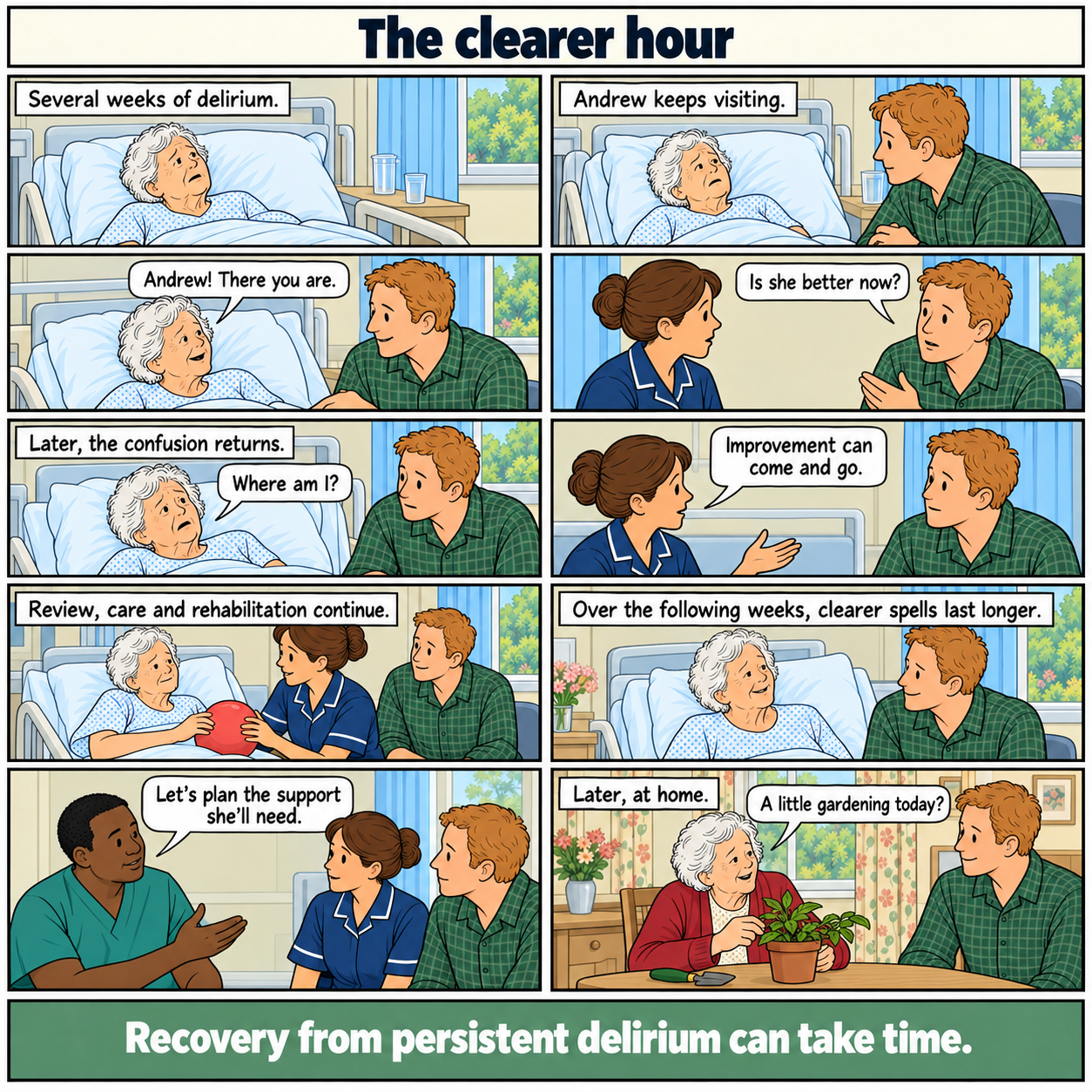
Recovery from delirium that lasts for weeks or months can be slow and uneven. A clearer conversation may be followed by another period of confusion. That can be hard for families who have been waiting for a sign of improvement.
This illustrated story shows one possible course: gradual recovery over weeks, with continued review, care and help to regain everyday skills. Other people recover differently, and some do not recover fully. Ask what has changed and what support is needed now.
Story text
-
Panel 1. Several weeks of delirium.
-
Panel 2. Andrew keeps visiting.
-
Panel 3.
- Elsie: Andrew! There you are.
-
Panel 4.
- Andrew: Is she better now?
-
Panel 5. Later, the confusion returns.
- Elsie: Where am I?
-
Panel 6.
- Nurse: Improvement can come and go.
-
Panel 7. Review, care and rehabilitation continue.
-
Panel 8. Over the following weeks, clearer spells last longer.
-
Panel 9.
- Doctor: Let’s plan the support she’ll need.
-
Panel 10. Later, at home.
- Elsie: A little gardening today?
Bottom band. Recovery from persistent delirium can take time.
Story B21
No better after treatment
Read story B21: No better after treatment (image and text)
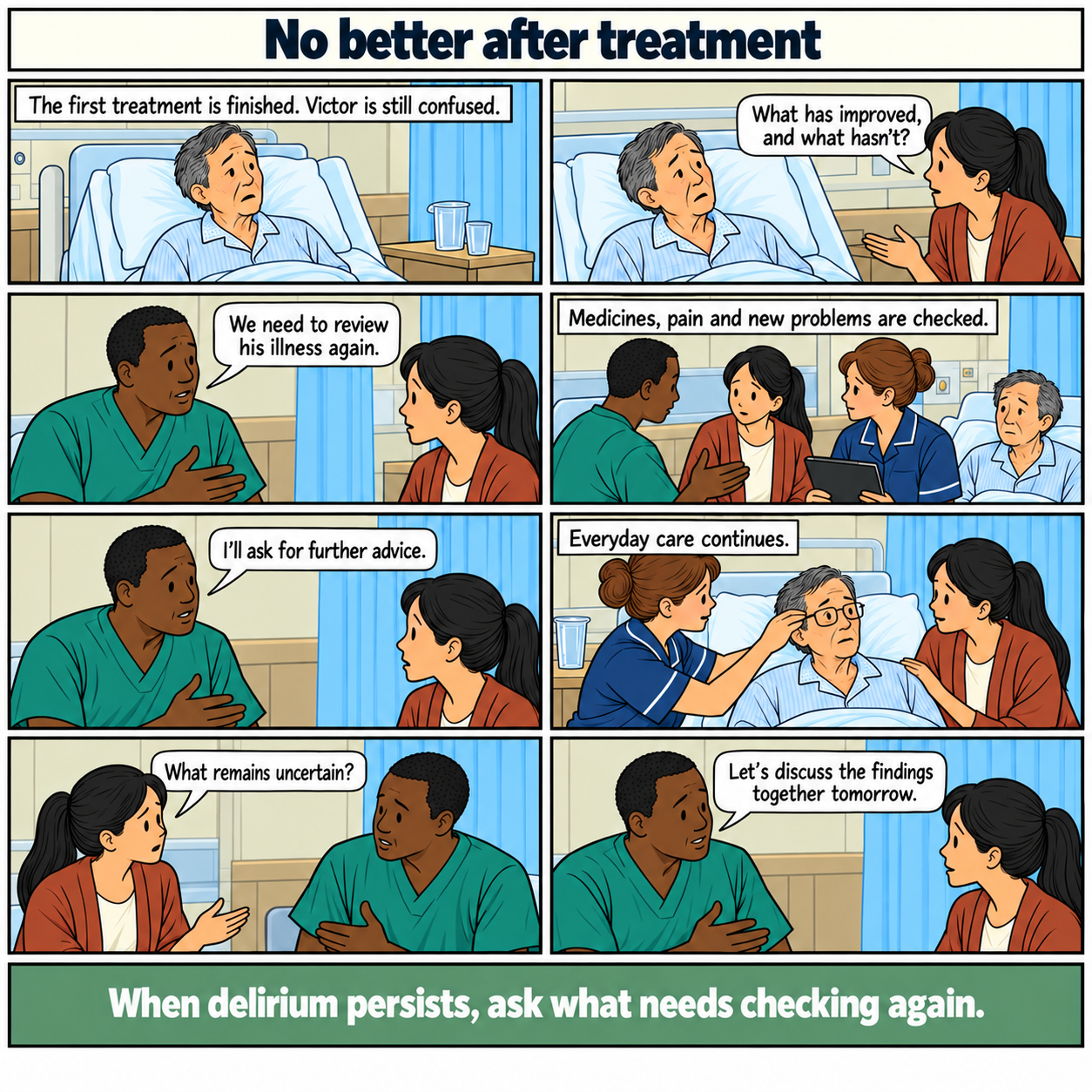
When delirium continues, it is reasonable to ask for another explanation of the plan. Has the original illness improved? Could medicines, pain or a new problem be contributing? What has been checked, and what happens next?
When delirium lasts a long time, there is not always an untreated cause that can be put right quickly. Continuing uncertainty still needs clear communication, ongoing care and review. Ask when you will next have an update and whom to contact if the person worsens.
Story text
-
Panel 1. The first treatment is finished. Victor is still confused.
-
Panel 2.
- Amy: What has improved, and what hasn’t?
-
Panel 3.
- Doctor: We need to review his illness again.
-
Panel 4. Medicines, pain and new problems are checked.
-
Panel 5.
- Doctor: I’ll ask for further advice.
-
Panel 6. Everyday care continues.
-
Panel 7.
- Amy: What remains uncertain?
-
Panel 8.
- Doctor: Let’s discuss the findings together tomorrow.
Bottom band. When delirium persists, ask what needs checking again.
Story B49
Home is different now
Read story B49: Home is different now (image and text)
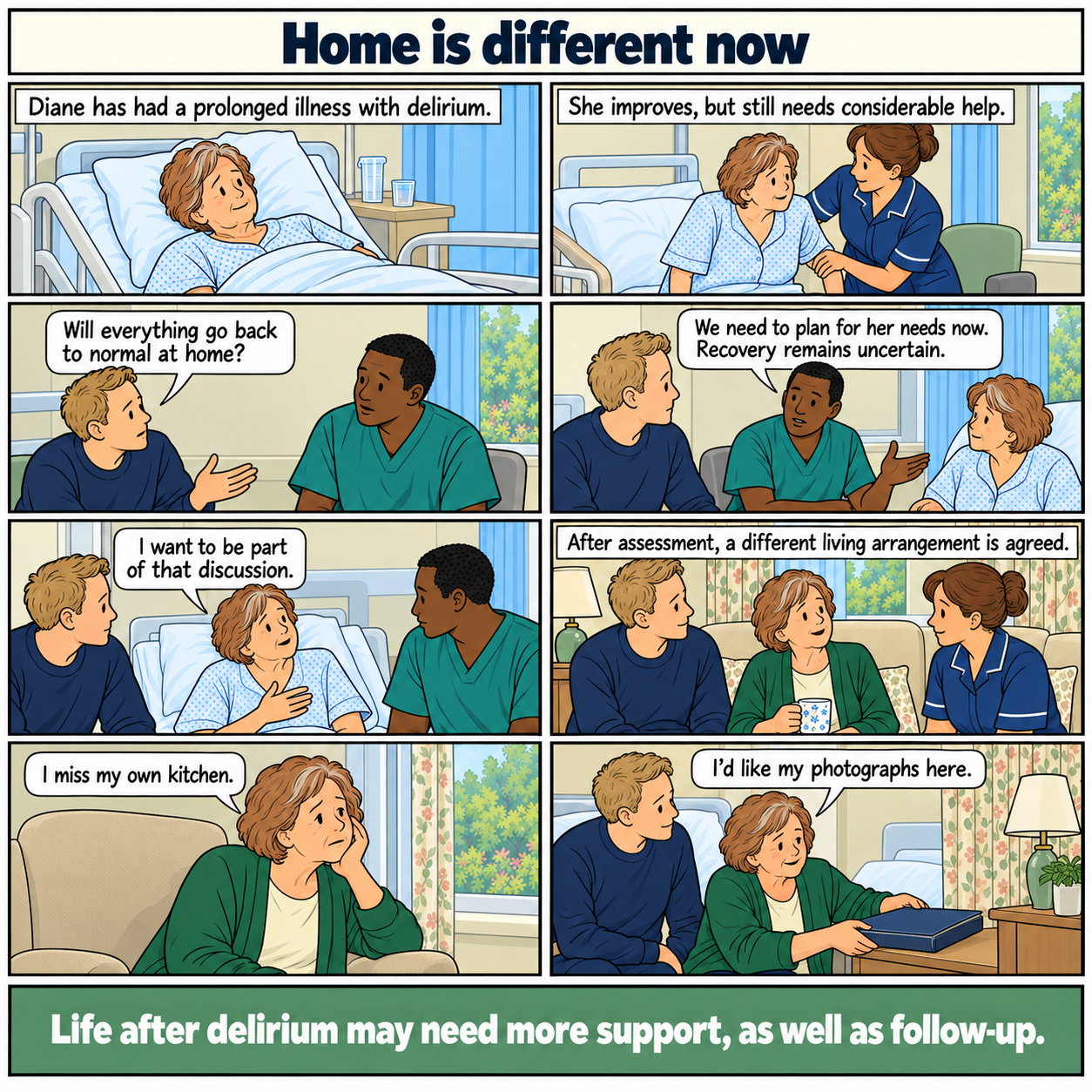
After a prolonged illness with delirium, some people need more help than before. Recovery may be incomplete or uncertain, and a change in living arrangements can bring a real sense of loss.
Planning should include careful assessment, help to regain everyday skills where appropriate and the person’s own wishes and choices. Continuing difficulties are not automatically continuing delirium. Ask what support is needed now and what will be reviewed as time passes. Include the person in everyday choices about their care.
Story text
-
Panel 1. Diane has had a prolonged illness with delirium.
-
Panel 2. She improves, but still needs considerable help.
-
Panel 3.
- Steven: Will everything go back to normal at home?
-
Panel 4.
- Doctor: We need to plan for her needs now. Recovery remains uncertain.
-
Panel 5.
- Diane: I want to be part of that discussion.
-
Panel 6. After assessment, a different living arrangement is agreed.
-
Panel 7.
- Diane: I miss my own kitchen.
-
Panel 8.
- Diane: I’d like my photographs here.
Bottom band. Life after delirium may need more support, as well as follow-up.
Story C18 · Example case
Six weeks is not a diagnosis
Read story C18: Six weeks is not a diagnosis (image and text)
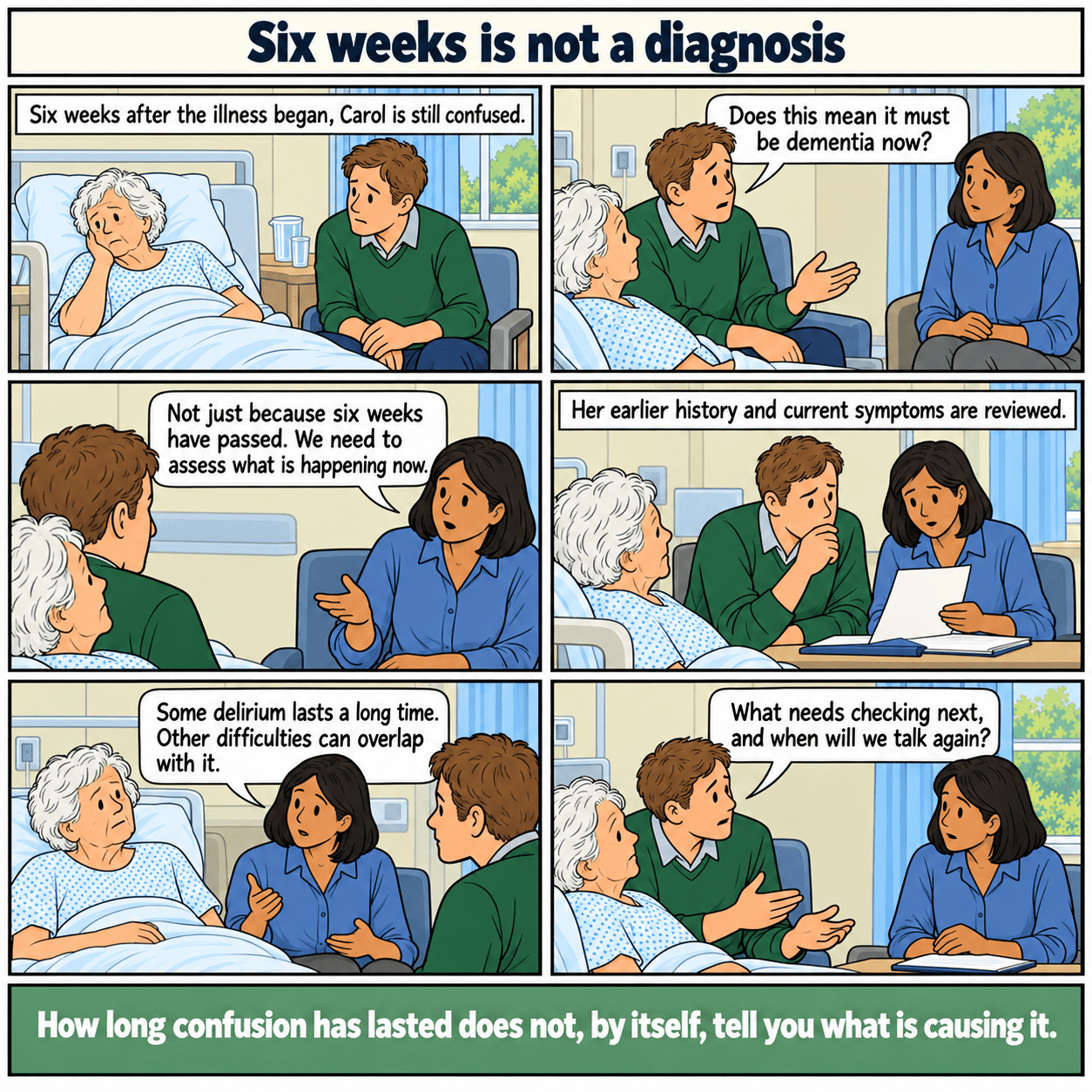
Persistent delirium or dementia? Understanding a prolonged illness
Carol remains confused six weeks after becoming ill. Dan wonders whether that means the diagnosis must now be dementia. The team reassesses her current symptoms, earlier abilities and possible contributors. Persistent delirium and longer-term cognitive problems can be difficult to separate. Duration alone does not answer the question or remove the need for care.
Story text
Panel 1. Six weeks after the illness began, Carol is still confused.
Panel 2.
- Dan: Does this mean it must be dementia now?
Panel 3.
- Doctor: Not just because six weeks have passed. We need to assess what is happening now.
Panel 4. Her earlier history and current symptoms are reviewed.
Panel 5.
- Doctor: Some delirium lasts a long time. Other difficulties can overlap with it.
Panel 6.
- Dan: What needs checking next, and when will we talk again?
Bottom band. How long confusion has lasted does not, by itself, tell you what is causing it.
Story C19 · Example case
The first full conversation
Read story C19: The first full conversation (image and text)
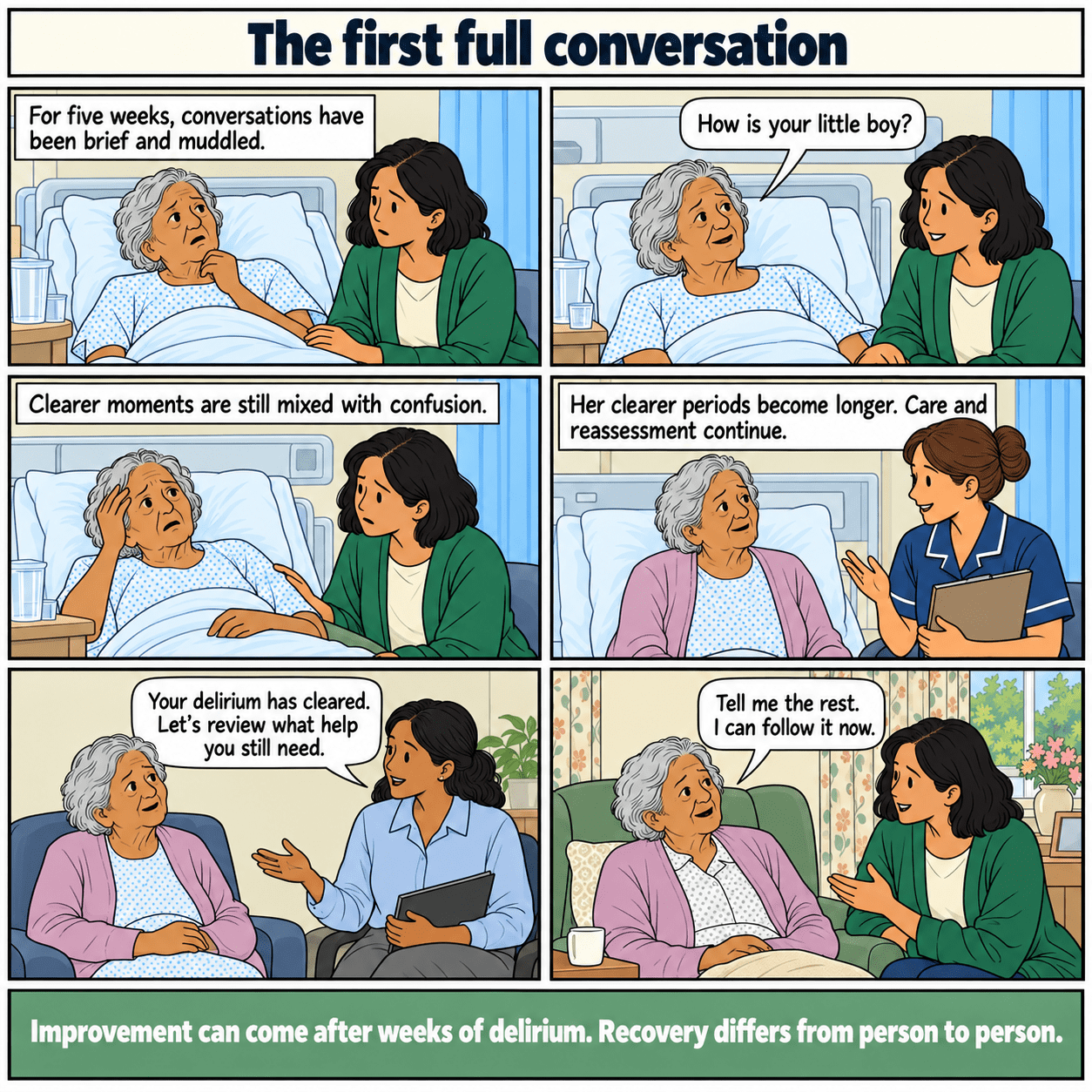
Can someone recover after weeks of delirium?
After weeks of delirium, Amina begins to have longer periods of clearer thinking. These periods gradually last longer while assessment, treatment and rehabilitation continue. Later she can follow a full conversation, although she still needs help. This is one possible recovery, not a timetable or a promise about another person.
Story text
Panel 1. For five weeks, conversations have been brief and muddled.
Panel 2.
- Amina: How is your little boy?
Panel 3. Clearer moments are still mixed with confusion.
Panel 4. Her clearer periods become longer. Care and reassessment continue.
Panel 5.
- Doctor: Your delirium has cleared. Let’s review what help you still need.
Panel 6.
- Amina: Tell me the rest. I can follow it now.
Bottom band. Improvement can come after weeks of delirium. Recovery differs from person to person.
Story C20 · Example case
Care while we wait
Read story C20: Care while we wait (image and text)
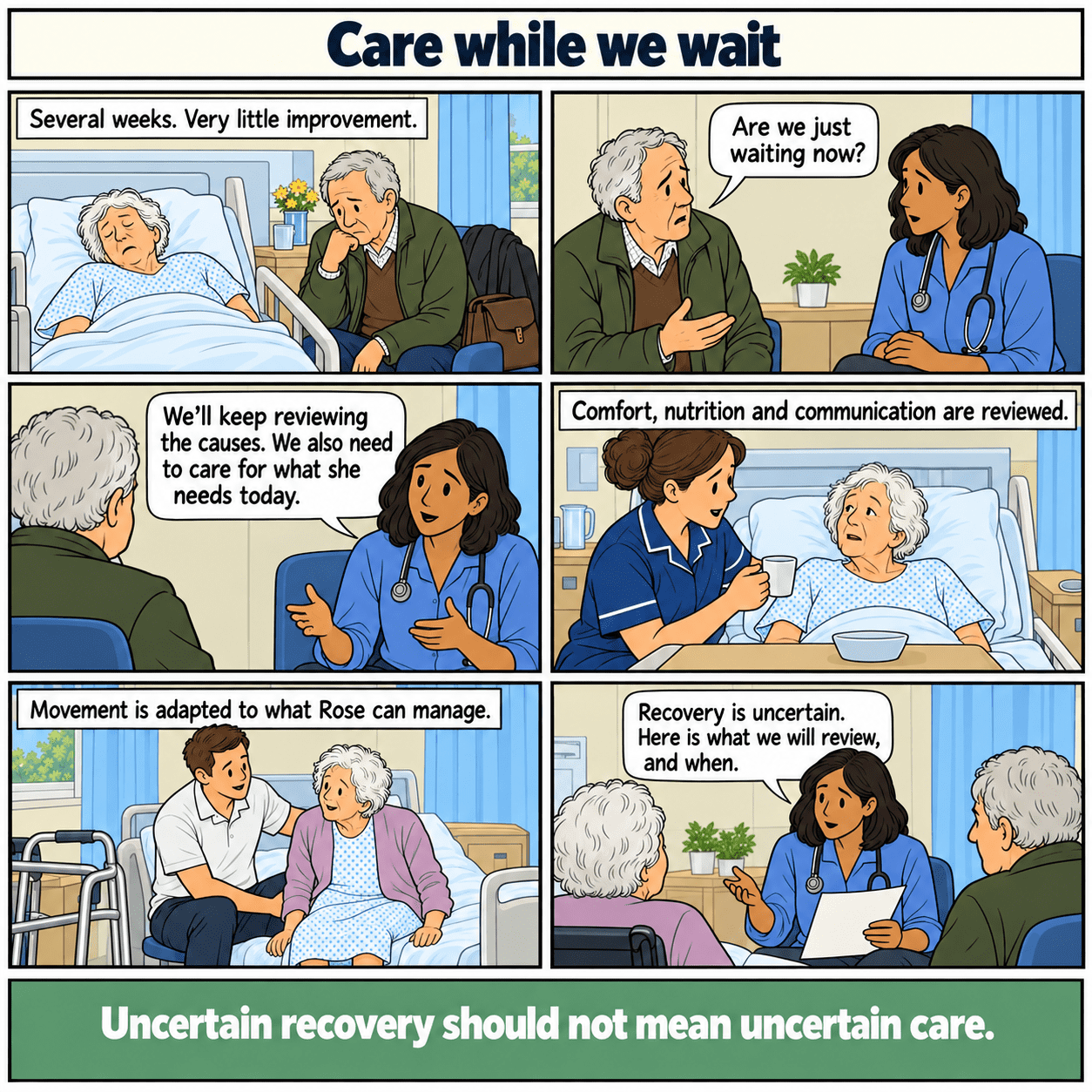
When delirium is not improving: care, comfort and a continuing plan
Rose’s delirium has changed little over several weeks. Frank hears that recovery is uncertain and wonders whether anything useful is still being done. Her team explains the continuing medical review and everyday care. Uncertainty about recovery is not a reason to abandon comfort, nutrition, safe movement, communication or a clear plan.
Story text
Panel 1. Several weeks. Very little improvement.
Panel 2.
- Frank: Are we just waiting now?
Panel 3.
- Doctor: We’ll keep reviewing the causes. We also need to care for what she needs today.
Panel 4. Comfort, nutrition and communication are reviewed.
Panel 5. Movement is adapted to what Rose can manage.
Panel 6.
- Doctor: Recovery is uncertain. Here is what we will review, and when.
Bottom band. Uncertain recovery should not mean uncertain care.
Story C21 · Example case
A new illness, not a bad day
Read story C21: A new illness, not a bad day (image and text)
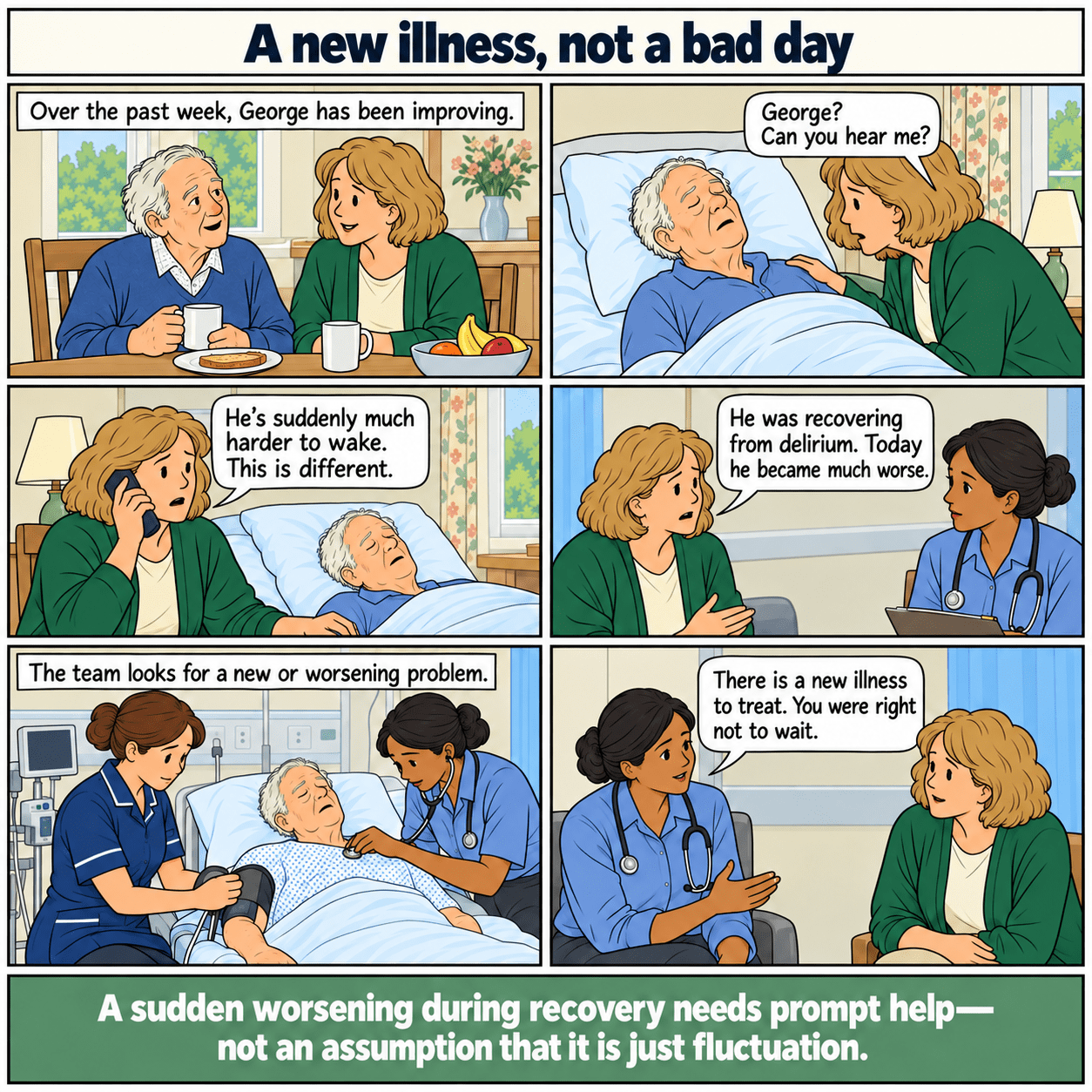
Sudden worsening during delirium recovery: when to seek help again
George has been improving, then suddenly becomes much harder to wake and follow a conversation. Pat remembers that recovery can fluctuate, but recognises a major new change. She seeks emergency help. A worsening illness or another problem may interrupt recovery; it should not automatically be dismissed as one of the ups and downs of delirium.
Story text
Panel 1. Over the past week, George has been improving.
Panel 2.
- Pat: George? Can you hear me?
Panel 3.
- Pat: He’s suddenly much harder to wake. This is different.
Panel 4.
- Pat: He was recovering from delirium. Today he became much worse.
Panel 5. The team looks for a new or worsening problem.
Panel 6.
- Clinician: There is a new illness to treat. You were right not to wait.
Bottom band. A sudden worsening during recovery needs prompt help—not an assumption that it is just fluctuation.
Story C23 · Example case
A question without a date
Read story C23: A question without a date (image and text)
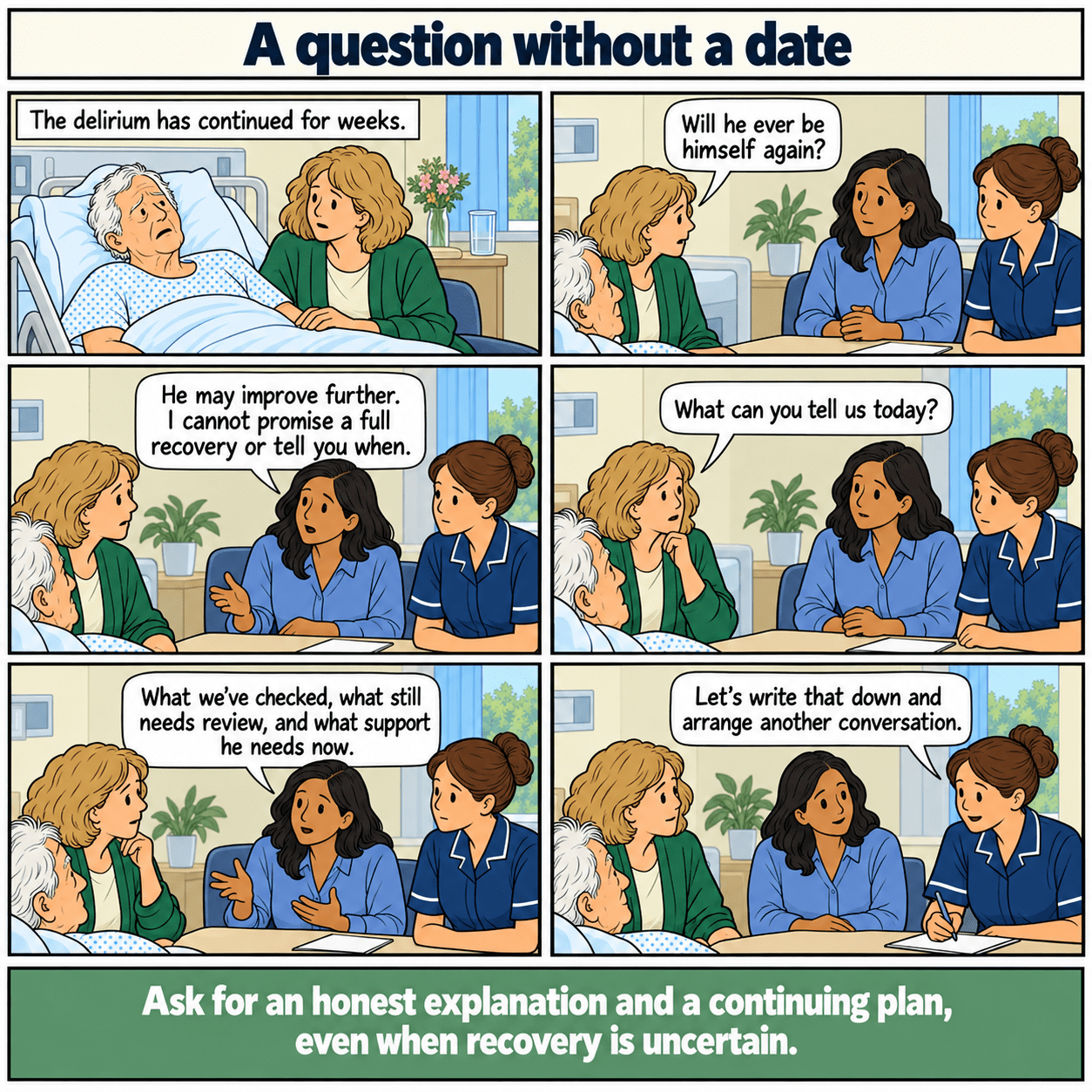
Will prolonged delirium get better? Discussing uncertainty
Beth wants to know whether Owen will return to his previous self. His recovery remains uncertain. The doctor explains what will be reviewed, asks about Owen’s needs and wishes, and agrees when they will talk again. Care and support continue while the team reassesses his progress.
Story text
Panel 1. The delirium has continued for weeks.
Panel 2.
- Beth: Will he ever be himself again?
Panel 3.
- Doctor: He may improve further. I cannot promise a full recovery or tell you when.
Panel 4.
- Beth: What can you tell us today?
Panel 5.
- Doctor: What we’ve checked, what still needs review, and what support he needs now.
Panel 6.
- Nurse: Let’s write that down and arrange another conversation.
Bottom band. Ask for an honest explanation and a continuing plan, even when recovery is uncertain.
Recovery and going home
Story B16
Home needs a plan
Read story B16: Home needs a plan (image and text)
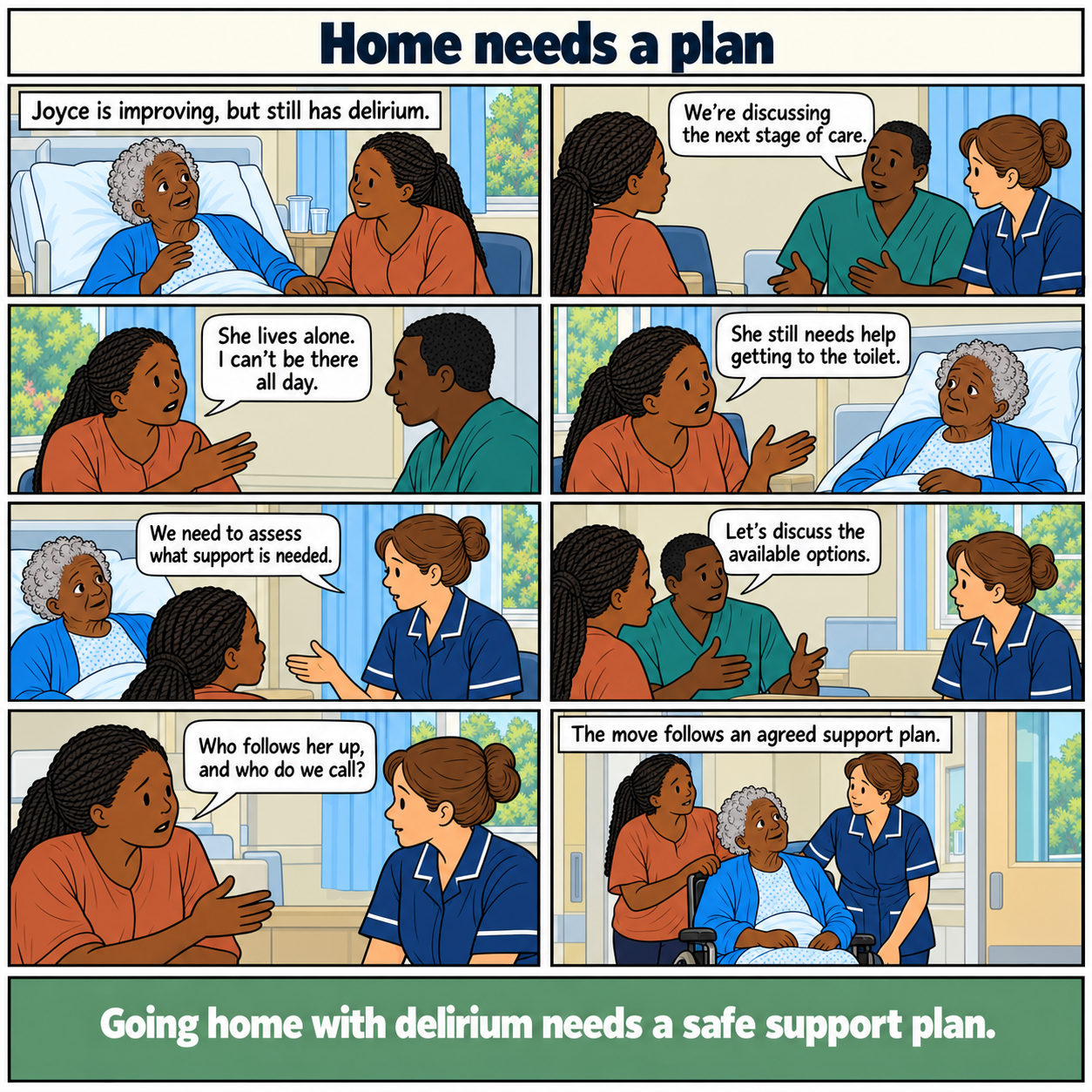
Being better than yesterday does not necessarily mean someone can manage safely at home. People may still have delirium, weakness or other care needs when staff discuss going home.
Be clear about what help is actually available and what tasks remain difficult. Ask about checks of what the person can manage, help to regain everyday skills, medicines, further appointments and whom to contact if things worsen. The plan should reflect the person’s needs and the support people can provide, rather than assuming that family members will manage everything.
Story text
-
Panel 1. Joyce is improving, but still has delirium.
-
Panel 2.
- Doctor: We’re discussing the next stage of care.
-
Panel 3.
- Denise: She lives alone. I can’t be there all day.
-
Panel 4.
- Denise: She still needs help getting to the toilet.
-
Panel 5.
- Nurse: We need to assess what support is needed.
-
Panel 6.
- Doctor: Let’s discuss the available options.
-
Panel 7.
- Denise: Who follows her up, and who do we call?
-
Panel 8. The move follows an agreed support plan.
Bottom band. Going home with delirium needs a safe support plan.
Story B19
Please tell me what happened
Read story B19: Please tell me what happened (image and text)
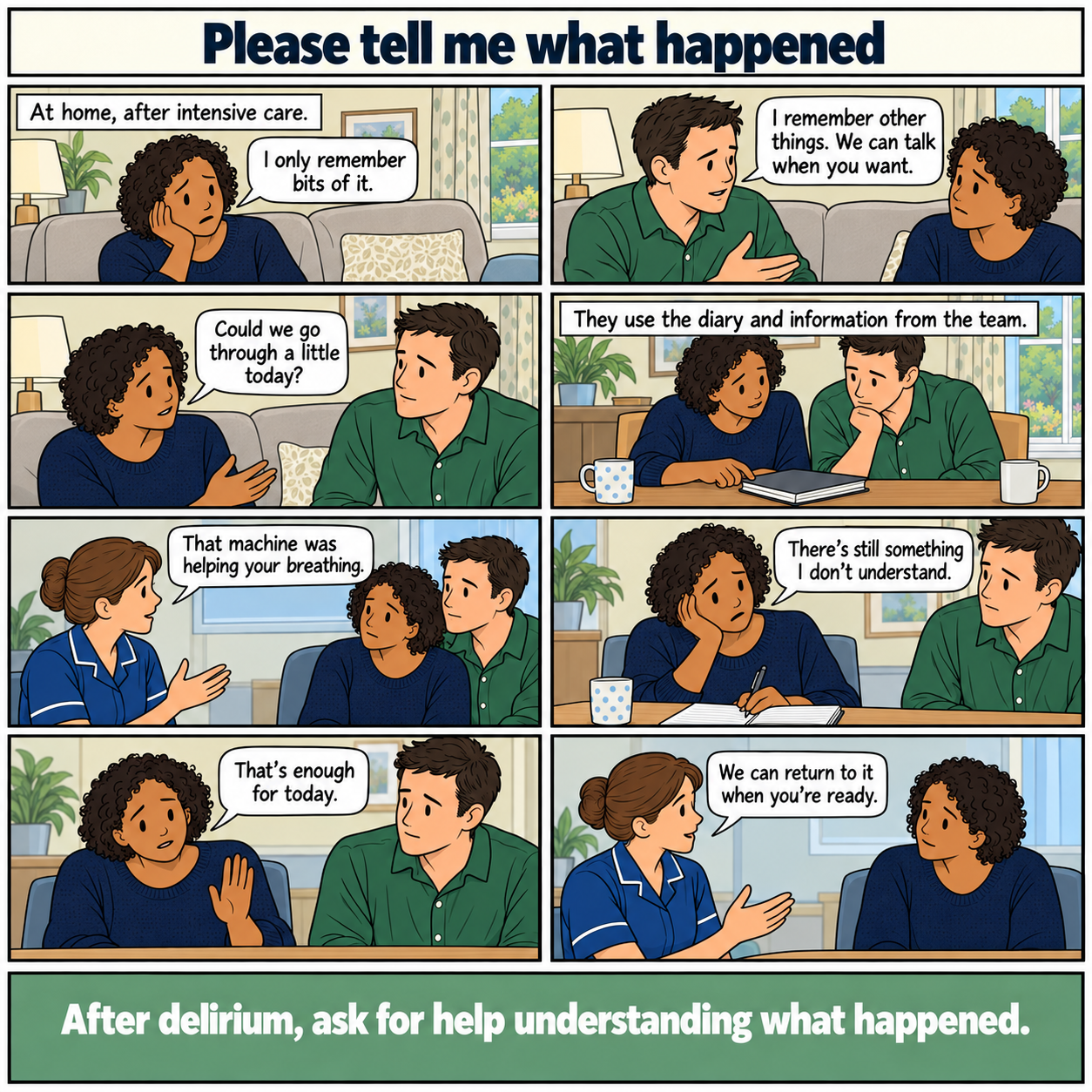
Memories of delirium and intensive care can be incomplete, very clear or difficult to explain. The person and their family may remember very different things.
Some people find it helpful to talk through the hospital stay, using information from the team or an intensive care diary if one is available. Others are not ready. Go at the person’s pace. If memories, nightmares or anxiety are affecting daily life, ask the family doctor or team seeing the person after hospital about support.
Story text
-
Panel 1. At home, after intensive care.
- Tessa: I only remember bits of it.
-
Panel 2.
- Dan: I remember other things. We can talk when you want.
-
Panel 3.
- Tessa: Could we go through a little today?
-
Panel 4. They use the diary and information from the team.
-
Panel 5.
- Nurse: That machine was helping your breathing.
-
Panel 6.
- Tessa: There’s still something I don’t understand.
-
Panel 7.
- Tessa: That’s enough for today.
-
Panel 8.
- Nurse: We can return to it when you’re ready.
Bottom band. After delirium, ask for help understanding what happened.
Story B20
A harder recovery
Read story B20: A harder recovery (image and text)
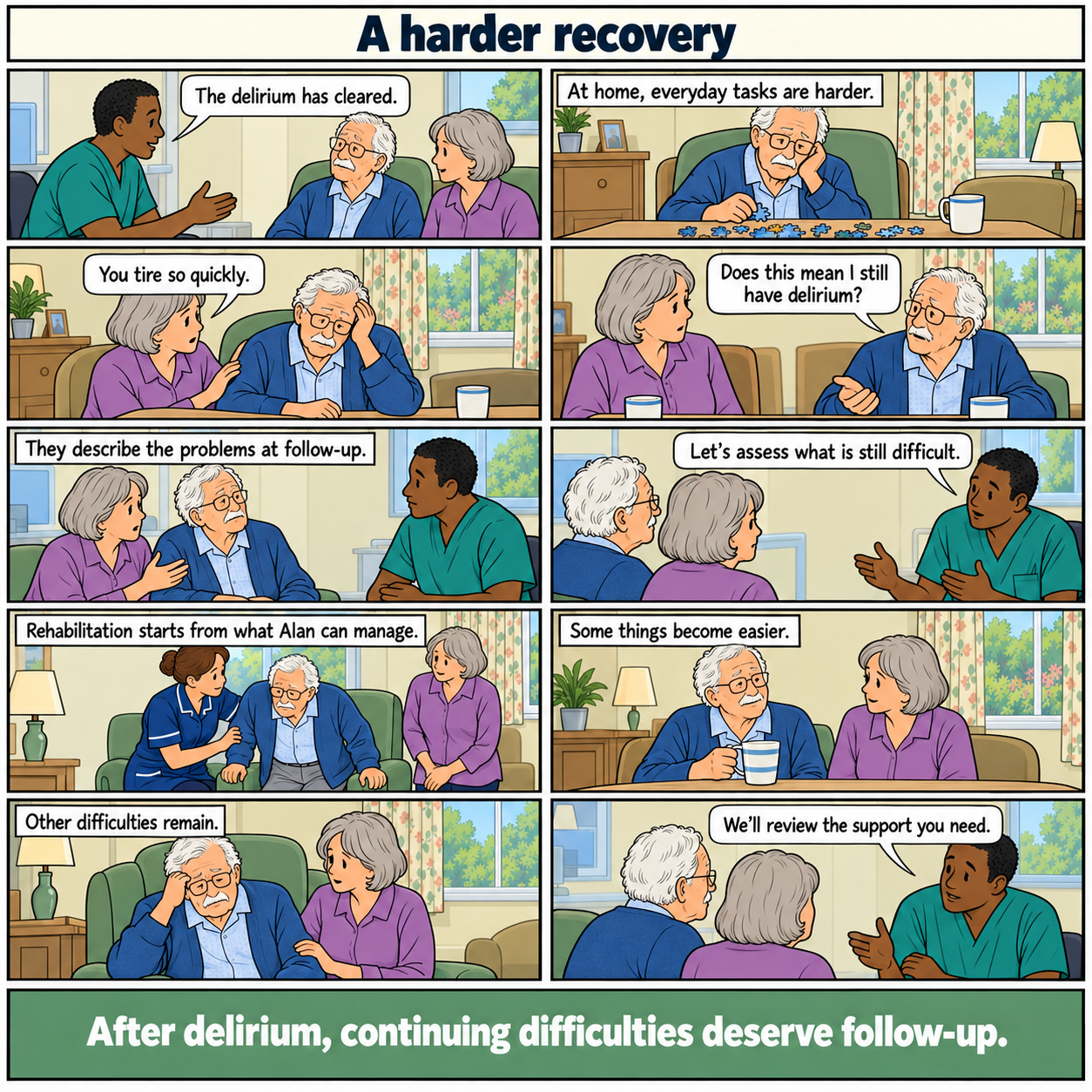
Delirium can clear while difficulties with strength, memory, concentration or everyday activities continue. Ask for these problems to be checked, and ask when the person will be seen again. They should not simply be dismissed because the hospital episode is over.
Tell the family doctor or team seeing the person after hospital what has changed and how it affects daily life. Recovery and the help needed to regain everyday skills vary from person to person. A new sudden worsening is different: seek urgent medical help rather than waiting for a planned appointment.
Story text
-
Panel 1.
- Doctor: The delirium has cleared.
-
Panel 2. At home, everyday tasks are harder.
-
Panel 3.
- June: You tire so quickly.
-
Panel 4.
- Alan: Does this mean I still have delirium?
-
Panel 5. They describe the problems at follow-up.
-
Panel 6.
- Doctor: Let’s assess what is still difficult.
-
Panel 7. Rehabilitation starts from what Alan can manage.
-
Panel 8. Some things become easier.
-
Panel 9. Other difficulties remain.
-
Panel 10.
- Doctor: We’ll review the support you need.
Bottom band. After delirium, continuing difficulties deserve follow-up.
Story B24
The words she said
Read story B24: The words she said (image and text)
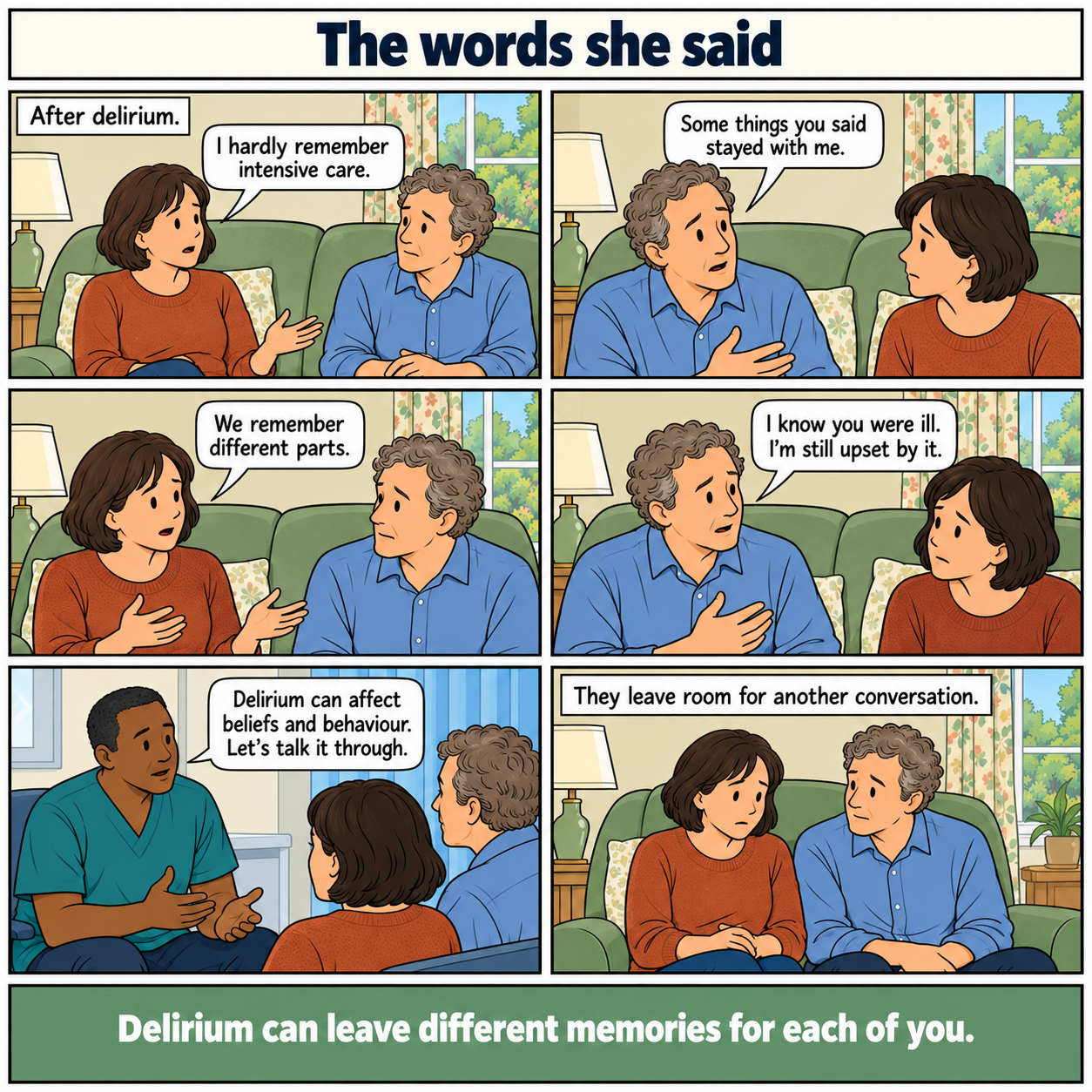
A person may remember little of delirium, while a relative remembers words or accusations that were painful to hear. Both people may need help to understand what happened.
Understanding that delirium affected the person’s thinking does not automatically remove the hurt. A conversation with the treating team or another appropriate professional may help explain what happened. There is no need to force a discussion before someone is ready, or to pretend that one conversation answers every question.
Story text
-
Panel 1. After delirium.
- Frances: I hardly remember intensive care.
-
Panel 2.
- Ben: Some things you said stayed with me.
-
Panel 3.
- Frances: We remember different parts.
-
Panel 4.
- Ben: I know you were ill. I’m still upset by it.
-
Panel 5.
- Doctor: Delirium can affect beliefs and behaviour. Let’s talk it through.
-
Panel 6. They leave room for another conversation.
Bottom band. Delirium can leave different memories for each of you.
Story B25
Still waking frightened
Read story B25: Still waking frightened (image and text)
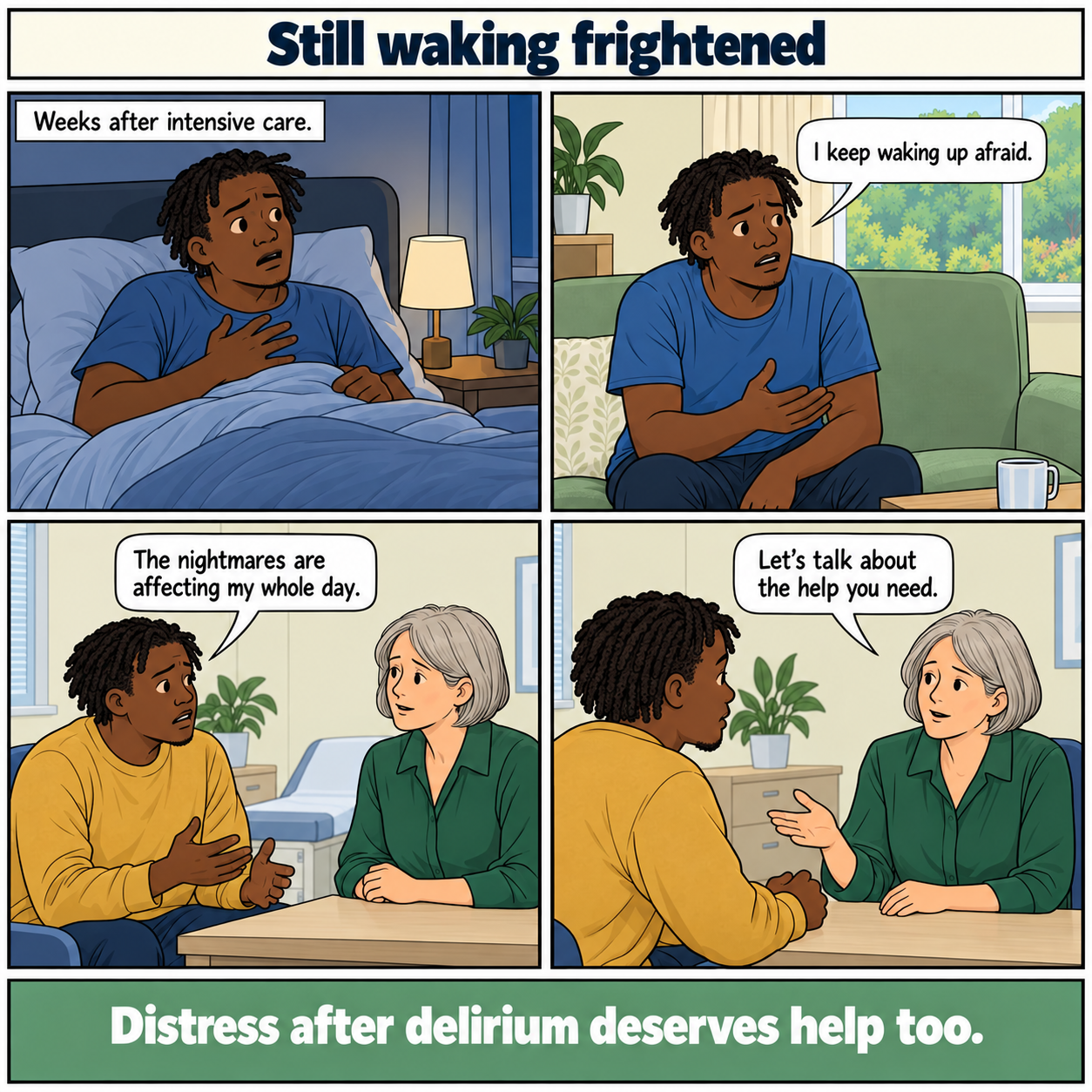
Distressing memories, nightmares and anxiety can continue after delirium. Some people find them difficult to mention, or feel that they should simply be grateful to have survived.
You can ask for help. Tell your family doctor or the team seeing you after hospital what you are experiencing, how often it happens and how it affects sleep or daily life. These symptoms deserve attention. You do not need to wait until you can explain every memory clearly.
Story text
-
Panel 1. Weeks after intensive care.
-
Panel 2.
- Isaac: I keep waking up afraid.
-
Panel 3.
- Isaac: The nightmares are affecting my whole day.
-
Panel 4.
- GP: Let’s talk about the help you need.
Bottom band. Distress after delirium deserves help too.
Story B26
Is this dementia now?
Read story B26: Is this dementia now? (image and text)
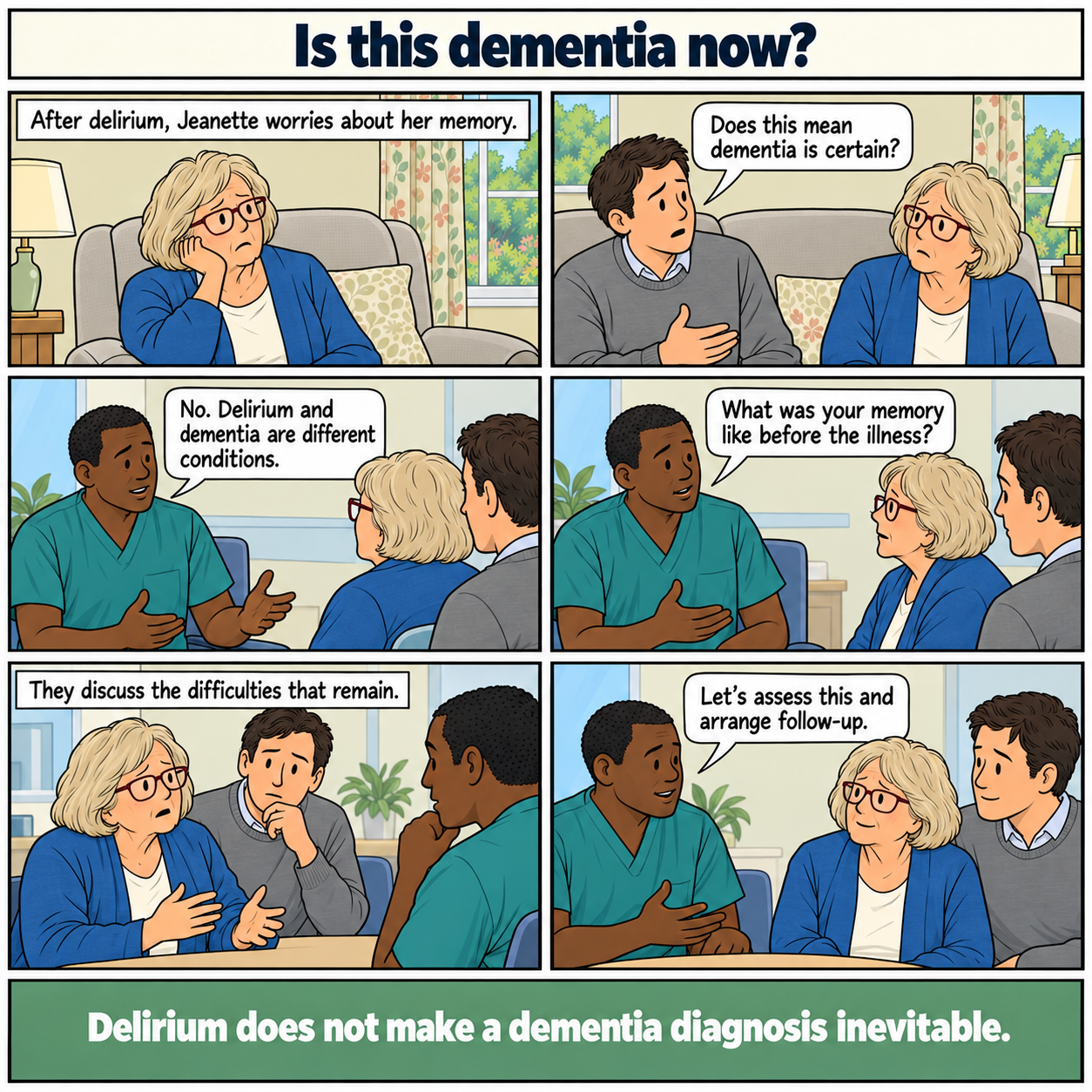
Delirium and dementia are different conditions, although they can occur together. Having delirium is linked with a higher risk of later problems with memory and thinking, but it does not make a future dementia diagnosis certain.
If memory or thinking difficulties remain, ask for a check by a doctor or nurse and further appointments. Information about the person’s abilities before the illness is useful. A new sudden change needs urgent help; longer-lasting concerns need a careful check by a doctor or nurse rather than assumptions about the diagnosis.
Story text
-
Panel 1. After delirium, Jeanette worries about her memory.
-
Panel 2.
- Simon: Does this mean dementia is certain?
-
Panel 3.
- Doctor: No. Delirium and dementia are different conditions.
-
Panel 4.
- Doctor: What was your memory like before the illness?
-
Panel 5. They discuss the difficulties that remain.
-
Panel 6.
- Doctor: Let’s assess this and arrange follow-up.
Bottom band. Delirium does not make a dementia diagnosis inevitable.
Story B28
What I can manage
Read story B28: What I can manage (image and text)
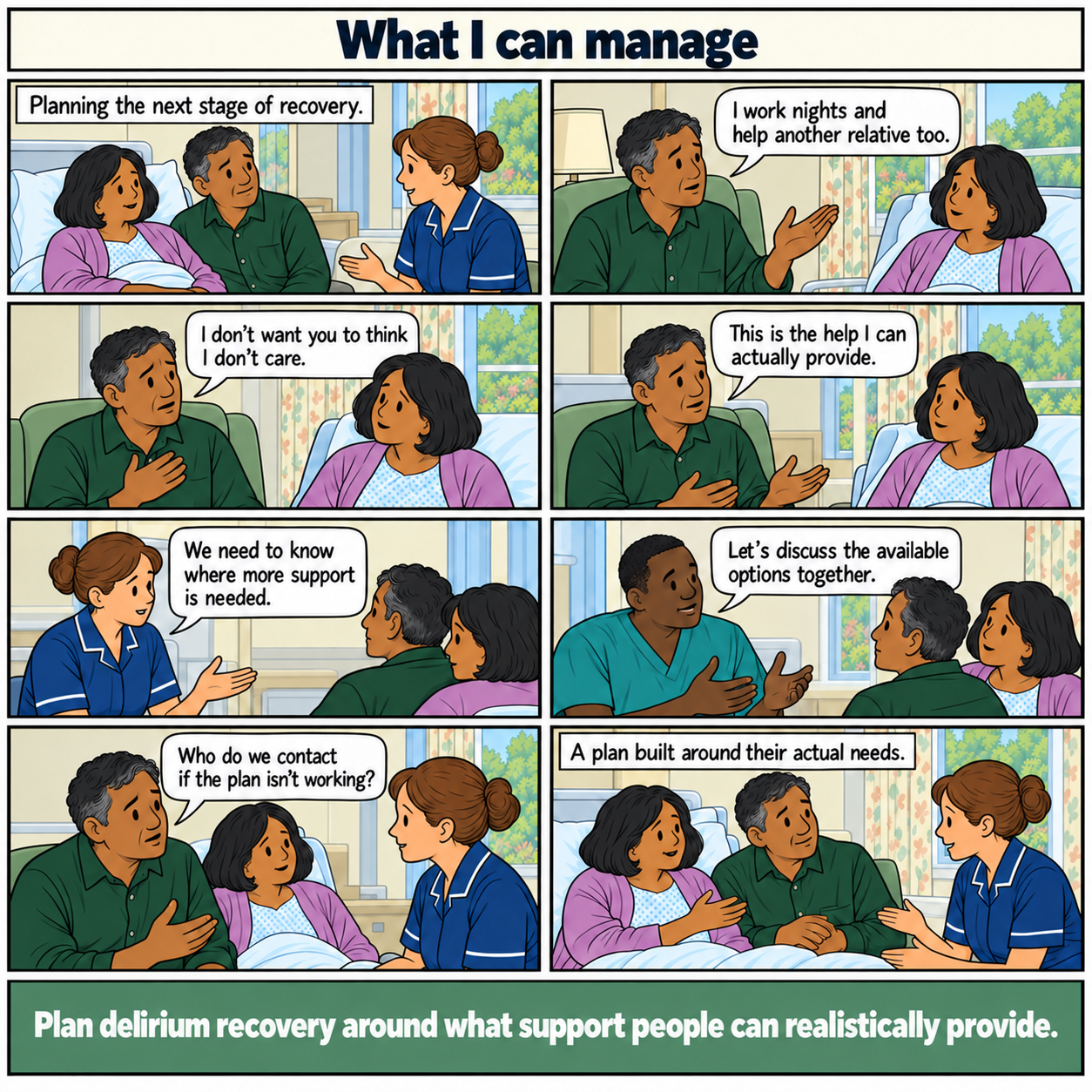
Families may be willing to help after delirium but still be unable to provide all the care a person needs. Work, health, sleep and other caring responsibilities affect what you can do.
Explain what you can realistically do and where more help is needed. That information is part of planning safe care, not evidence that you care less. Ask about available support, alternatives and whom to contact if the plan is not working. Include the person recovering as far as possible.
Story text
-
Panel 1. Planning the next stage of recovery.
-
Panel 2.
- Kamal: I work nights and help another relative too.
-
Panel 3.
- Kamal: I don’t want you to think I don’t care.
-
Panel 4.
- Kamal: This is the help I can actually provide.
-
Panel 5.
- Nurse: We need to know where more support is needed.
-
Panel 6.
- Doctor: Let’s discuss the available options together.
-
Panel 7.
- Kamal: Who do we contact if the plan isn’t working?
-
Panel 8. A plan built around their actual needs.
Bottom band. Plan delirium recovery around what support people can realistically provide.
Story B44
Still me
Read story B44: Still me (image and text)
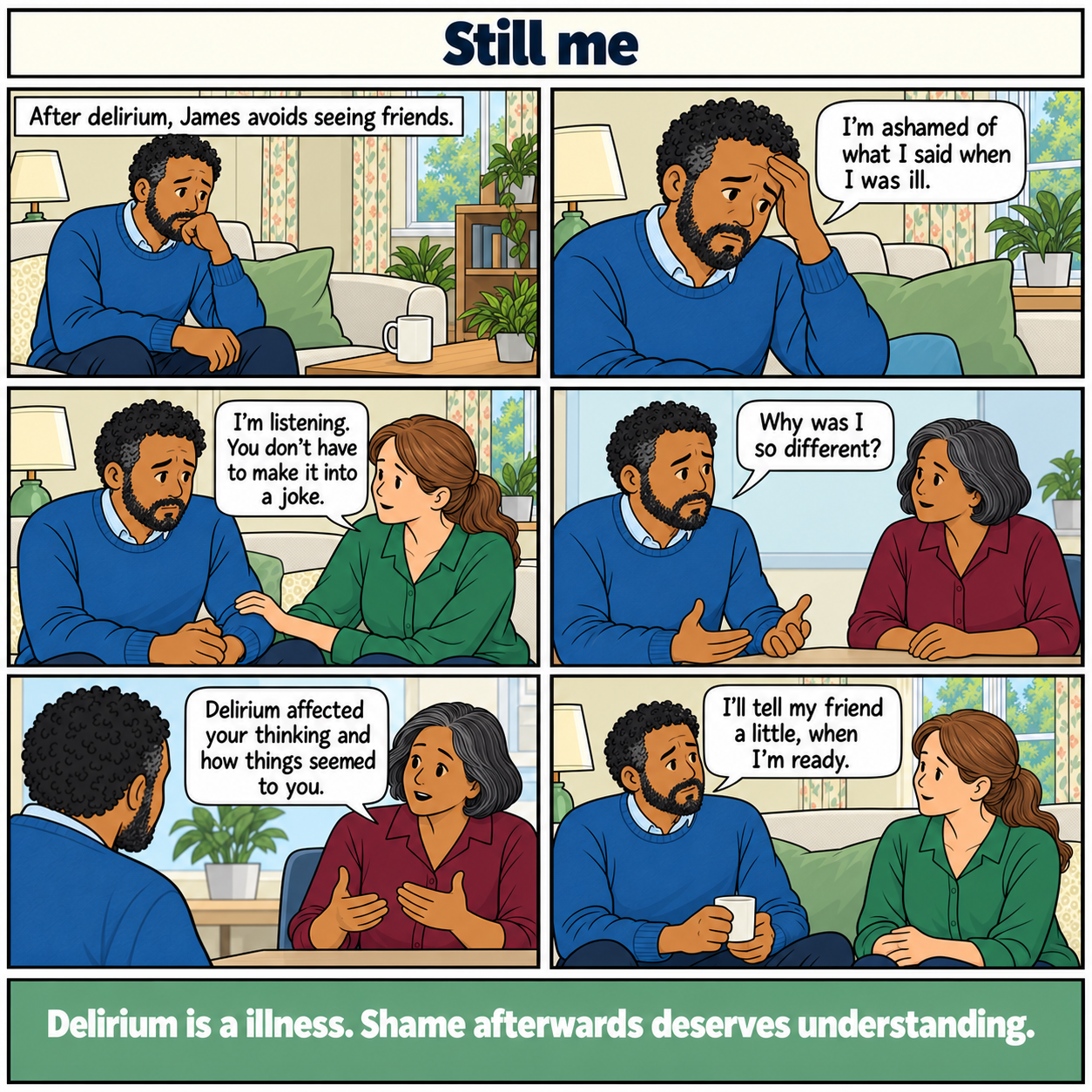
Some people feel embarrassed or ashamed about things they said or did during delirium. They may worry about how others now see them.
Delirium can greatly affect how someone thinks, understands what is happening, and behaves. These experiences deserve understanding, not jokes at the person’s expense. It can help to ask a doctor or nurse to explain what happened. The person can choose what to share, with whom, and when. Ongoing distress is also a reason to ask for support.
Story text
-
Panel 1. After delirium, James avoids seeing friends.
-
Panel 2.
- James: I’m ashamed of what I said when I was ill.
-
Panel 3.
- Emma: I’m listening. You don’t have to make it into a joke.
-
Panel 4.
- James: Why was I so different?
-
Panel 5.
- GP: Delirium affected your thinking and how things seemed to you.
-
Panel 6.
- James: I’ll tell my friend a little, when I’m ready.
Bottom band. Delirium is an illness. Shame afterwards deserves understanding.
Story C08 · Example case
The missing word
Read story C08: The missing word (image and text)
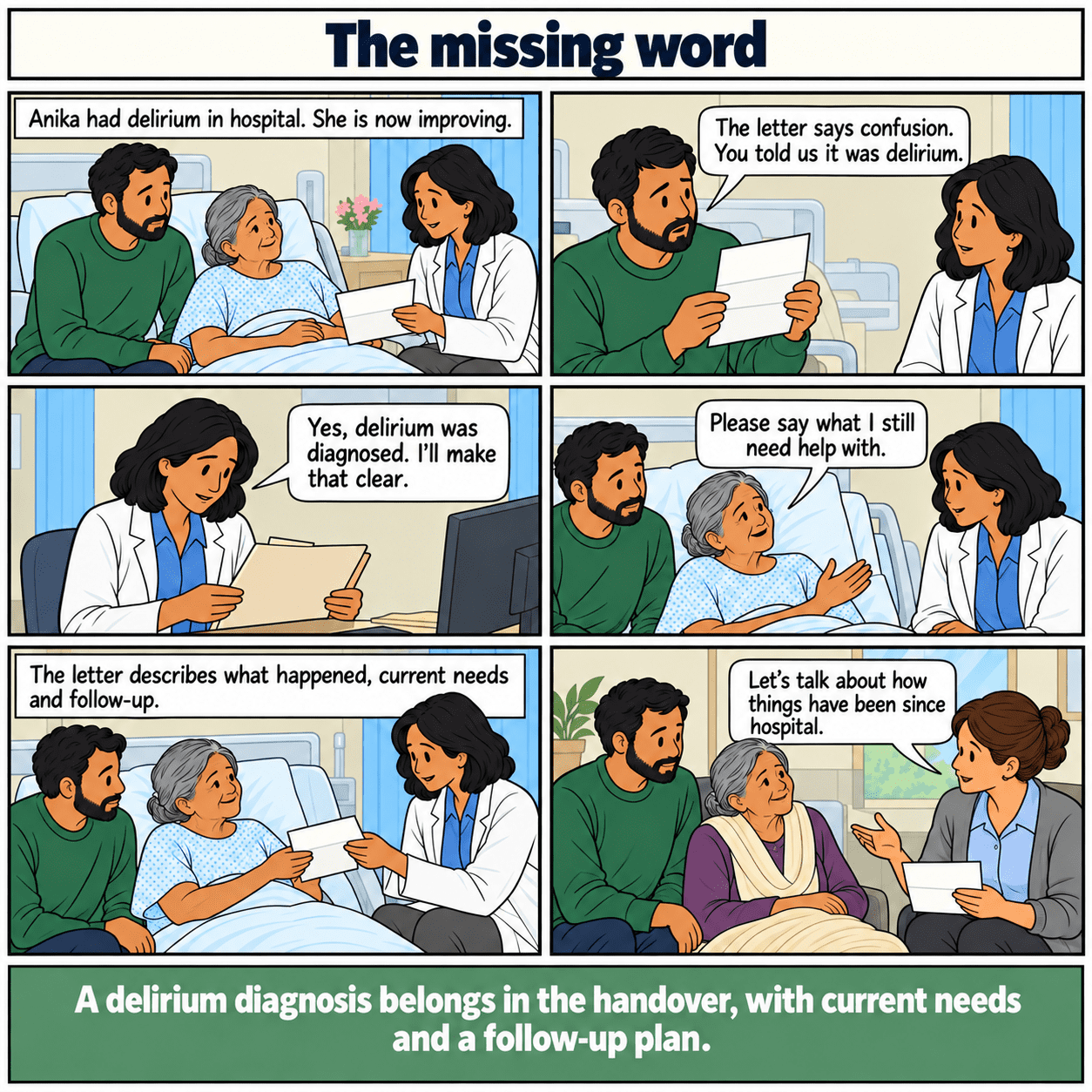
Recording delirium clearly in the discharge letter
Anika was diagnosed with delirium, but her draft discharge letter mentions only confusion. Her son asks for the diagnosis, current recovery and follow-up plan to be recorded clearly. The next team should not have to reconstruct what happened. Accurate documentation supports continuity; it does not mean assuming every later difficulty is delirium.
Story text
Panel 1. Anika had delirium in hospital. She is now improving.
Panel 2.
- Ravi: The letter says confusion. You told us it was delirium.
Panel 3.
- Doctor: Yes, delirium was diagnosed. I’ll make that clear.
Panel 4.
- Anika: Please say what I still need help with.
Panel 5. The letter describes what happened, current needs and follow-up.
Panel 6.
- Family doctor: Let’s talk about how things have been since hospital.
Bottom band. A delirium diagnosis belongs in the handover, with current needs and a follow-up plan.
Story C22 · Example case
Talking better, still needing help
Read story C22: Talking better, still needing help (image and text)
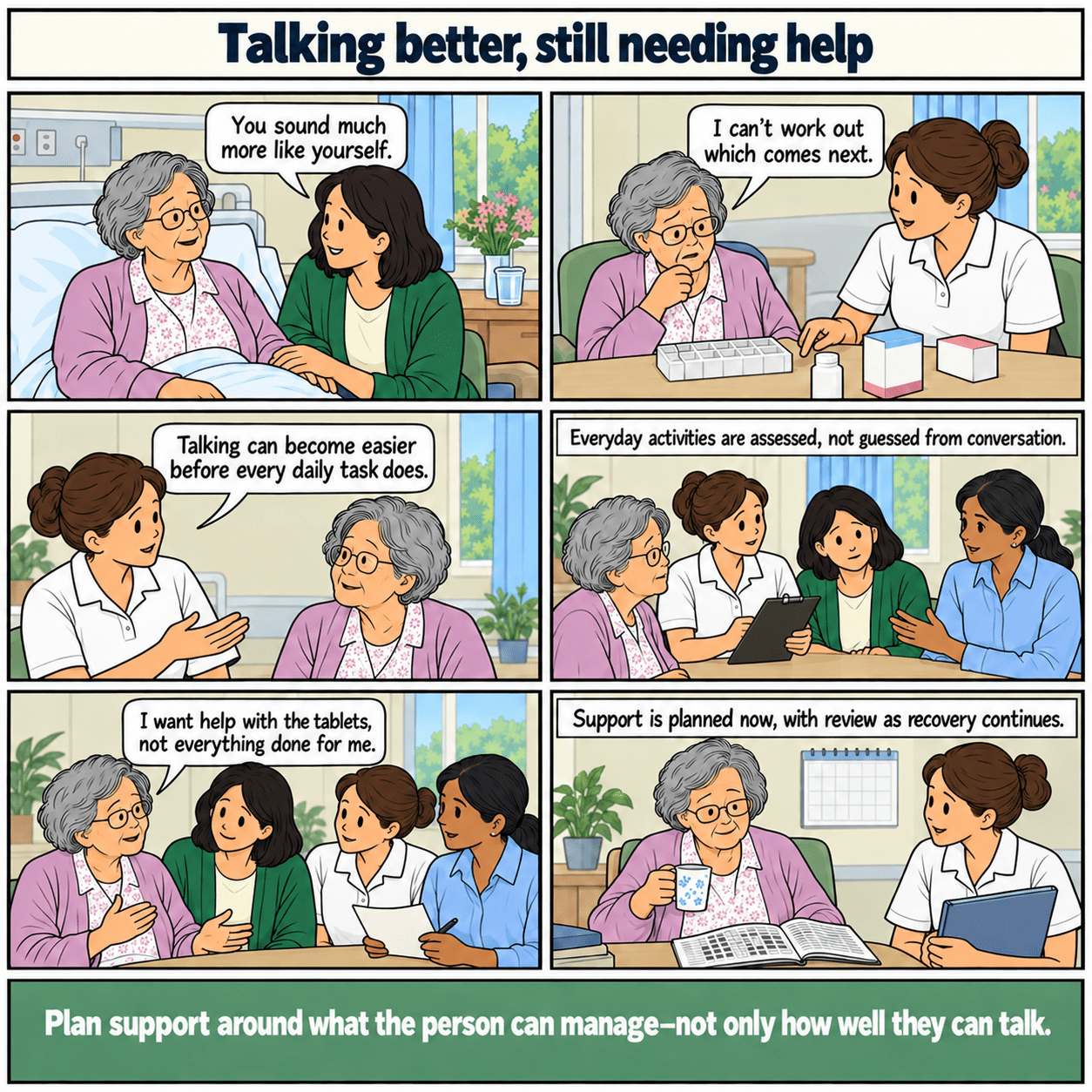
After delirium: clearer conversation does not mean every skill has recovered
May’s conversation is much clearer, but organising her tablets remains difficult. The team checks practical abilities rather than judging recovery from a pleasant conversation alone. The immediate plan includes support and later review. Remaining difficulties need assessment; they do not by themselves establish persistent delirium or dementia.
Story text
Panel 1.
- Iris: You sound much more like yourself.
Panel 2.
- May: I can’t work out which comes next.
Panel 3.
- Occupational therapist: Talking can become easier before every daily task does.
Panel 4. Everyday activities are assessed, not guessed from conversation.
Panel 5.
- May: I want help with the tablets, not everything done for me.
Panel 6. Support is planned now, with review as recovery continues.
Bottom band. Plan support around what the person can manage—not only how well they can talk.
Story C24 · Example case
The appointment nobody arranged
Read story C24: The appointment nobody arranged (image and text)
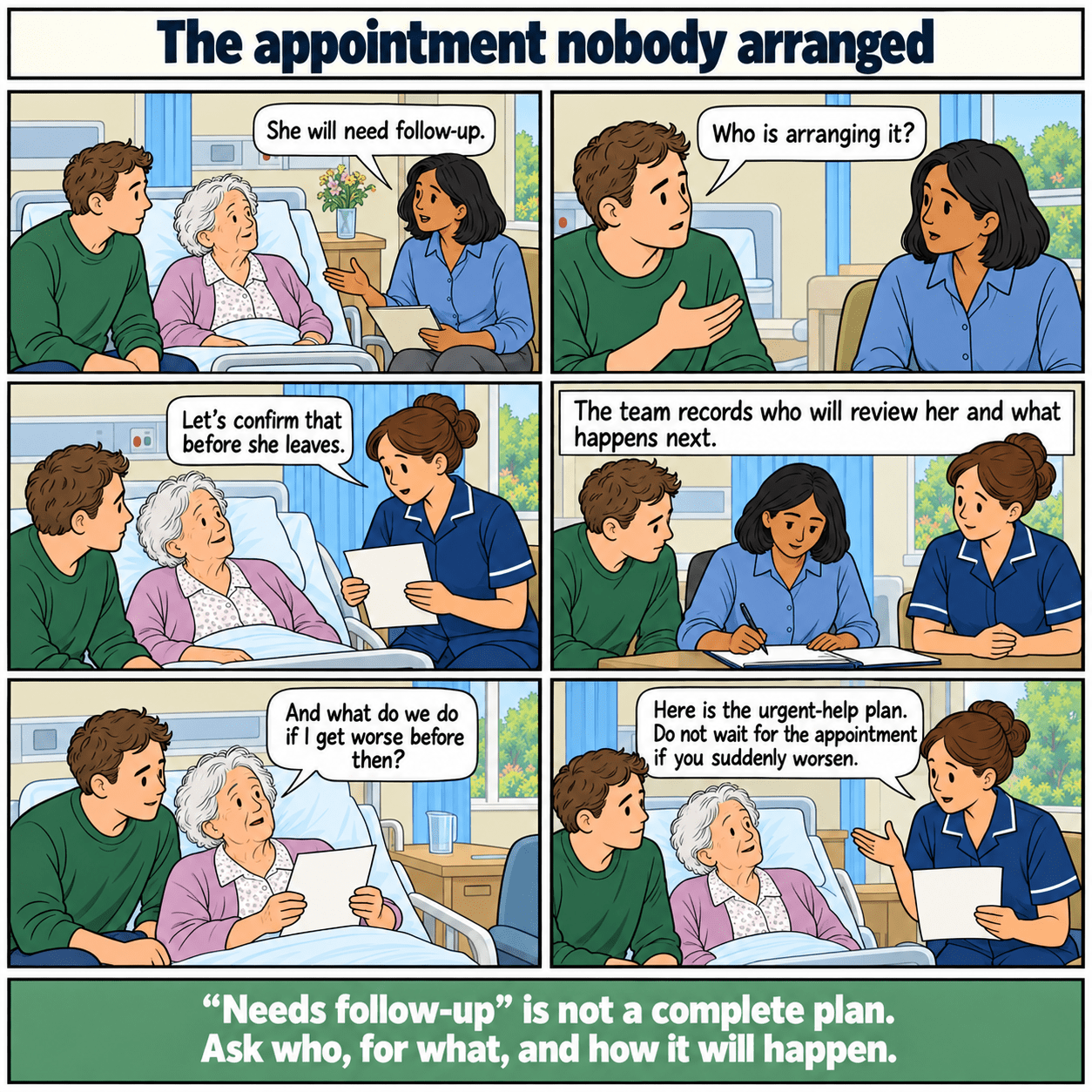
Follow-up after delirium: who reviews the continuing problems?
Moira is ready for the next stage of care, but her family has only been told to seek follow-up. They ask who will arrange it and what it is meant to assess. The team makes the responsibility explicit. A workable plan names a route to review and a route to urgent help if something changes sooner.
Story text
Panel 1.
- Doctor: She will need follow-up.
Panel 2.
- Calum: Who is arranging it?
Panel 3.
- Nurse: Let’s confirm that before she leaves.
Panel 4. The team records who will review her and what happens next.
Panel 5.
- Moira: And what do we do if I get worse before then?
Panel 6.
- Nurse: Here is the urgent-help plan. Do not wait for the appointment if you suddenly worsen.
Bottom band. “Needs follow-up” is not a complete plan. Ask who, for what, and how it will happen.
Story C38 · Example case
I was quiet. I was frightened.
Read story C38: I was quiet. I was frightened. (image and text)
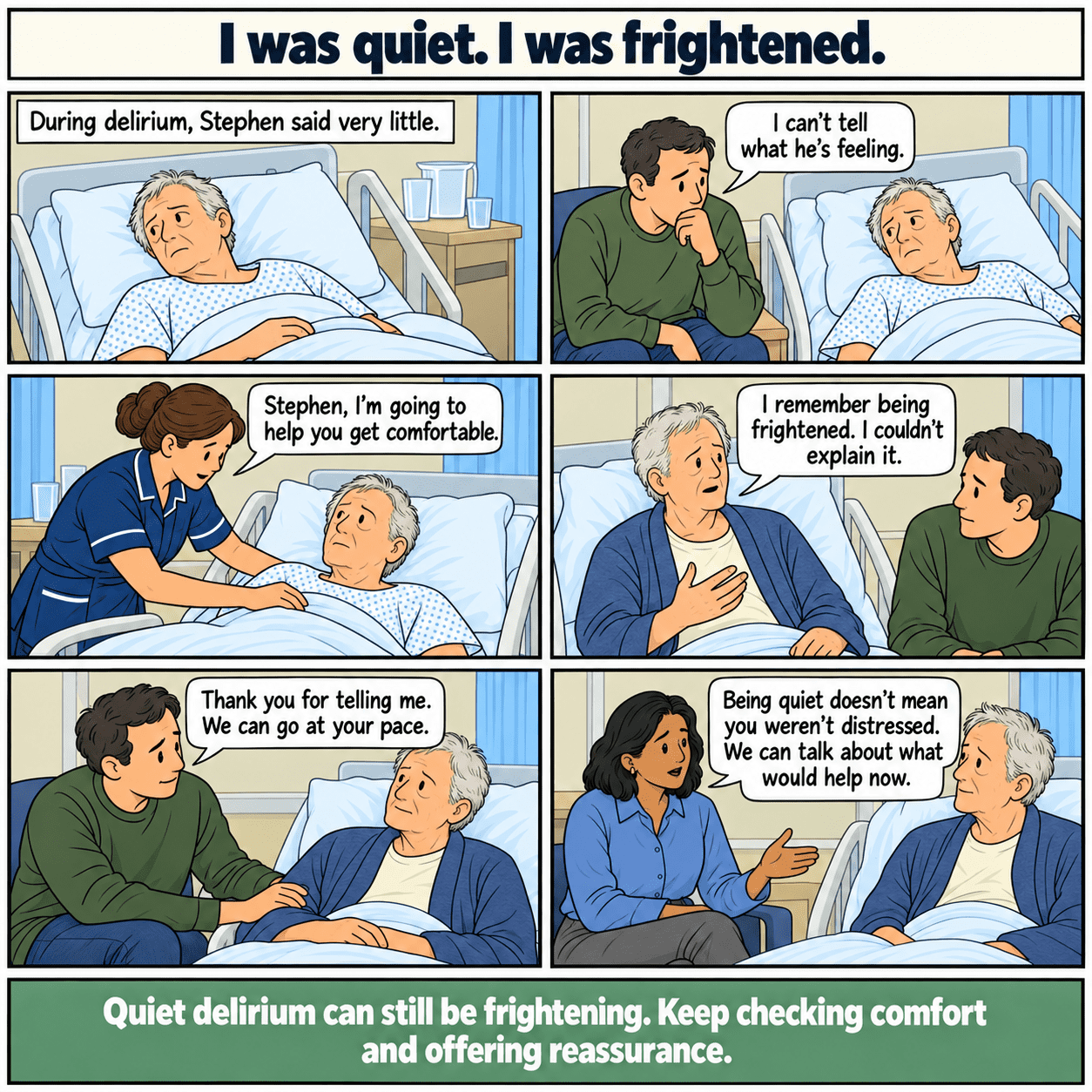
Hypoactive delirium can be frightening, even when the person is quiet
During delirium, Stephen looked quiet and withdrawn. Later he remembers being frightened but unable to explain it. Rob and the team listen without insisting that he remember everything. Quiet delirium can include distress, although experiences and recall vary. The absence of shouting does not tell us that someone feels safe.
Story text
Panel 1. During delirium, Stephen said very little.
Panel 2.
- Rob: I can’t tell what he’s feeling.
Panel 3.
- Nurse: Stephen, I’m going to help you get comfortable.
Panel 4.
- Stephen: I remember being frightened. I couldn’t explain it.
Panel 5.
- Rob: Thank you for telling me. We can go at your pace.
Panel 6.
- Doctor: Being quiet doesn’t mean you weren’t distressed. We can talk about what would help now.
Bottom band. Quiet delirium can still be frightening. Keep checking comfort and offering reassurance.
End-of-life care and loss
Some of these stories include dying and bereavement. They are here because some readers want them. Read them only if and when you feel ready. You can skip this section entirely.
Story B22A
Months, and no recovery — part 1
This story includes a death after prolonged illness.
Read story B22A: Months, and no recovery — part 1 (image and text)
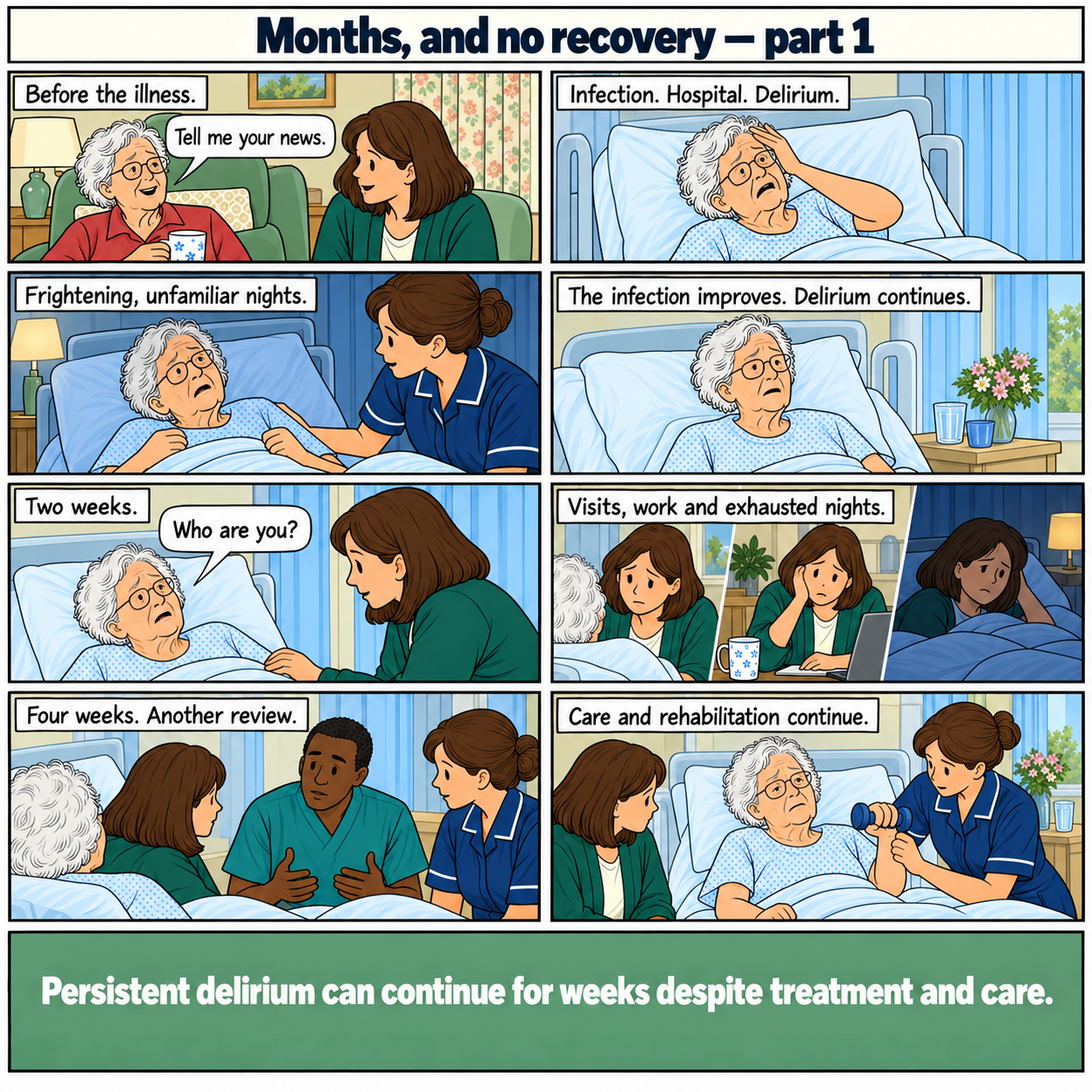
Part 1 of 2.
Delirium can continue for weeks even while the original illness improves and care continues. This story follows Margaret and her daughter Helen through the first four weeks.
Families need clear explanations, regular checks by the team and support. Continuing delirium does not mean that treatment or care has stopped.
Story text
-
Panel 1. Before the illness.
- Margaret: Tell me your news.
-
Panel 2. Infection. Hospital. Delirium.
-
Panel 3. Frightening, unfamiliar nights.
-
Panel 4. The infection improves. Delirium continues.
-
Panel 5. Two weeks.
- Margaret: Who are you?
-
Panel 6. Visits, work and exhausted nights.
-
Panel 7. Four weeks. Another review.
-
Panel 8. Care and rehabilitation continue.
Bottom band. Persistent delirium can continue for weeks despite treatment and care.
Story B22B
Months, and no recovery — part 2
This story includes a death after prolonged illness.
Read story B22B: Months, and no recovery — part 2 (image and text)
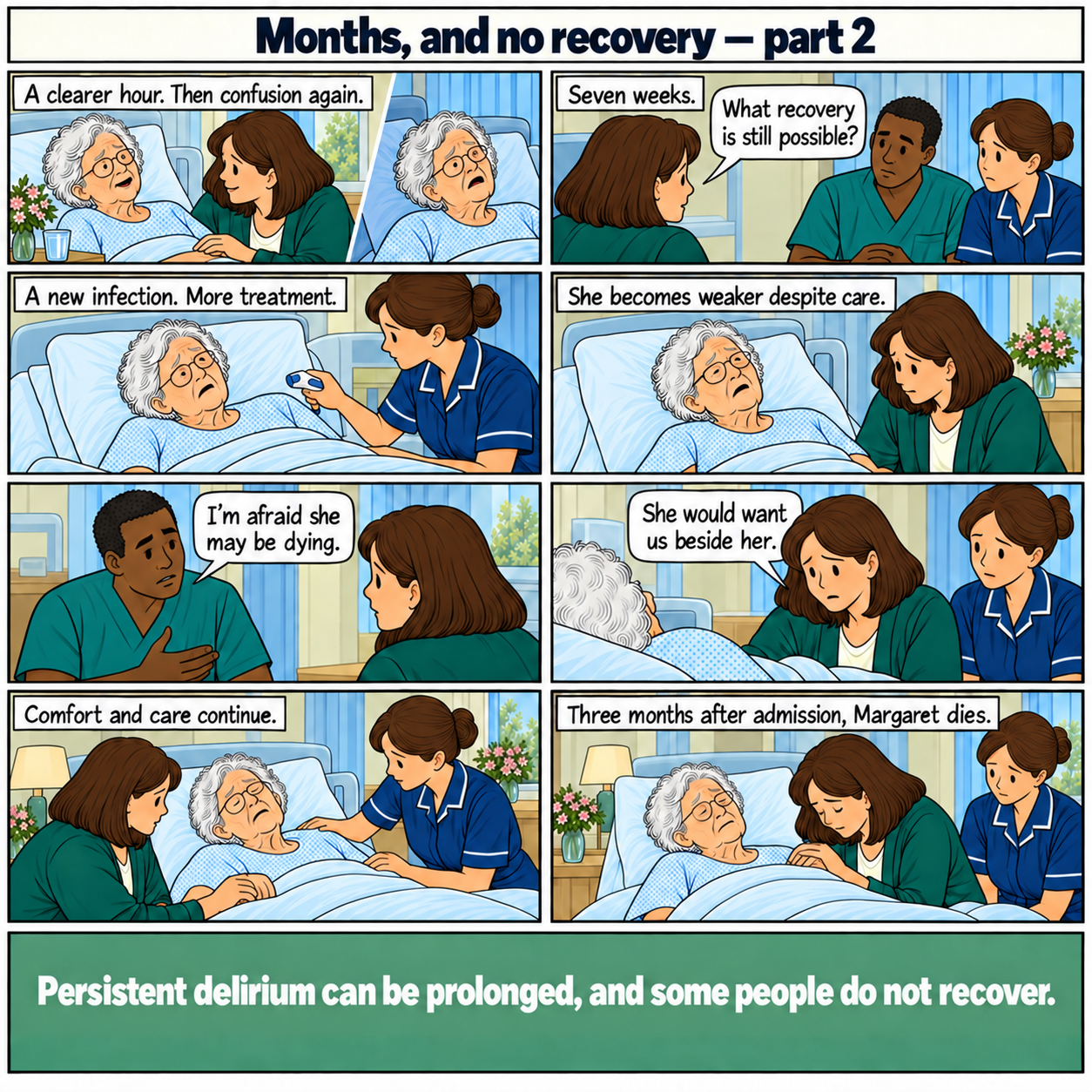
Part 2 of 2. This story includes a death after prolonged illness.
Margaret has a brief clearer spell, but her delirium returns. Further illness follows and she becomes weaker despite care. Three months after admission, she dies without fully recovering. This is one possible course of delirium that continues for a long time.
Families need honest explanations, attention to comfort and support throughout. A clearer spell does not guarantee recovery.
Story text
-
Panel 1. A clearer hour. Then confusion again.
-
Panel 2. Seven weeks.
- Helen: What recovery is still possible?
-
Panel 3. A new infection. More treatment.
-
Panel 4. She becomes weaker despite care.
-
Panel 5.
- Doctor: I’m afraid she may be dying.
-
Panel 6.
- Helen: She would want us beside her.
-
Panel 7. Comfort and care continue.
-
Panel 8. Three months after admission, Margaret dies.
Bottom band. Persistent delirium can be prolonged, and some people do not recover.
Story B23
What comfort looks like
Includes end-of-life care
Read story B23: What comfort looks like (image and text)
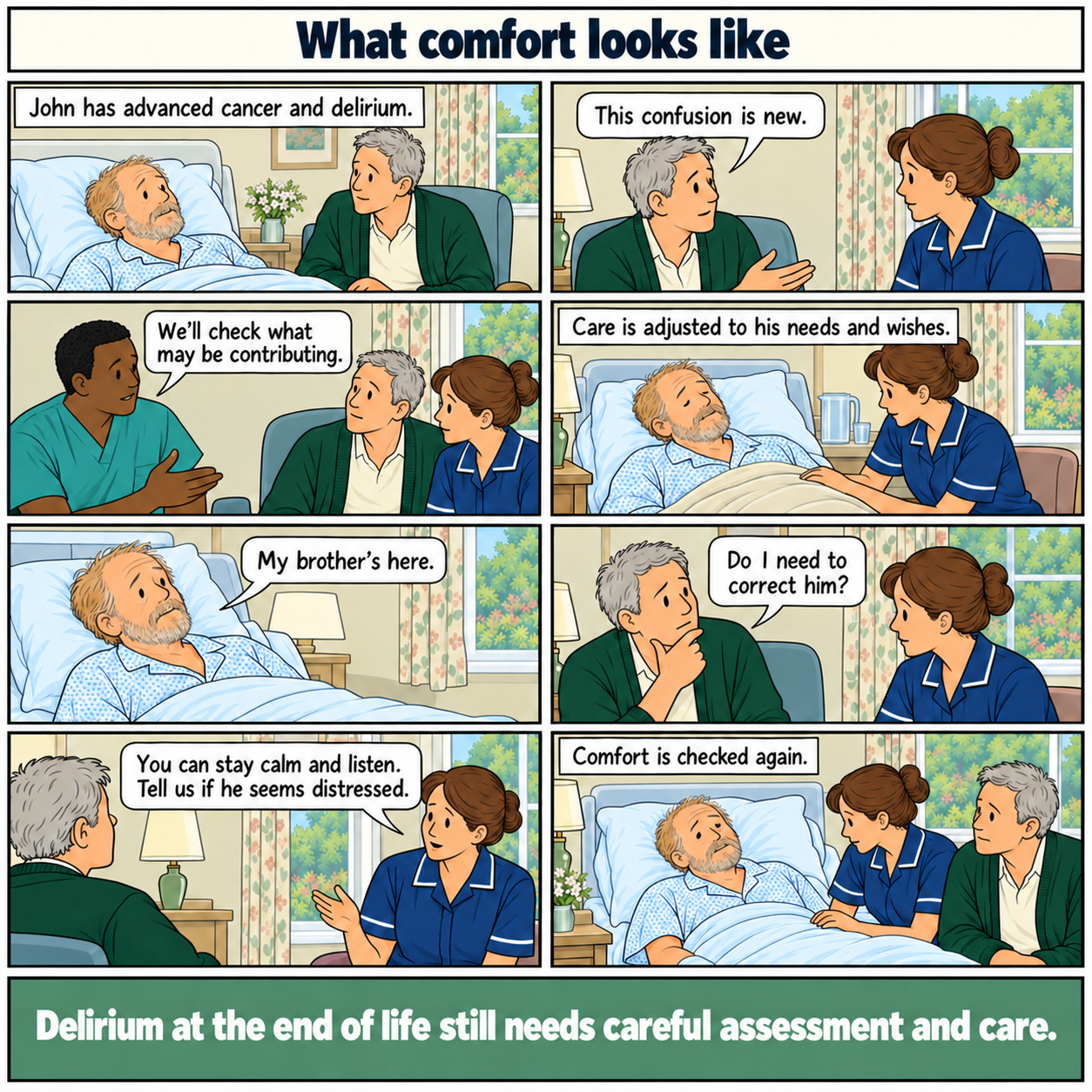
Delirium near the end of life still needs careful assessment by the team and care to keep the person comfortable. Care should take account of the person’s illness, wishes and what is likely to help.
Not every unusual experience is frightening. You do not need to argue about a calm experience, but tell staff about new changes and any signs of distress. A peaceful vision on its own does not mean that the person has delirium. In this story, delirium has already been identified.
Story text
-
Panel 1. John has advanced cancer and delirium.
-
Panel 2.
- Paul: This confusion is new.
-
Panel 3.
- Doctor: We’ll check what may be contributing.
-
Panel 4. Care is adjusted to his needs and wishes.
-
Panel 5.
- John: My brother’s here.
-
Panel 6.
- Paul: Do I need to correct him?
-
Panel 7.
- Nurse: You can stay calm and listen. Tell us if he seems distressed.
-
Panel 8. Comfort is checked again.
Bottom band. Delirium at the end of life still needs careful assessment and care.
Story B31
The shadows in the hospice
Includes end-of-life care
Read story B31: The shadows in the hospice (image and text)
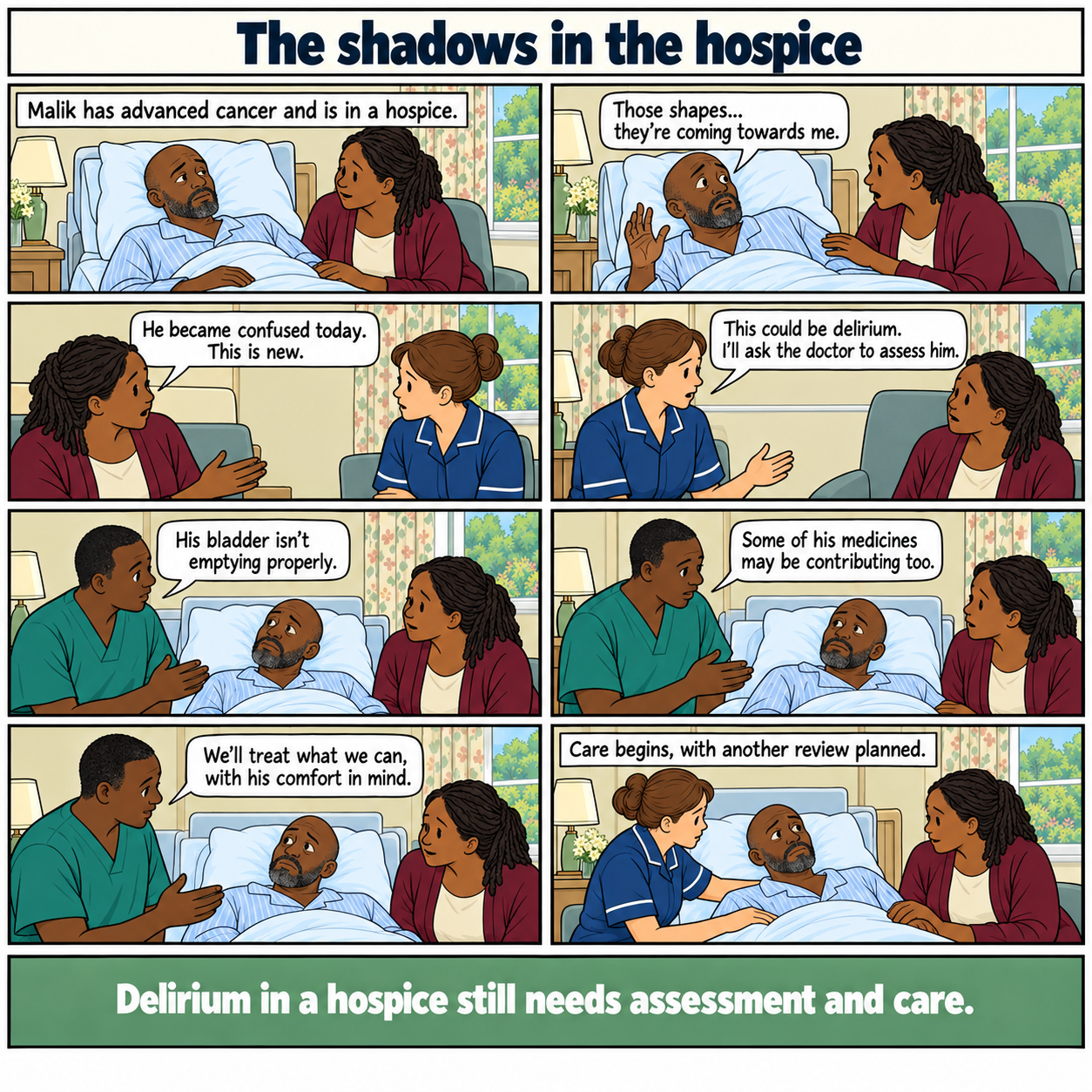
Delirium can occur in a hospice. Tell staff about a new change in thinking, attention or behaviour, even when someone is already very ill.
In this illustrated story, the team recognises delirium and finds problems that may be contributing to the distress. The team decides what checks and treatment to offer based on Malik’s condition and wishes. The aim includes helping him feel less frightened and more comfortable. The next story follows what happens after the plan is reviewed.
Story text
-
Panel 1. Malik has advanced cancer and is in a hospice.
-
Panel 2.
- Malik: Those shapes… they’re coming towards me.
-
Panel 3.
- Yvonne: He became confused today. This is new.
-
Panel 4.
- Nurse: This could be delirium. I’ll ask the doctor to assess him.
-
Panel 5.
- Doctor: His bladder isn’t emptying properly.
-
Panel 6.
- Doctor: Some of his medicines may be contributing too.
-
Panel 7.
- Doctor: We’ll treat what we can, with his comfort in mind.
-
Panel 8. Care begins, with another review planned.
Bottom band. Delirium in a hospice still needs assessment and care.
Story B32
A quieter goodbye
This story includes a death from advanced cancer.
Read story B32: A quieter goodbye (image and text)
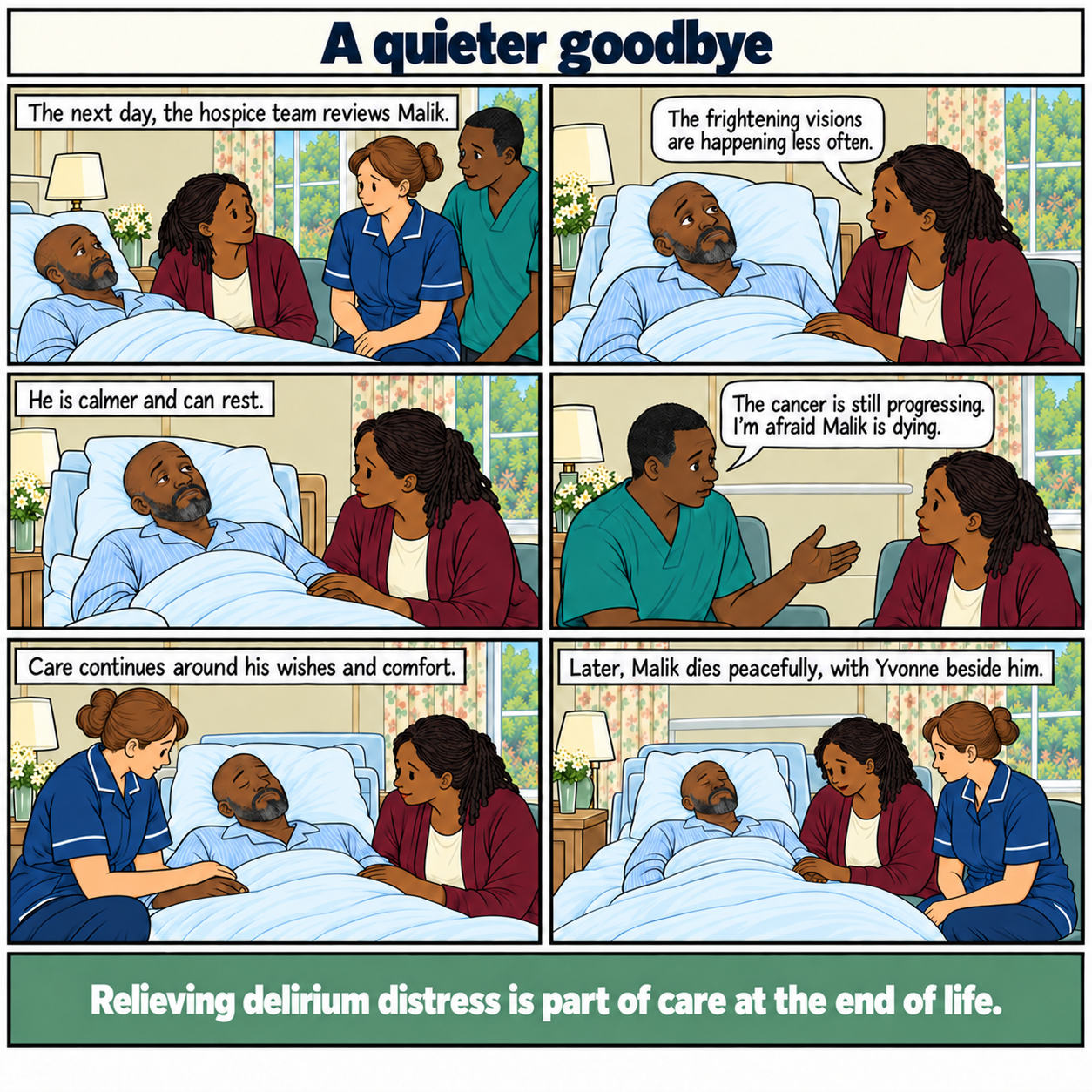
This story includes a death from advanced cancer.
In the previous hospice story, Malik had frightening hallucinations: seeing or hearing things that are not there. These happen less often after treatment and review. He is calmer, although the cancer continues to get worse. He later dies peacefully.
Easing distress caused by delirium can make an important difference even when a person is dying. This is one possible course, not a promise that symptoms will always settle. People with delirium and their families need continued care, honest explanations and support.
Story text
-
Panel 1. The next day, the hospice team reviews Malik.
-
Panel 2.
- Yvonne: The frightening visions are happening less often.
-
Panel 3. He is calmer and can rest.
-
Panel 4.
- Doctor: The cancer is still progressing. I’m afraid Malik is dying.
-
Panel 5. Care continues around his wishes and comfort.
-
Panel 6. Later, Malik dies peacefully, with Yvonne beside him.
Bottom band. Relieving distress caused by delirium is part of care at the end of life.
Story B36
When swallowing changes
Includes end-of-life care
Read story B36: When swallowing changes (image and text)
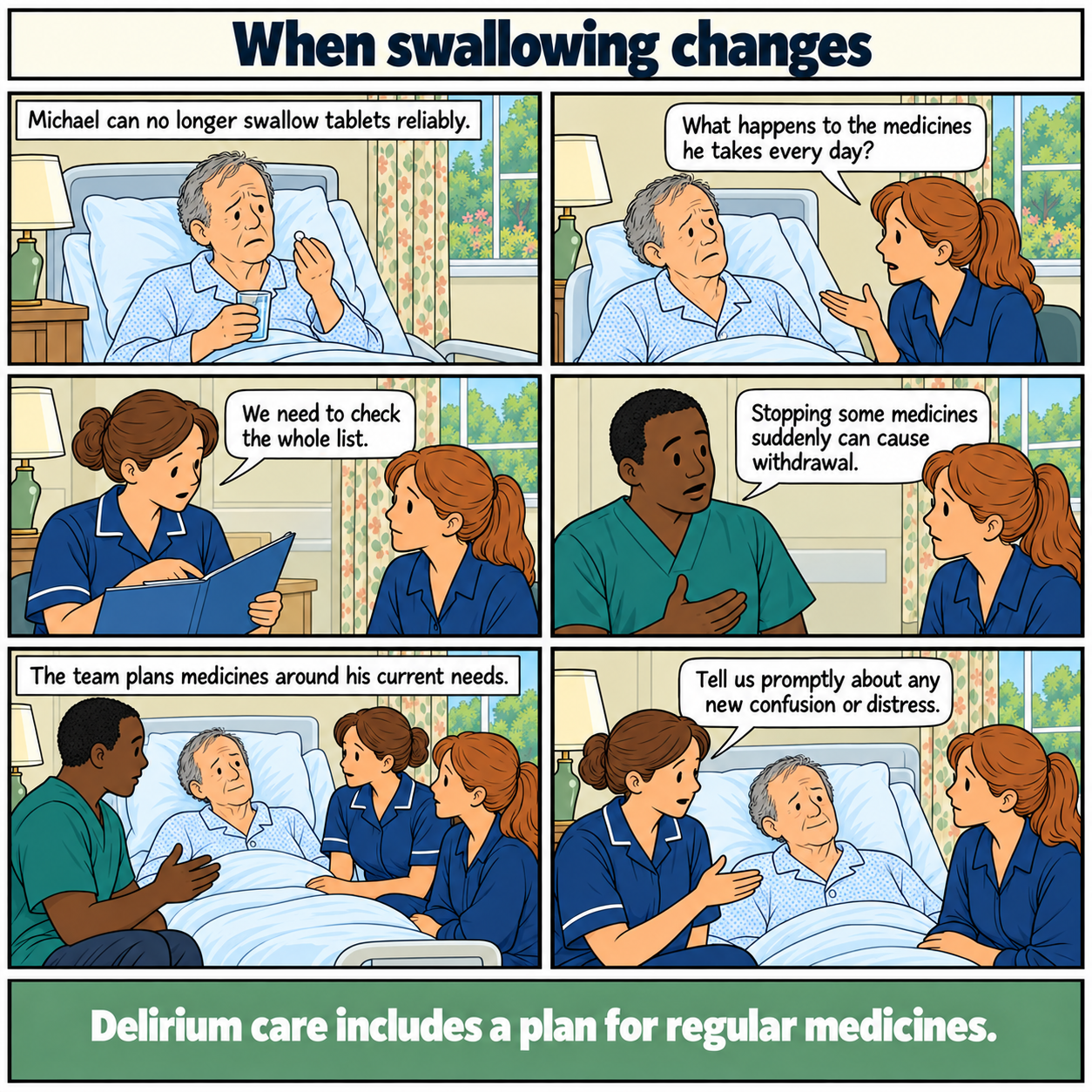
When swallowing becomes difficult near the end of life, regular medicines need review. Simply leaving them out may cause problems. Some, including benzodiazepines taken regularly for anxiety or sleep, can cause dangerous symptoms if stopped suddenly.
Ask the hospice team, or the team helping with comfort and symptoms, what the plan is. They can decide which medicines remain useful and how they should be managed. Do not crush, change or stop tablets without advice. Report new confusion or distress promptly.
Story text
-
Panel 1. Michael can no longer swallow tablets reliably.
-
Panel 2.
- Claire: What happens to the medicines he takes every day?
-
Panel 3.
- Nurse: We need to check the whole list.
-
Panel 4.
- Doctor: Stopping some medicines suddenly can cause withdrawal.
-
Panel 5. The team plans medicines around his current needs.
-
Panel 6.
- Nurse: Tell us promptly about any new confusion or distress.
Bottom band. Delirium care includes a plan for regular medicines.
Story B41
The question we feared
This story includes a death in intensive care.
Read story B41: The question we feared (image and text)
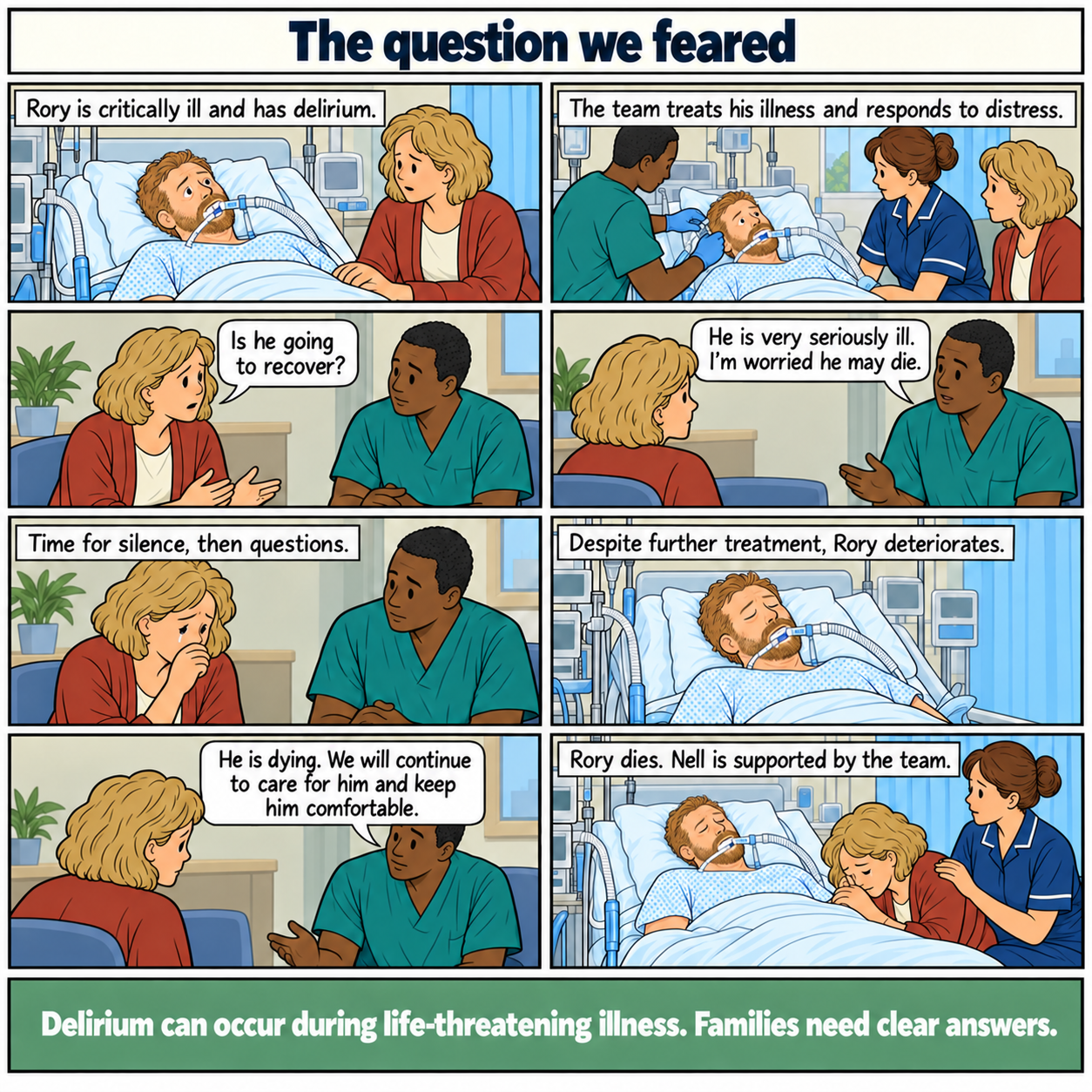
This story includes a death in intensive care.
Delirium can occur during life-threatening illness, including in younger adults. Some people die despite treatment of the illness and careful attention to delirium and distress.
Families need clear explanations, time for questions and support when the news is difficult. It is possible to be honest about the risk of death while continuing compassionate care. This illustrated story is one possible outcome, not a prediction for another person.
Story text
-
Panel 1. Rory is critically ill and has delirium.
-
Panel 2. The team treats his illness and responds to distress.
-
Panel 3.
- Nell: Is he going to recover?
-
Panel 4.
- Doctor: He is very seriously ill. I’m worried he may die.
-
Panel 5. Time for silence, then questions.
-
Panel 6. Despite further treatment, Rory deteriorates.
-
Panel 7.
- Doctor: He is dying. We will continue to care for him and keep him comfortable.
-
Panel 8. Rory dies. Nell is supported by the team.
Bottom band. Delirium can occur during life-threatening illness. Families need clear answers.
Story B42
After the funeral
This story is about grief after a death in intensive care.
Read story B42: After the funeral (image and text)
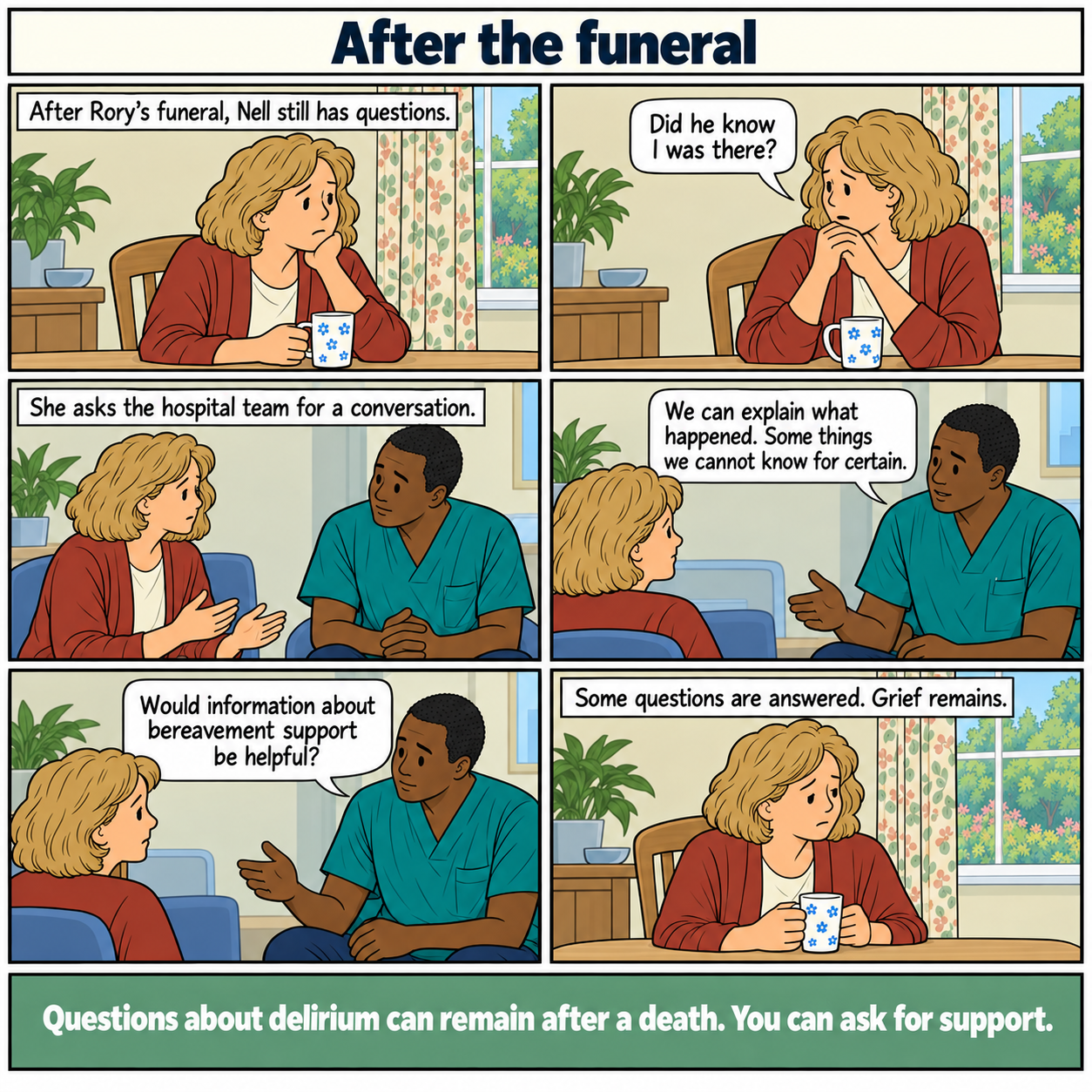
This story is about grief after a death in intensive care.
Questions about delirium may remain after someone has died. Families may wonder what the person experienced, whether they recognised them, or why the confusion continued.
You can ask the treating team for an explanation of the hospital stay. They may be able to explain some things and say what they can’t know. Support after a death may also help. There is no obligation to have every question answered, or to feel better after one conversation.
Story text
-
Panel 1. After Rory’s funeral, Nell still has questions.
-
Panel 2.
- Nell: Did he know I was there?
-
Panel 3. She asks the hospital team for a conversation.
-
Panel 4.
- Doctor: We can explain what happened. Some things we cannot know for certain.
-
Panel 5.
- Doctor: Would information about bereavement support be helpful?
-
Panel 6. Some questions are answered. Grief remains.
Bottom band. Questions about delirium can remain after a death. You can ask for support.
Story B43
Another review in the hospice
Includes end-of-life care
Read story B43: Another review in the hospice (image and text)
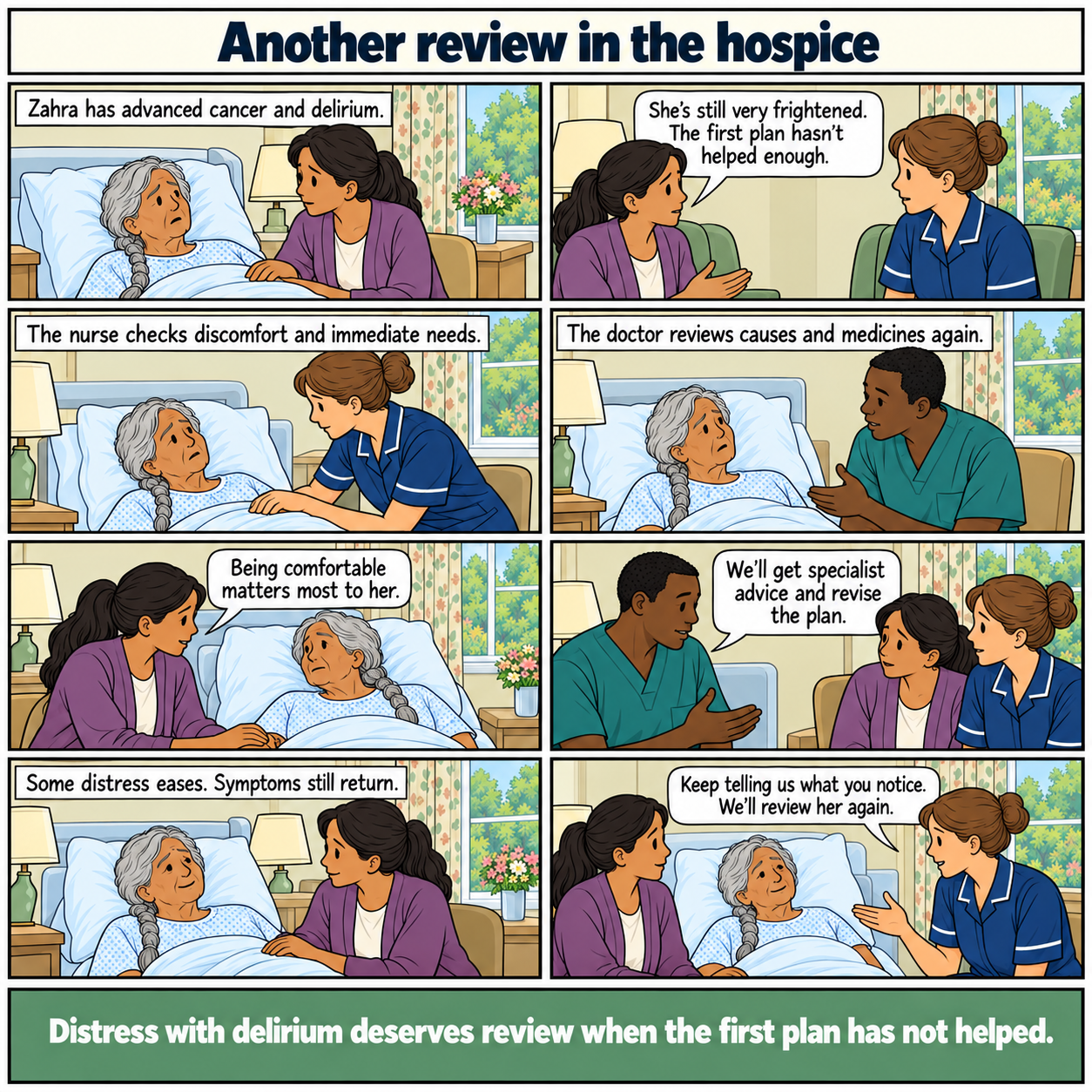
Distress caused by delirium does not always settle with the first approach. If someone remains frightened or uncomfortable, tell the team what you are seeing and ask the team to check again.
In a hospice, this may include another look at discomfort, possible causes and medicines, with specialist advice when needed. Care should reflect the person’s condition and wishes. Some symptoms may ease while others continue. People with delirium and their families still deserve attention, explanations and support throughout.
Story text
-
Panel 1. Zahra has advanced cancer and delirium.
-
Panel 2.
- Maryam: She’s still very frightened. The first plan hasn’t helped enough.
-
Panel 3. The nurse checks discomfort and immediate needs.
-
Panel 4. The doctor reviews causes and medicines again.
-
Panel 5.
- Maryam: Being comfortable matters most to her.
-
Panel 6.
- Doctor: We’ll get specialist advice and revise the plan.
-
Panel 7. Some distress eases. Symptoms still return.
-
Panel 8.
- Nurse: Keep telling us what you notice. We’ll review her again.
Bottom band. Distress with delirium deserves review when the first plan has not helped.
Story B45
The familiar song
Includes end-of-life care
Read story B45: The familiar song (image and text)
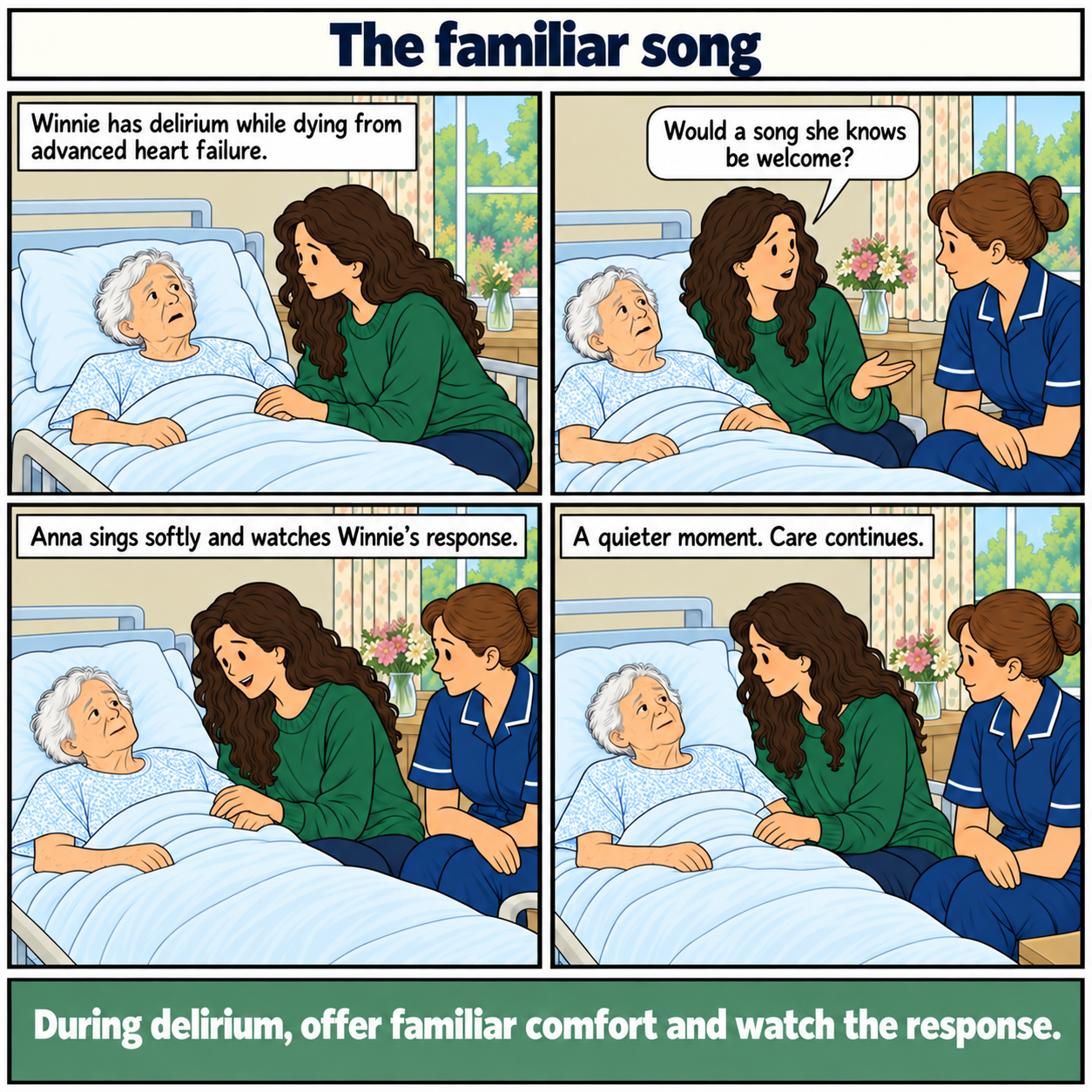
A person with delirium may find a familiar voice, song or quiet presence comforting, including near the end of life, but people respond differently.
Check with the person and staff where possible, watch the response and stop if it seems unwelcome or tiring. Comforting contact is one part of care. It does not replace treatment or mean that delirium has ended. Families can help without having to make every moment better.
Story text
-
Panel 1. Winnie has delirium while dying from advanced heart failure.
-
Panel 2.
- Anna: Would a song she knows be welcome?
-
Panel 3. Anna sings softly and watches Winnie’s response.
-
Panel 4. A quieter moment. Care continues.
Bottom band. During delirium, offer familiar comfort and watch the response.
Story B50
Not the ending we hoped for
This story includes death and grief.
Read story B50: Not the ending we hoped for (image and text)
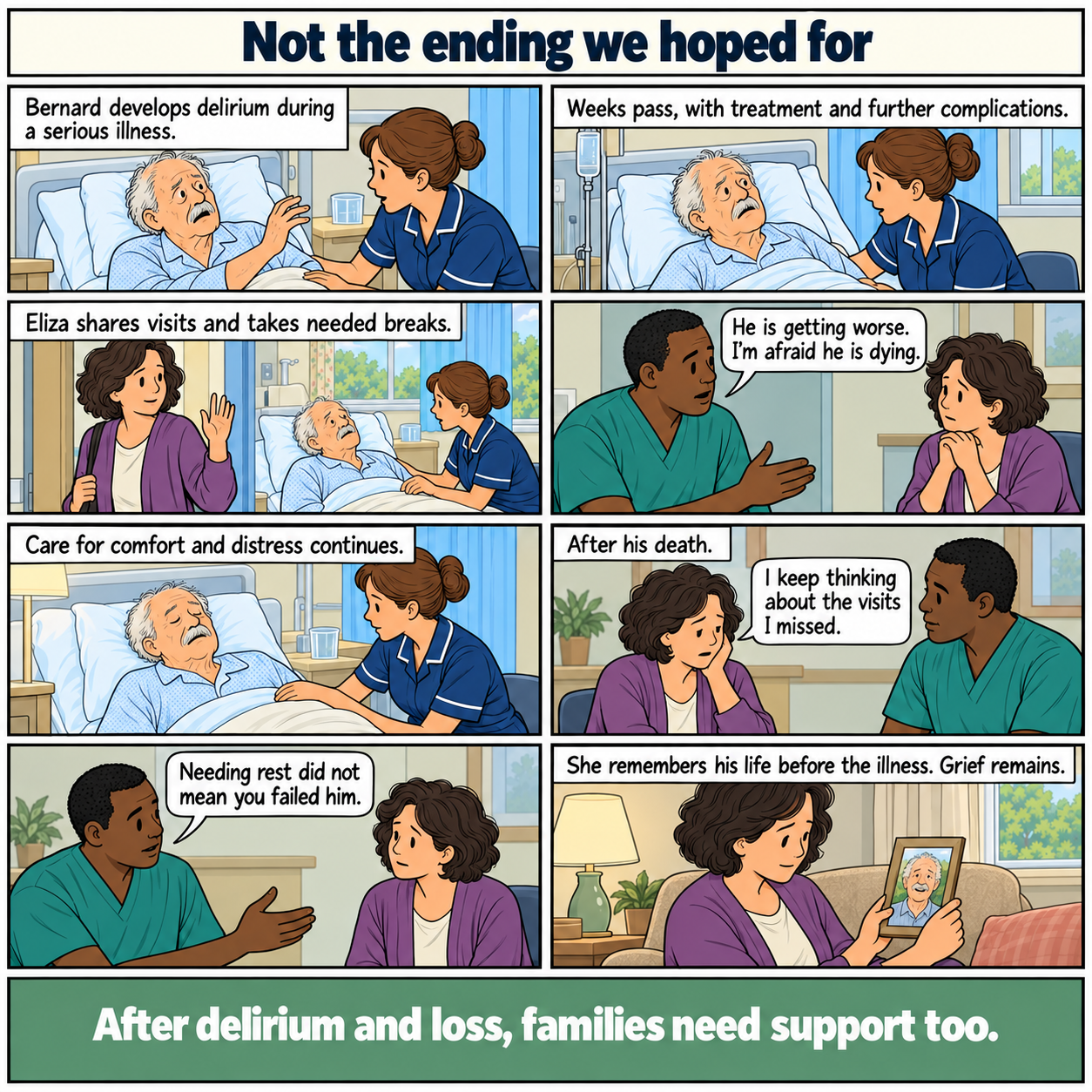
This story includes death and grief.
A prolonged illness with delirium can leave families exhausted. After a death, some think repeatedly about the visits they missed or the things they wish they had said.
Needing sleep, work or help with visiting does not mean a family has failed. Questions about the illness and care deserve a response, including concerns that something was missed. Support may help, but people grieve for different lengths of time and do not have to feel better after one conversation.
Story text
-
Panel 1. Bernard develops delirium during a serious illness.
-
Panel 2. Weeks pass, with treatment and further complications.
-
Panel 3. Eliza shares visits and takes needed breaks.
-
Panel 4.
- Doctor: He is getting worse. I’m afraid he is dying.
-
Panel 5. Care for comfort and distress continues.
-
Panel 6. After his death.
- Eliza: I keep thinking about the visits I missed.
-
Panel 7.
- Doctor: Needing rest did not mean you failed him.
-
Panel 8. She remembers his life before the illness. Grief remains.
Bottom band. After delirium and loss, families need support too.