Information for families and friends
“New confusion” has a name: delirium
Delirium is a sudden change in a person’s thinking, memory or alertness, usually caused by an illness, an injury, surgery or medicines. A lot of people know it as acute confusion. Delirium is the medical name, and the word to use with doctors and nurses. It affects about 1 in 4 older people in hospital. Many families have never heard its name.
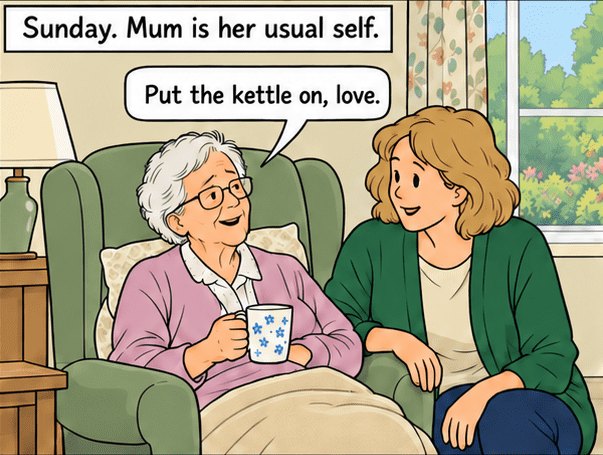
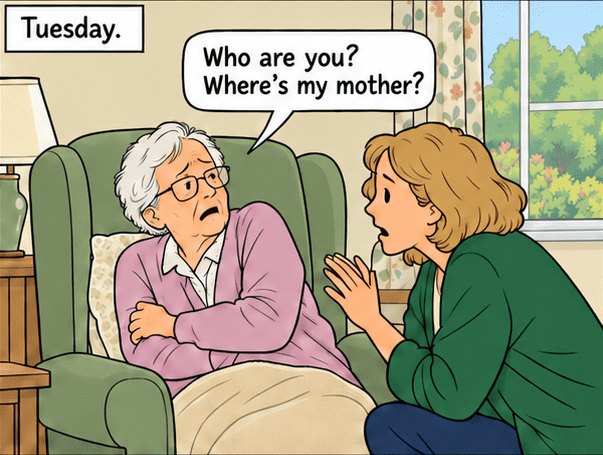
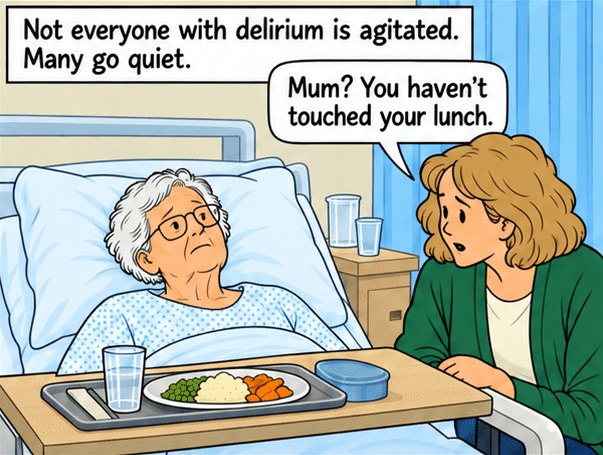
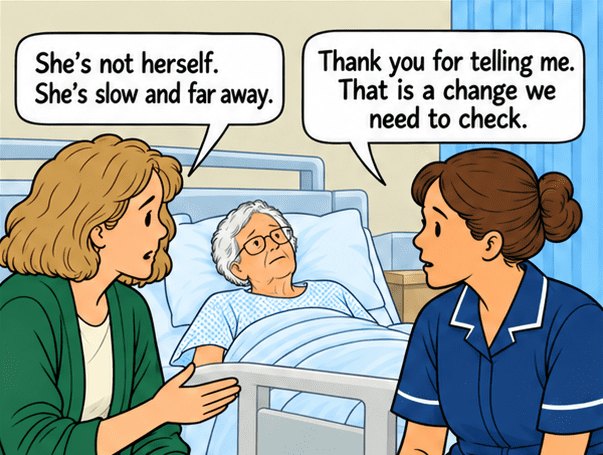
One-page printable guides for patients and families, plus a poster for wards and clinics.
This website focuses mainly on delirium in older people outside intensive care. Much of it is relevant in an ICU, but Vanderbilt has more specific ICU information. It does not cover paediatric delirium; the Resources page links to specialist information for babies, children and young people.
Is this delirium? The common signs
Delirium appears over hours or days. The person is different from their normal self. You might notice:
Disorientated and mixed up
Losing track of where they are or what day or time it is. Losing track of what is happening around them. Saying strange things.
Trouble paying attention
They find it hard to follow a conversation. They may stop responding in the middle of a sentence or seem not to hear you.
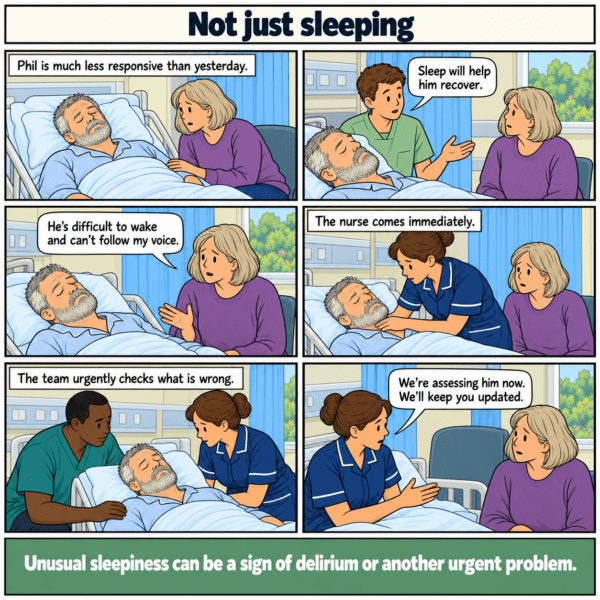
Unusual drowsiness
Much sleepier than usual, sleeping through visits, or slow to respond. If they are hard to wake or barely responding, get emergency help now.
Restlessness or agitation
A change in mood, with anxiety often present. Pacing, fiddling with bedclothes, pulling at drips, sometimes showing fear or anger.
New suspicion, or seeing things
Believing others mean harm, or seeing people or animals that are not there.
Symptoms that come and go
For example, clearer in the morning, but more confused in the afternoon. Evenings and nights are often worse.
What to do now
Delirium can be caused by serious illness, and it needs urgent assessment.
Who to contact and what to sayAt home
Get medical help now. Call local emergency services now. Describe the change and say the word delirium.
In hospital
Tell the nurse looking after the person immediately. Describe the change from normal, with times, and ask directly for a delirium assessment.
In a care home or nursing home
Tell the nurse or person in charge of the shift immediately what has changed and when it started, and ask them to arrange for a doctor or nurse to check the person now. If staff can’t arrange prompt medical assessment, call local emergency services.
If the person is hard to wake, struggling to breathe, has signs of a stroke, has a seizure or head injury, or is getting worse quickly, call local emergency services immediately. In hospital, use the call bell and ask for an emergency clinical review. Do not wait to see if it settles.
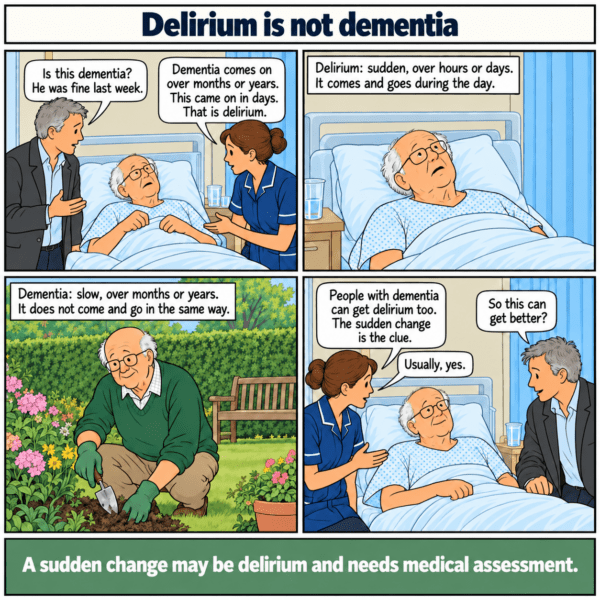
Delirium is not dementia
Dementia usually develops slowly, over months and years. Delirium starts over hours or days, and it usually improves once its causes are found and treated. The two conditions are often mistaken for each other, including by professionals.
If someone who already has dementia suddenly gets much worse, treat the change as possible delirium.
See the differences at a glanceDementia
changes over months to years
Delirium
changes over hours to days
What you can do
Get medical help now
Sudden confusion needs medical assessment now. Who to contact where you live, what to say, and when to call local emergency services immediately.
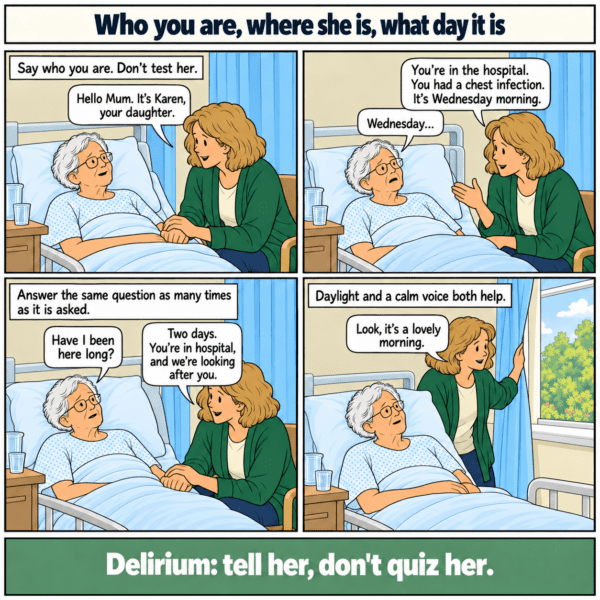
Help at the bedside
You know the person’s normal self better than anyone. What to tell the team, and what actually helps, hour to hour.
Speak up for them
If you think delirium is being missed or given another name, how to raise it with staff, and the words to use.
Help them recover
Recovery is often gradual and uneven. What to expect in the weeks afterwards, and when to ask a doctor for a review.
Someone to talk to
A sudden illness can leave families worried and unsure where to turn. Ask the team looking after the person about local services for families, carers and patients. Our resources page also links to specialist information and a list of dementia organisations by country.
Find information and supportFree course for families
Understanding delirium, at your own pace
Eight short sections explain delirium, its treatment and recovery, and how families and friends can help. They include short films, questions with explanations, and a summary to keep.
About 30 minutes. No sign-up needed.
Start the family courseQuestions families ask
Straight answers to the questions that come up most.
How long does delirium last?
Delirium may improve over days, but it can last weeks or months.
Why is my mother confused after surgery?
Confusion in the first days after an operation is usually delirium. It is common, and it often improves as the person recovers from the surgery.
Can a urinary tract infection (UTI) cause confusion?
Yes, a urine infection (urinary tract infection, or UTI) can cause delirium in an older person. But it is often blamed when it is not the cause, and stopping there can mean the real cause is missed.
Why is delirium worse in the evening or at night?
Delirium is usually worse in the late afternoon, evening and night. A clear morning does not mean it has gone.
Did we cause this? Should we have spotted it sooner?
No. Delirium is caused by physical illness, injury, surgery or medicines. Delirium can be difficult to recognise. Families should not blame themselves for not knowing what it was.
Is delirium a sign that someone is dying?
Delirium is common in the last days of life. It is also common in people who are seriously ill and then recover completely. On its own, it does not show which is happening.
Printable help to keep or share
Clear guides for the hospital bedside, the kitchen drawer, or a relative who does not use the internet. Choose A4 or US Letter, or download the combined family pack.
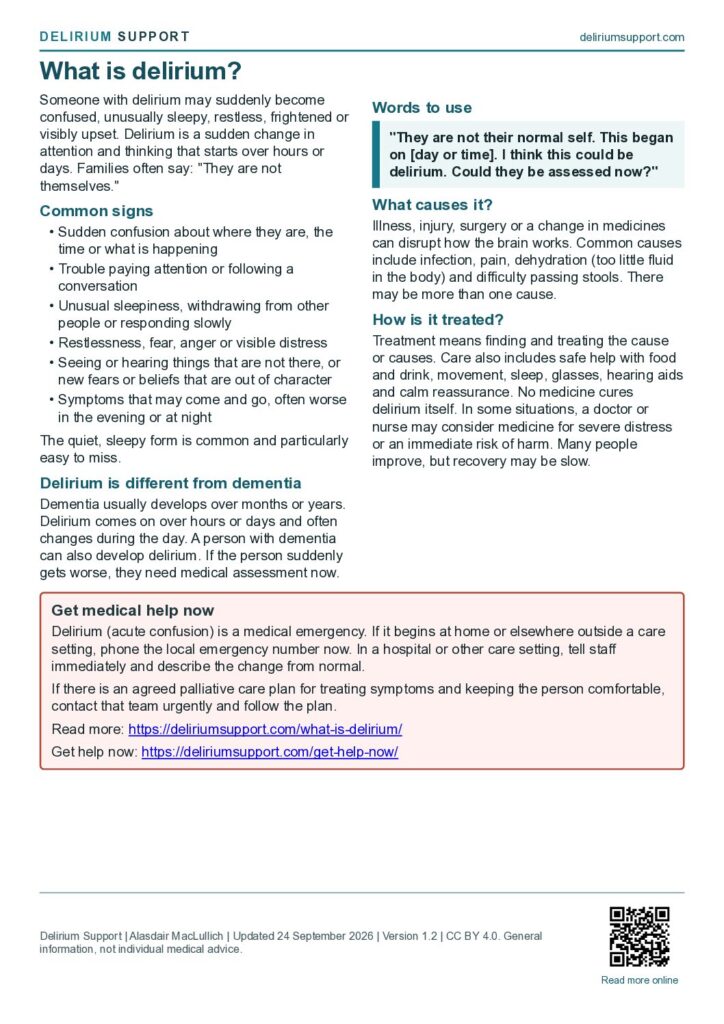 What is delirium?The meaning, common signs, causes, treatment and what to do.Download (PDF)
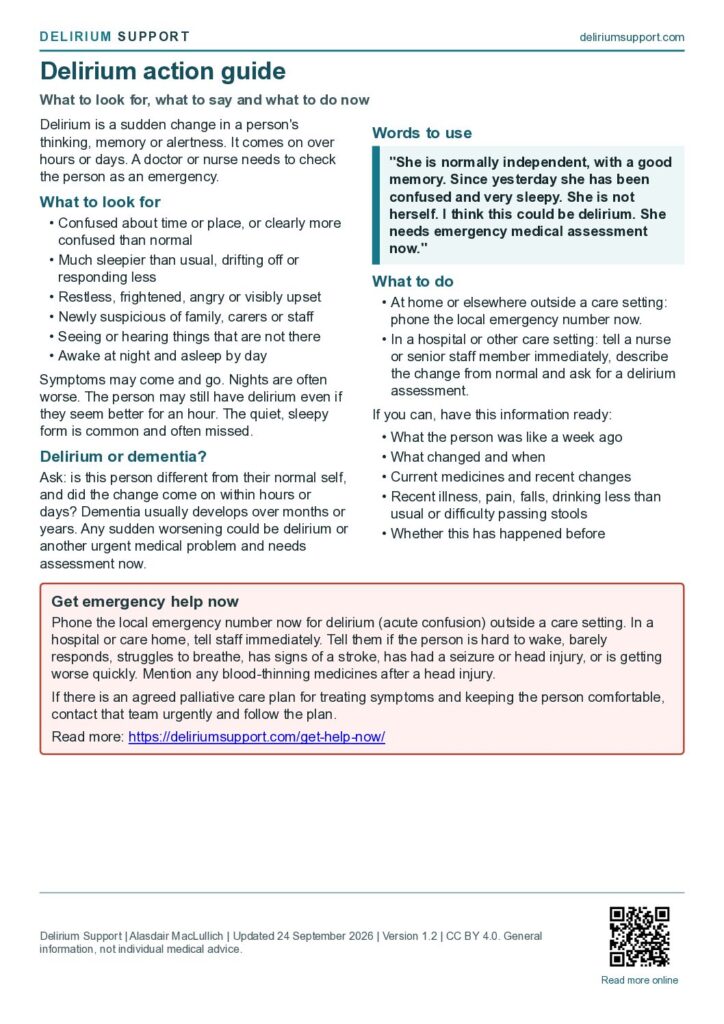 Delirium action guideThe signs, who to contact, and when to seek emergency help.Download (PDF)
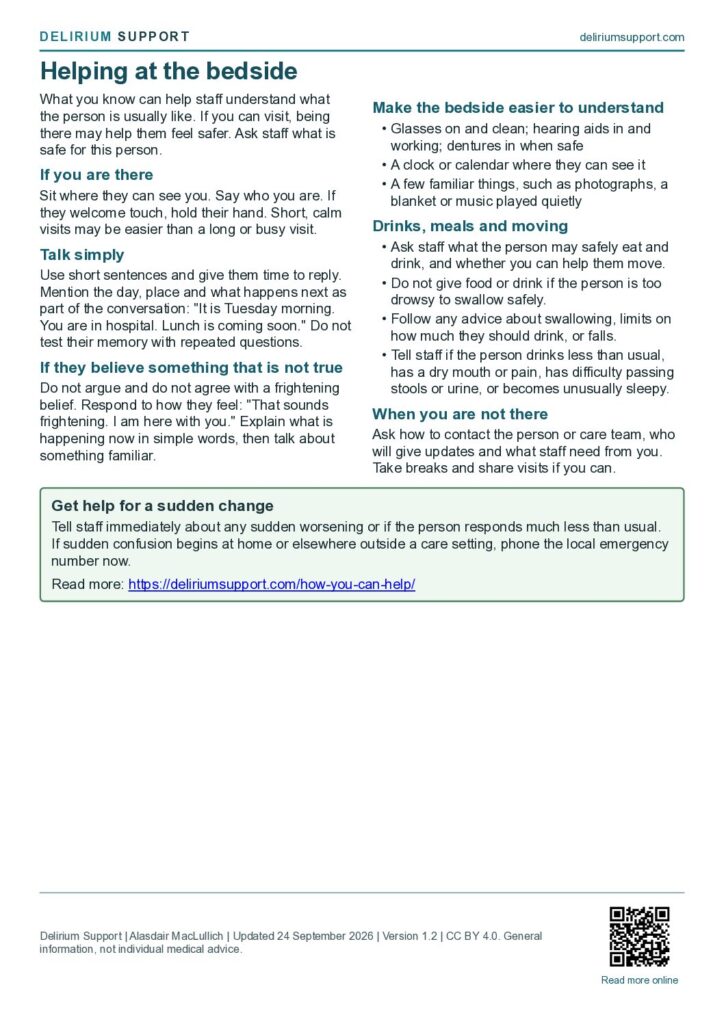 Helping at the bedsideSimple things that may reduce fear and confusion during the day.Download (PDF)
Who writes this site
This site is written by Professor Alasdair MacLullich, Professor of Geriatric Medicine at the University of Edinburgh and a consultant physician at the Royal Infirmary of Edinburgh.
His work on delirium includes:
- Designing the 4AT (2011, with Dr Tracy Ryan and Dr Helen Cash), a two-minute bedside test for delirium now used across the world.
- Co-chairing the Scottish national (SIGN) guideline on delirium (2019).
- Serving as Editor-in-Chief of Delirium, the specialist research journal.
Free
Everything on Delirium Support is free.
Independent
No paid placement or commercial ranking is used.
Checked
Clinical and safety statements are checked against authoritative guidance and relevant published evidence.
Reusable
Original text is licensed under CC BY 4.0 unless stated otherwise.