Home / About
About
Delirium often comes with no warning, and most families do not know its name when they first see it. This site explains the condition in plain English and shows what families can do.
It is written for family members and carers, and for people who have had delirium and want to make sense of what happened. It is not a medical textbook, and it is not a substitute for the clinicians looking after your relative.
Who writes it
This site is written by Professor Alasdair MacLullich, Professor of Geriatric Medicine at the University of Edinburgh and a consultant physician at the Royal Infirmary of Edinburgh. He has worked as a doctor since 1993, with delirium as his main research and clinical focus since 2005.
His work on delirium includes:
- Designing the 4AT (2011, with Dr Tracy Ryan and Dr Helen Cash), a two-minute bedside test for delirium now used across the world. It has been validated in 33 diagnostic-accuracy studies involving more than 6,000 patients and translated into more than 20 languages. NICE’s 2023 delirium guideline recommends the 4AT for assessment when indicators of delirium are identified. In critical care or the recovery room after surgery, it recommends CAM-ICU or ICDSC instead. A healthcare professional with relevant expertise makes the final diagnosis.
- Co-founding the European Delirium Association (2006) and co-founding World Delirium Awareness Day (2016).
- Founding the Scottish Delirium Association (2011).
- Co-chairing the Scottish national (SIGN) guideline on delirium (2019).
- Serving as Editor-in-Chief of Delirium, the specialist research journal.
- More than 200 publications and other research outputs, and hundreds of talks, webinars and workshops on delirium, including more than 100 international presentations.
Links: Personal website · the4at.com · University of Edinburgh profile · ORCID 0000-0003-3159-9370 · Wikipedia biography
The medical explanations and practical guidance are written for families in any country. Health services and job titles vary, so advice about getting care refers to your local services and the team looking after the person.
How this site is written and checked
The content is drawn from the book, from UK national guidance (the SIGN 157 and NICE CG103 delirium guidelines), and from the international research literature. Detailed clinical pages show when they were last reviewed. Where evidence is uncertain, the pages say so; where numbers are given, they are rounded for readability (“about 1 in 4”).
We use a limited form of Google Analytics to understand which pages people use and improve the site. It is not used for advertising. You can turn it off at any time using Analytics settings in the footer. Read the privacy notice for details.
What this site can’t do
Everything here is general information. It can’t tell you what is wrong with your relative, whether their medicines are right, or when they will recover. Advice about an individual person can only come from the clinicians looking after them: the team caring for them in hospital, and their own doctor at home. If someone has become suddenly confused or unusually drowsy, get medical help now.
Contact
The best routes are the Delirium Support Facebook page, X (Twitter) or LinkedIn. Please do not send questions about an individual patient. Speak to the team caring for them or their doctor. See Resources and helplines for local support organisations and specialist information.
The book
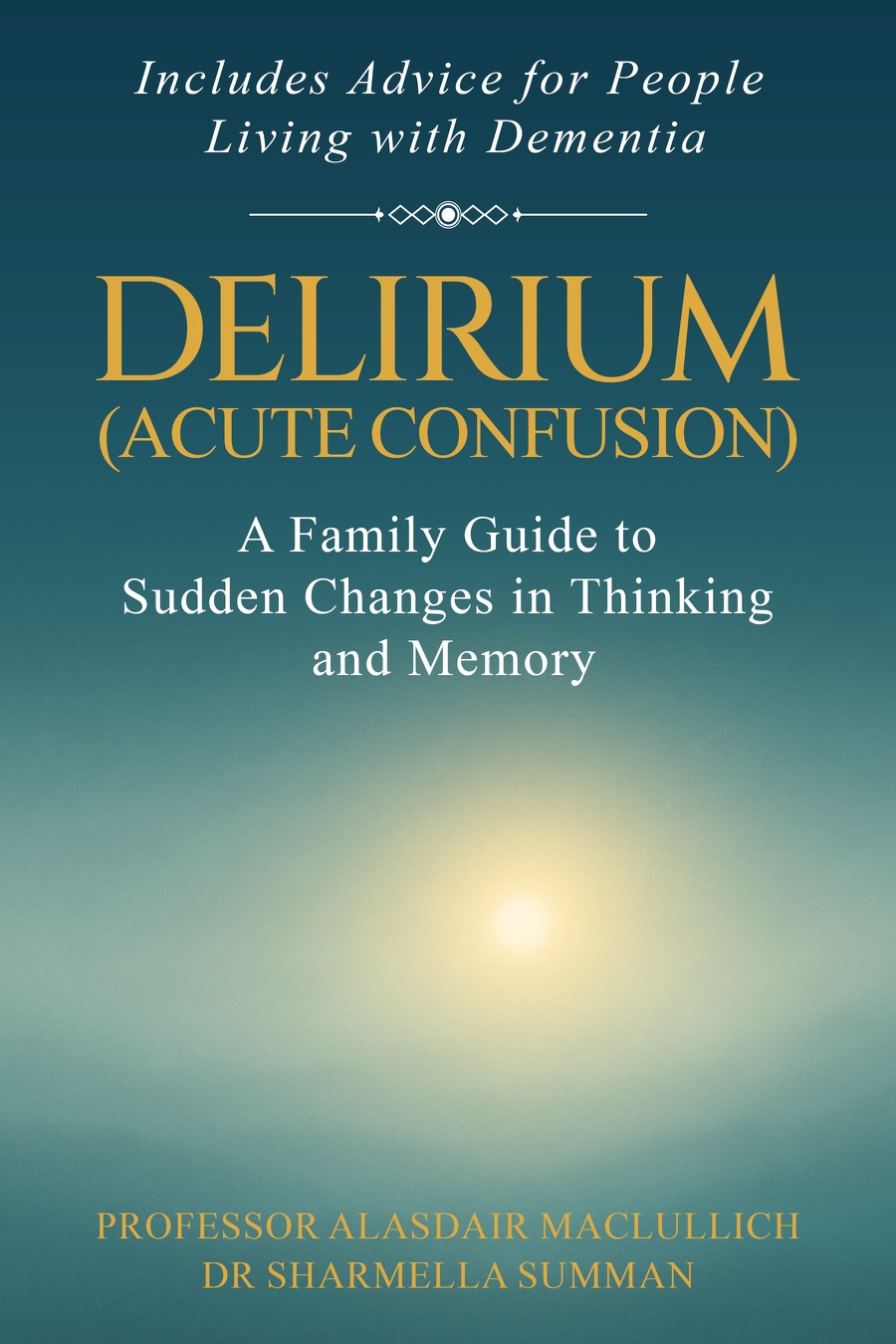
Delirium (Acute Confusion): A Family Guide to Sudden Changes in Thinking and Memory – Includes advice for people living with dementia is a detailed, book-length guide to delirium written for families and carers. It will be published in October 2026.
Chapter 1 of the book is free. Enter your email address on the book website, deliriumfamilyguide.com, and a link to the PDF will be emailed to you. News of publication will go to the same list.
The co-authors are Professor Alasdair MacLullich and Dr Sharmella Summan. Dr Summan has cared for people with delirium as a doctor and experienced severe delirium herself while in intensive care. Her account appears early in the book.
The book begins with what delirium is, its causes, diagnosis, treatment and prevention. It then covers people’s experiences, hospital and intensive care, care homes, raising concerns, recovery, end-of-life care, and the link with dementia. It closes with a quick action guide, a glossary and the questions families ask most.
Everything on the website Delirium Support is free and available without buying the book. The book offers an option for those who would like more information and depth. Details of where it can be purchased.