Delirium Support / Course for families
Free · About 30 minutes · No sign-upUnderstanding delirium: a course for families
Short lessons about delirium, its treatment and recovery, and how families and friends can help.
Read, watch the short films and pause to think. Finish with eight questions and a summary to keep.
Section 1 of 8 · about 3 minutes
Understanding delirium
Explain what delirium is and why it can change how someone thinks, feels and behaves.
Welcome. This course is for relatives, friends and unpaid carers who want to understand delirium. You do not need any medical knowledge. You may be learning because someone you know is unwell, or simply because you want to be better prepared. Both are good reasons to be here.
Over about thirty minutes, we will look at what delirium is, what can cause it, how it is treated, and what families can do. Short films will show some of the experiences we discuss. There are pauses to think and a self-assessment at the end. You can stop, return later or repeat a section. This is an opportunity to learn, not a test of how well you care for someone.
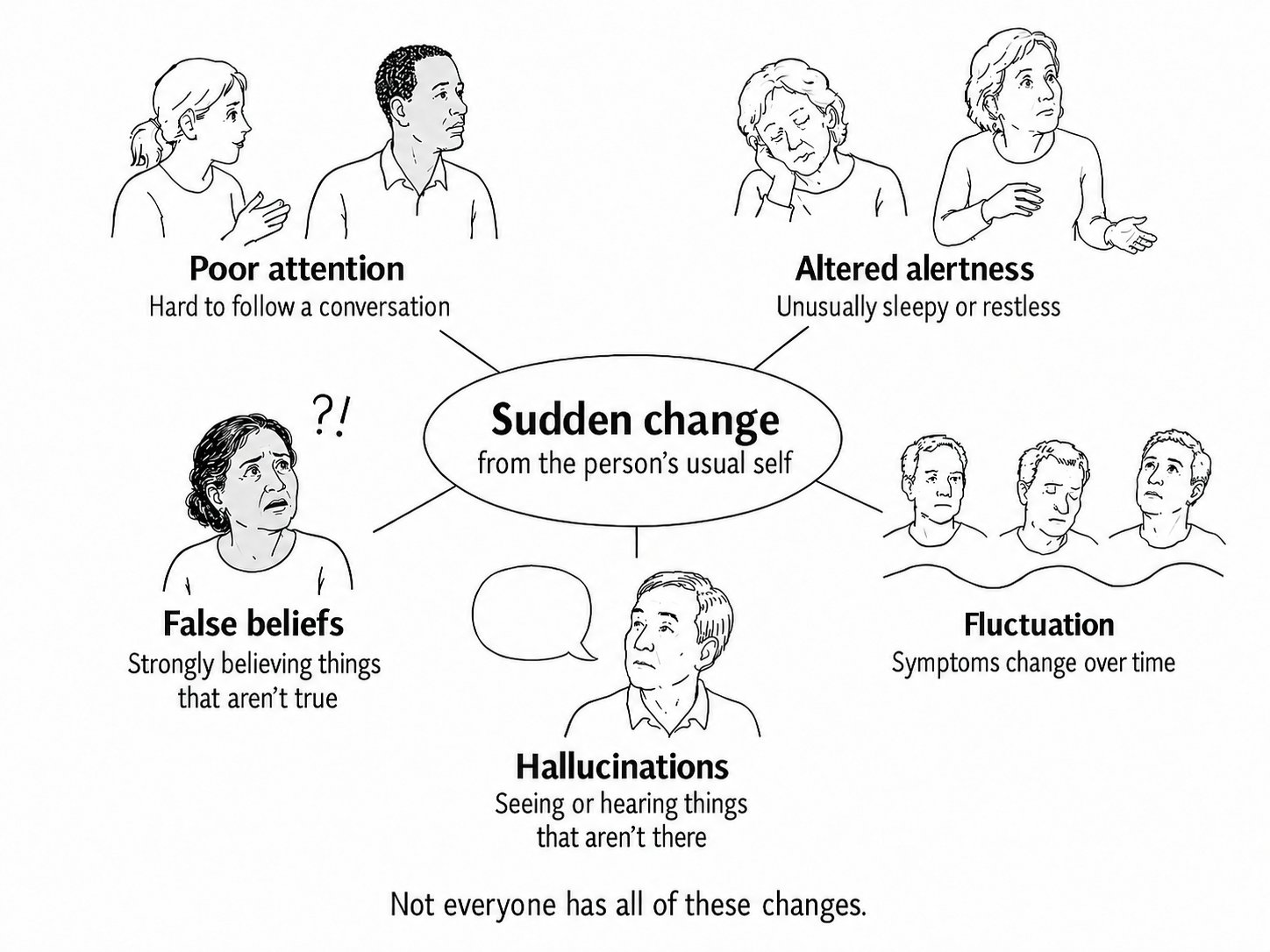
Delirium is a sudden change in how the brain is working. It usually develops over hours or days, during an illness, after an injury or operation, or because of the effects of medicines. A person may find it difficult to concentrate, follow a conversation or understand where they are. They may be much sleepier than usual, or restless and frightened. Some see or hear things that other people do not.
The change can be startling. Someone who normally enjoys a conversation may hardly speak. Someone who trusts you may seem suspicious. These changes can be part of the illness. They do not tell you what the person really thinks of you.
Delirium is a medical condition, and it needs assessment and treatment. It is not an inevitable part of getting older. It can affect adults of any age, although older people and people with dementia are more likely to develop it.
There is treatment, and many people improve as the causes are treated. Recovery can take time, and some people do not return fully to how they were before. We will come back to recovery later.
For now, keep this simple idea: when the body is unwell, the brain can be affected too. Understanding delirium helps you make sense of what you are seeing and have more useful conversations with the care team.
Pause and think
In your own words, how would you explain delirium to a friend? Pause before revealing the example.
Read the example or explanation
Delirium is a sudden change in how the brain is working, often during illness. It can affect attention, alertness and how the person experiences what is around them.
Section 2 of 8 · about 4 minutes
Recognising a change
Recognise different forms of delirium and explain how delirium differs from dementia.
Delirium does not look the same in everyone. Some people become restless. They may call out, try to leave, or seem frightened by the people around them. Others become unusually sleepy, slow or withdrawn. They may look peaceful, yet be very unwell. A person can move between these patterns.
Watch the short scene of Nadia visiting her father. Notice his difficulty engaging with her. This illustrates one possible change. It is not enough information to make a diagnosis. The useful question is: how does this compare with his usual self?
Read the scene and dialogue
Visual context: Nadia sits beside her father, who responds only briefly and then looks away. This is an AI-simulated scene, with no real patients.
[His daughter takes his hand]
NADIA: Dad, it’s me. It’s Nadia.
[He looks at her without recognition]
IQBAL: …Aye… hello…
[His gaze drifts away]
Attention is often affected. Attention means being able to focus on something, such as the conversation you are having. Someone with delirium may lose track after a few words, give an answer that does not fit, or take much longer to respond. This can make even ordinary conversation tiring.
The symptoms often change over the day. A person may seem clearer on one visit and much more confused on the next. A good spell is welcome, but it does not necessarily mean the delirium has ended. Equally, a change for the worse should be reported rather than automatically put down to the usual fluctuation.
How is this different from dementia? Dementia is caused by diseases that affect the brain over time. Difficulties generally develop over months or years. Delirium usually starts over hours or days. Both can affect thinking and behaviour, and some forms of dementia also cause marked fluctuations or hallucinations. The distinction is not always simple.
A person can have both conditions. Dementia makes delirium more likely, and delirium can make existing difficulties suddenly much worse. Someone with dementia who usually chats over breakfast might become too sleepy to eat or unable to follow a familiar conversation. That new change deserves an explanation of its own.
You do not have to work out the diagnosis. Describe what is different, when it began and what the person was usually like. Clinicians can assess them, look for causes and decide what is happening. Assessment may include short questions and checks of attention and alertness, considered alongside the person’s history and physical health. A useful phrase is: “They have dementia, but this is a change from how they normally are. Could it be delirium?”
Pause and think
Someone with dementia usually enjoys lunch and conversation. Today they are much sleepier and barely speaking. Which is more useful: “Their dementia is worse”, or “Since this morning, they are much sleepier and barely speaking”?
Read the example or explanation
The second description gives a specific change and a time. It helps staff assess what is happening without assuming the cause. Dementia does not explain away a sudden deterioration.
Section 3 of 8 · about 4 minutes
Causes and treatment
Describe the main causes of delirium and the three parts of care: treating causes, supporting recovery and relieving distress.
A common question is: “If the problem is in their chest, why are they confused?” The brain depends on the rest of the body working well. Illness elsewhere in the body can disturb the way it works. An infection, an injury or an operation can therefore affect thinking and alertness as well as physical health.
There may be several contributing problems. These can include infection, dehydration, pain, constipation, difficulty passing urine, low oxygen levels and the effects of medicines. The combination is different for each person. Finding one problem does not mean there are no others. Confusion alone does not establish a particular cause, such as a urine infection.
Treatment has three connected parts. First, the team looks for causes and treats what they find. This may involve examining the person, checking medicines and arranging tests. You can ask what the team thinks is contributing and what treatment has started.
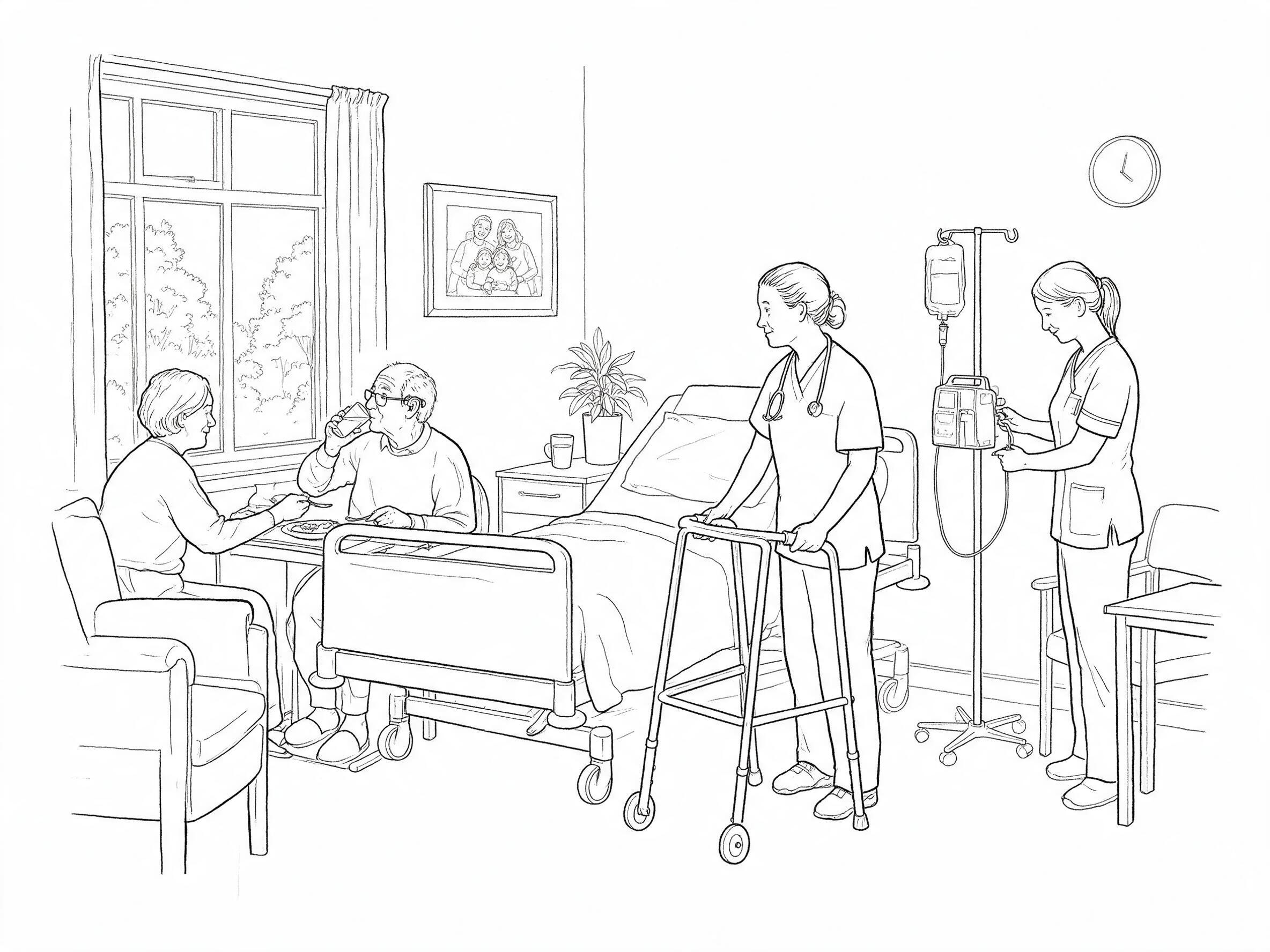
Second, the person needs care that supports recovery: enough food and fluid, help with hearing and sight, sleep, safe movement and attention to comfort. These may look like ordinary care, but they are an important part of delirium care.
Third, the team should help with distress and safety. A calm approach and understanding what is troubling the person come first. There is no single medicine that reliably cures delirium. Sometimes medication is considered for severe distress or a risk of harm when other approaches have not been enough. It needs a clear reason and review because it can also cause harm. You can ask what a medicine is for, what benefit is expected and when it will be reviewed. Do not stop or change medicines yourself.
Pain deserves particular attention. A person who cannot explain pain clearly may wince, pull away during care, become restless or go unusually still. These changes are clues, not proof of pain. Describe what you have noticed so the team can assess the person.
Notice the difference between describing and explaining. “She winces when she is moved” is useful information. It does not require you to decide whether the cause is a fracture, a sore area or something else. Families should not have to investigate every possibility. Their observations can help the team ask better questions and examine the person carefully.
Pause and think
A relative pulls away whenever someone helps them turn in bed. What could you say to the nurse without trying to diagnose the cause?
Read the example or explanation
“I have noticed that they pull away and wince each time they are turned. This is new. Could you assess whether they are in pain or uncomfortable?” A specific observation is useful even when you do not know what it means.
Section 4 of 8 · about 4 minutes
Communication and distress
Choose a calm, truthful response when someone is disorientated or frightened.
Imagine being in a place you do not recognise, surrounded by people whose intentions you cannot understand. During delirium, ordinary surroundings can seem unfamiliar or threatening. The person may be frightened even when everyone is trying to help.
Some people have hallucinations: they see or hear something that other people do not. Others develop beliefs that are not true, such as believing that staff are trying to harm them. These experiences can feel real. They are not deliberate inventions, and an argument is unlikely to settle them.
In the first film, a woman fears that she will be kept in hospital forever. Her daughter acknowledges the fear and explains what she knows: the nurse is coming back after lunch. She does not promise a discharge date. She offers to stay while they speak to the nurse.
Read the scene and dialogue
A daughter listens to her mother’s fear, says what she knows and offers to stay while they speak to the nurse.
They’re keeping me here forever.
You sound frightened.
I don’t know how long you’ll be here.
I do know the nurse is coming back after lunch.
We can tell her you’re worried.
I still don’t trust them.
I hear that.
I’ll stay while we speak to the nurse.
You could say, “I cannot see anyone there, but I can see that you are frightened. I am here with you.” Use words that are true at that moment. You need not promise that everything is fine or that you can stay all night. Let staff know about new experiences or distress.
Ordinary conversation helps when it is simple. Approach where the person can see you, introduce yourself and speak in short sentences. Give them time to answer. Explain where they are and what is happening, if you know. Offer information rather than testing memory. “You are in hospital. I have come to visit” is usually kinder than repeatedly asking, “Do you know where you are?”
The second film begins with two questions in quick succession. Anna then introduces herself, explains where Jim is and gives him time. Notice the difference. A familiar topic or photograph may help, but follow the person’s response. Too much talking, touching or stimulation can be unwelcome.
Read the scene and dialogue
The scene begins with two questions in quick succession. Anna then introduces herself, explains where Jim is and waits.
“Dad, can you hear me?”
“Jim, do you know where you are?”
“Jim, it’s Anna. You’re in hospital.”
“I’m going to stay for a while.”
If the person becomes more distressed, pause and give them space. Ask staff for help. You are not expected to handle a difficult or unsafe situation alone. A conversation may bring comfort without removing the confusion. If reassurance does not work, that does not mean you have failed.
Pause and think
Someone says, “There are strangers in my room.” Try forming a response that acknowledges the fear without agreeing that strangers are there.
Read the example or explanation
For example: “That sounds frightening. I cannot see anyone else here. I can sit with you while we ask the nurse to help.” Adapt it to what you can truthfully offer. Acknowledge their experience and tell staff about the change.
Section 5 of 8 · about 4 minutes
How families can help
Give useful information to the team and choose practical support that suits the person and your circumstances.
You may know things about the person that the care team has not had a chance to learn. What were they doing last week? How do they usually communicate? What name do they prefer? What helps them feel comfortable? That knowledge can make care more personal and help staff understand a change.
The films in this section show two small ways of responding to the person: offering their usual glasses and respecting their response to touch. Neither scene shows an immediate recovery. The aim is to make the encounter more comfortable.
You can organise what you want to say in three parts: usually, now, and since when. For example: “Usually she follows a conversation and gets dressed with a little help. Today she keeps falling asleep while we talk. This began yesterday.” You do not need medical words. If you do not know an answer, say so. Partial information is still useful.
Tell the team about recent falls, illness, changes in eating or drinking, and medicines that have been started or stopped. Include medicines bought without a prescription. Ask how to pass on further information and how you will receive updates. If your concern has not been addressed, ask the nurse in charge or the clinician responsible for their care.
At the bedside, start with what the person needs and welcomes. Clean glasses and working hearing aids may make conversation easier. A familiar photograph, a short conversation or sitting together may be helpful. Ask before touching, and respect signs that the person wants a rest.
Read the scene and dialogue
A visitor offers the man his usual glasses. He puts them on himself. She sits where he can see her; the scene does not show a sudden recovery.
These are your usual glasses. Would you like them? I’ll sit where you can see me. If your sight or hearing seems suddenly different today, I’ll tell the staff.
Read the scene and dialogue
Maya starts to reach towards Mrs Shah, who stiffens and raises a hand. Maya stops, returns her hands to her lap and gives her space. There is no touch. She offers to sit with her.
I’m sorry. I should have asked. I won’t touch you. I’ll keep my hands here. Would you like me to sit with you?
If you would like to help with food, drinks or movement, first agree with staff what is safe. Swallowing problems, fluid restrictions or unsteadiness can change what is appropriate. You are not expected to lift the person, manage equipment or take over nursing care.
You can also contribute from a distance, through a phone call, a short written account or a familiar voice message if the person would welcome it. Ask for an interpreter or an accessible way to communicate when needed. Families and friends differ in what they can offer. Useful involvement does not depend on being at the bedside all day.
Pause and think
Practise a two-sentence “usually, now, since when” account. Use the anonymised composite example in this lesson, drawn from real clinical practice. You do not need to enter anyone’s personal information.
Read the example or explanation
“Usually she follows a conversation and gets dressed with a little help. Since yesterday she has been falling asleep while we talk.” You might then ask, “Could you assess this change?” Include what you know and be clear about what you do not know.
Section 6 of 8 · about 3 minutes
Recovery and going home
Explain why recovery varies and identify useful questions before discharge.
Recovery from delirium can be uneven. Some people improve over a few days. For others, confusion and changes in thinking last for weeks or months. Physical health may improve before attention, energy and confidence have returned. A single good conversation does not tell the whole story.
It is reasonable to ask the team what improvement they are seeing and what difficulties remain. If the delirium is not settling, clinicians may need to look again for causes and arrange follow-up. New deterioration should not automatically be accepted as part of a slow recovery.
- Faster improvement
- Gradual improvement
- Continuing difficulties
Some people remember little of the delirium. Others remember frightening experiences very clearly, even when those experiences did not match what people around them saw. They may feel embarrassed about things they said or did. Listen if they want to talk. Explain that delirium can affect thinking and behaviour during illness. You do not have to correct every detail or persuade them to discuss it before they are ready.
Before going home, ask for a clear account of what happened and what comes next. Has delirium been recorded in the discharge information? What medicines have changed? What help will be available with everyday activities? Who will review continuing problems, and whom should you contact if you are worried? Ask for the plan in a form you can use.
Tell the team honestly what support is possible at home. Being willing to help does not mean being able to provide care around the clock. The discharge plan should take account of the person’s needs and the support available.
Many people make a good recovery, but some do not return fully to their previous level of thinking or independence. Continuing memory problems need follow-up; they do not by themselves prove that the person now has dementia. Assessment is more informative when the acute illness and delirium have been considered.
There is no deadline by which a family should have everything back to normal. Asking for another explanation, a review or more support is part of dealing with recovery.
Pause and think
You have time for one final conversation before discharge. Name two questions that would help you understand the plan.
Read the example or explanation
Examples: “What support will be in place at home?” “Who will review the ongoing confusion?” “Which medicines have changed, and why?” “Who should we contact if we are worried?” Choose questions that address your own uncertainties.
Section 7 of 8 · about 3 minutes
Your role and your wellbeing
Recognise the limits of a family role and plan a manageable way to stay involved.
When someone close to you has delirium, it can be hard to leave them. You may feel guilty about going home, or worry that they will be frightened when you are not there. You may also be trying to work, care for someone else or manage your own health. These pressures can exist together.
In this film, Rosa explains what is worrying her. The nurse does not ask her to cover the person’s care. They discuss an update plan and what Rosa can manage. The lesson is not that leaving feels easy. It is that families should be able to talk about their limits and receive support.
Read the scene and dialogue
Visual context: an exhausted visitor, Rosa, talks with nurse Jamie in a hospital waiting area. They discuss her concern and agree to make a contact plan.
JAMIE: Rosa, you look exhausted. What are you most worried about?
ROSA: If I go home, who’ll stay with him?
JAMIE: You don’t have to stay overnight to cover his care. That’s our responsibility.
Let’s agree how we’ll update you and what visit tomorrow would suit you both.
Who can support you tonight?
ROSA: My neighbour can. I need to go home and sleep.
JAMIE: That’s okay. We’ll make the contact plan before you leave.
Your role is to be a relative, friend or carer, with the knowledge and relationship that brings. Learning about delirium can help you understand the illness and ask useful questions. It does not make you responsible for preventing every problem, finding every cause or ensuring that the person recovers.
A practical plan might include a named contact, an agreed time for an update and visits that suit both you and the person. If several people are involved, agree who will pass on information, with the person’s wishes in mind. If there is no one to share this with, tell the team rather than assuming you must manage alone.
Think about your own rest, food and support as well. A trusted person, a carers’ organisation or your GP may help if you are struggling. Feeling upset does not mean you are coping badly. You are dealing with an illness that can be difficult to understand and painful to witness.
Before the final questions, take a moment to remember the purpose of this course: to give you understanding and useful choices. It is not a list of duties.
Pause and think
Which part of staying involved would be hardest for you: getting updates, visiting, understanding the plan, or finding time to rest? Think of one question you could ask the team.
Read the example or explanation
For example: “I cannot visit every day. Could we agree how I will receive updates?” or “I am worried about going home tonight. Can we talk about the care plan?” There is no single right answer to this reflection.
Section 8 of 8 · about 5 minutes
Check your understanding
Apply the main ideas to everyday situations and identify any points you want to revisit.
You have reached the end of the course. The questions below bring together the main ideas. Choose one answer for each, then read the explanations. You can return to a lesson or try the questions again as often as you like.
When you finish, you could think of one idea you would want to explain to another family member or friend.
Delirium can be difficult to witness. Understanding what it is, how care works and what questions you can ask can make the experience less bewildering. Keep the course and its summary available to return to when you need them. Share it with others who might benefit.
Choose one answer to each question, then check it to read the explanation. You can change an answer and check it again.
Pause and think
After the questions, name one thing you understand better and one question you would still like to ask.
Read the example or explanation
There is no model answer. Use the take-home summary to return to the ideas you want to remember.
Keep or share this summary
Understanding delirium: a reminder for families
Delirium is a sudden change in how the brain is working, often during illness. It can affect attention, alertness and how the person experiences the world. It can be restless, sleepy or both, and can happen alongside dementia.
Care has several parts: look for and treat causes, support the person’s recovery, and understand and relieve distress. There is no single medicine that reliably cures delirium.
Your observations can help. Describe the person’s usual abilities, what is different now and when the change began. You do not need to diagnose the cause.
Speak simply, give time to respond and offer truthful reassurance. Explain rather than quiz. Agree with staff which practical help is safe and welcome.
Recovery varies. Ask what difficulties remain, what support is planned, who will review ongoing problems and whom to contact if you are worried. Tell the team what care is possible at home.
Your own limits count. Agree how to stay informed and involved. You are not responsible for every outcome.
New sudden confusion is a medical emergency. Outside a care setting, phone the local emergency number now. In a hospital or care home, tell staff immediately. If an agreed palliative-care plan covers this situation, follow that plan and contact the care team urgently.
You can revisit the course whenever you wish. Questions to take to the team: What is causing the delirium? What is the plan? What should we expect next?